
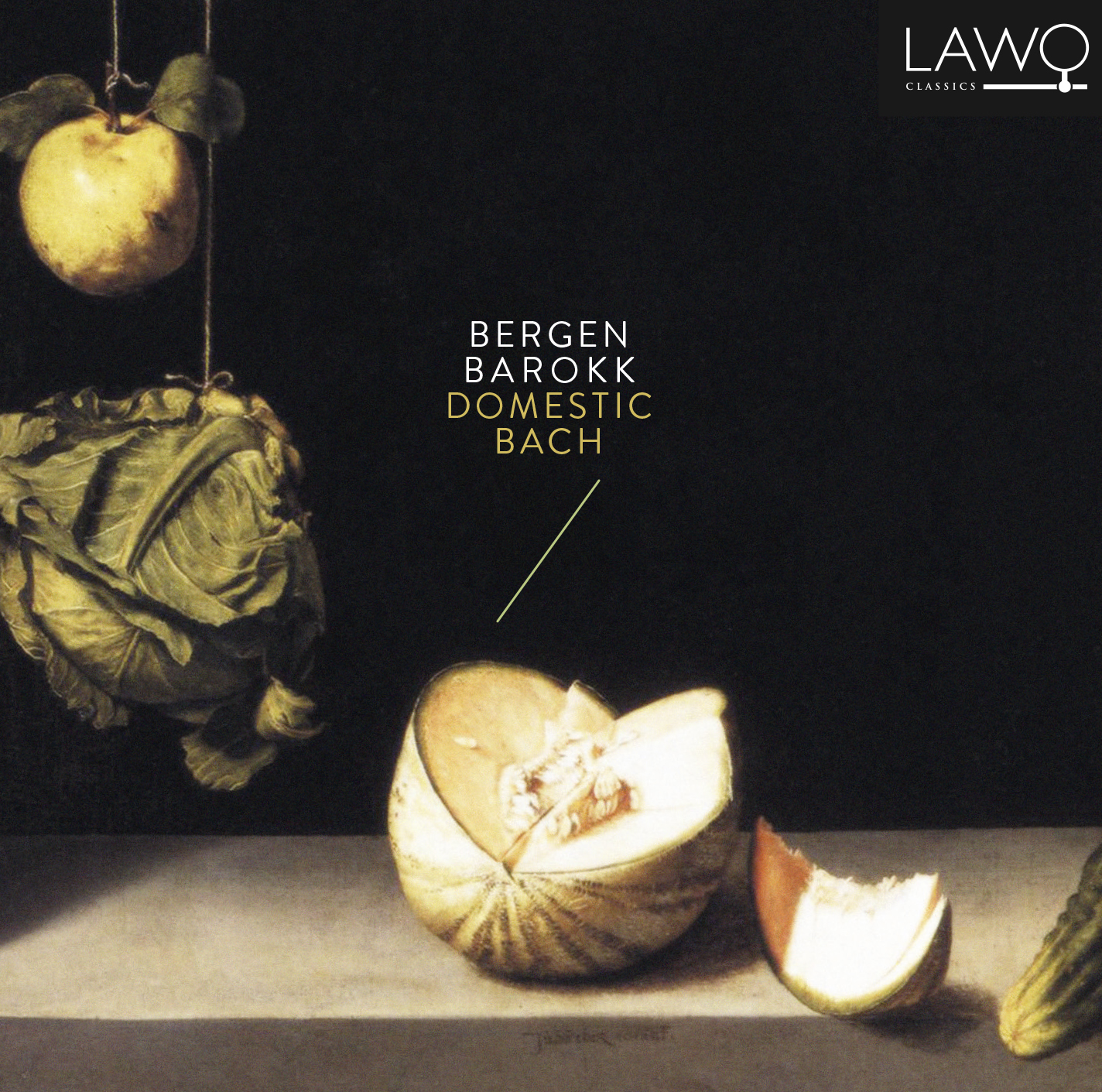
Domestic Bach
Bergen Barokk (Early music ensemble)
Stream & download
Tracks
Johann Sebastian Bach (1685–1750)
Trio Sonata adapted from BWV 1039 and BWV 1027 (G major)
Choral
Choral
Canon a 2 per Tonos
Choral praeludium, BWV 728
Choral
Reviews
Bergen Barokk – one of the country’s truly accomplished early music ensembles – has turned its attention to the Bach family, presenting more or less light-hearted musical examples…
Show more Show less
Bergen Barokk – one of the country’s truly accomplished early music ensembles – has turned its attention to the Bach family, presenting more or less light-hearted musical examples for both educational and entertainment purposes. Yes, it is light-hearted, but in the most positive sense of the word. This has turned out to be an exceptionally well-crafted album [...]Show original
Bergen Barokk - ett av landets virkelig dyktige tidligmusikkensembler - har tatt for seg familien Bach mer eller mindre huslige musikkeksemplarer innenfor både opplæring og underholdning. Ja, lettbent er det, men i den absolutte positive betydning. Dette er blitt en plate som er usedvanlig godt gjennomarbeidet[...]

It almost feels as if you are attending a house concert at the Bach family’s home, where a modest number of musicians are playing an unorthodox mix of secular and church music in…
Show more Show less
It almost feels as if you are attending a house concert at the Bach family’s home, where a modest number of musicians are playing an unorthodox mix of secular and church music in a way that thumps its nose at the Urtext—the Urtext camp in search of a deeper authenticity.Show original
Det føles nesten som om du er tilstede ved en huskonsert hjemme hos familien Bach, der et beskjedent antall musikere spiller i en uortodoks miks av sekulær og kirkemusikk på en måte som peker nese av Urtext-menigheten på leting etter en dypere autentisitet.
 Klassisk Musikkmagasin
Norwegian
BERGEN BAROKK revisits Johann Sebastian Bach himself on its latest Lawo release, offering a well-rounded mix of secular and sacred music – in its own arrangements!
Show original
BERGEN BAROKK bedriver gjenbruk av selveste Johann Sebastian Bach på sin seineste Lawo-utgivelse, og serverer en velassortert blanding av verdslig og kirkelig musikk –i egne arrangementer!
 Dagbladet
Norwegian
Instrumentation in the Baroque era was a flexible proposition, and composers such as Bach would have expected their music to be freely adapted to various ensembles and performing contexts.…
Show more Show less
Instrumentation in the Baroque era was a flexible proposition, and composers such as Bach would have expected their music to be freely adapted to various ensembles and performing contexts. The Norwegian ensemble Bergen Barokk demonstrates this principle quite convincingly in this varied program of chamber music.
 Fanfare Magazine
Credits
- Performer
- Bergen Barokk | Frode Thorsen (Recorder) | Hans Knut Sveen (Harpsichord) | Mona Julsrud | Markku Luolajan-Mikkola (Viola da gamba) | Mikko Perkola
- Early music ensemble
- Bergen Barokk
- Composer
- Johann Sebastian Bach
- Producer
- Vegard Landaas
- Engineer
- Thomas Wolden
- Editing
- Vegard Landaas
- Mastering
- Thomas Wolden
- Liner notes
- Bergen Barokk
- English translation
- Jim Skurdall
- Executive producer
- Vegard Landaas
- Booklet editor
- Hege Wolleng
- Design
- Anette L’orange | Blunderbuss
- Recording country
- Norway
- Original source
- 96 kHz, 24 bit
- Discs / tracks
- 1 disc | 23 tracks
- Produced with support from
- Municipality Of Bergen | Arts and Culture Norway
- Release year
- 2014
- Label
- LAWO Classics
- Duration
- 62:29
- EAN
- 7090020180854
- ISRC
- NOEHX1416010/230
Booklet text
[Bach Reused — editorial working title; the booklet prints a Norwegian heading ("Bach gjenbrukt") for this section but no English equivalent heading]
One of the merits of the early music movement has been to highlight the flexibility of the Baroque repertoire and to show how conducive it is to realisation in a variety of ensembles and contexts. Yet the modern perception of Bach clearly has a life of its own. There is an almost unspoken romanticised notion among musicians, researchers and the listening public that the genius of this master's works, unlike those of his contemporaries, must be understood and respected in the context of complete and perfect compositions. To tamper with these works would somehow compromise this perfection. However, this is not the way the master himself would have seen it. Bach saw music as a science and himself as a researcher. Like some of his contemporaries, he would not be averse to re-use his own material (often called musical parody). This is by no means due to laziness, rather because re-using for him was really a way to further explore the material's potential. The same can be said for his attitude towards reworking the oevres of other composers. Bach was not one to plagiarize or "improve" his contemporaries' works, but preferred to learn from and explore the opportunities of a composition. Armed with a score by a Vivaldi or a Pergolesi, he would inevitably pick up Italian musical traits and link it in with his own personal style.
Inspired by Bach's practice, Bergen Barokk has for many years arranged, and at times quite radically rearranged, several of Bach's works and adapted them to our performance situations. We have both abridged and elaborated on original scores and discovered that there is scarcely a harpsichord piece, an organ trio, cantata, aria or dance from Notebook for Anna Magdalena Bach that is not waiting to be unravelled in several ways. In this recording we present some selected examples.
MUSICA DOMESTICA
Baroque musicians composed for contexts in the categories of theatre, church and chamber music (According to Johann G. Walther (1684–1748), Musicalisches Lexicon, 1732: Musica Theatralis, Musica Ecclesiastica and Cammer-Music, or Johann N. Forkel, Über die Theorie der Musik (1777): die Kirchen/Kammer/Theater schreibart). These categories are broad and encompass numerous compositional forms and instrumentations. Much of the compositional material, from brief motifs and harmonic phrases to sections and movements, could be mutually intertwined between the categories. A basic affect is expressed using the same intervals, keys, rhythms, instrumentation etc., regardless of whether it is praising Louis XIV or God, meditating about the piety of Jesus, or glorifying a good cup of coffee.
On this basis, it is tempting to add a fourth category to the above-mentioned three, blending more pragmatic situations into the equation: Musica Domestica - music in the home. The numerous handwritten notebooks from the 1600s and 1700s, which could follow a family over generations, clearly document an extraordinary mix of demanding sonatas and church music, simple spiritual songs and dances performed and taught in the homes of cultured citizens. The Notebook for Anna Magdalena Bach is no exception and it is easy to envisage the many children of the Bach family immersing themselves in the skillful playing or singing of their guests, who would adapt this material to various social and educational situations and purposes.
Another way to categorise Baroque music is to distinguish between scholarly, often contrapuntal and/or stylistically refined music on one side, and simple syllabic songs and dance tunes on the other. In the case of the former we find music that was primarily performed by the trained and professional musicians of the court, the church and theatres as well as well-trained (and usually wealthy) dilettantes. Parts of this repertoire, such as collections of sonatas and suites, were published in impressive editions or kept in bound manuscript on top-notch paper. In the latter category we find music that was popular among the common people, performed by the unschooled at home or in the tavern, or by the authorised town musicians and peddlers - unauthorised musicians - at private functions such as weddings. This music was given the budget publishing treatment and/or spread through word of mouth and entries from the many handwritten note books in the day.
When considering Notebook for Anna Magdalena Bach with these two categorisations in mind, we find elements from all categories. Sophisticated compositions and simpler popular music, from the church, chamber and theatre repertoire are all documented. Even the theatre one may ask? Indeed. The Bach standard "Bist du bei mir" (track 22) is actually an aria from the opera Diomedes by GH Stölzel (1690–1749).
Á3
Writing music for three parts represented a compositional technique that was held in high esteem by professionals throughout the Baroque period. Any learned musician of the era had to master this demanding genre, which involved both polyphonic and homophonic techniques. The composer would often, though by no means always, denote specific instrumental ensembles in their scores. Performers would often find pragmatic solutions, depending on which musicians were available. In its published edition, the trio would be written for two violins, allowing the basso continuo to be formed in various other ways. In the works and writings of, for instance, F. Couperin, G. Ph. Telemann, CPE Bach and JJ Quantz, the following á3 options are referred to:
1. two similar melodic instruments and basso continuo
2. two different melodic instruments and basso continuo
3. one melodic instrument and the "cembalo obligato", where the bass voice and second voice are played on the harpsichord by the left hand and right hand respectively.
4. organ or harpsichord solo (possibly using pedal)
In some cases we also see recommendations for the melodic voices (see points 1 and 2) to be reinforced with tutti violini while the basso continuo can be padded out with several instruments providing chords - bassoon and cello, viol, violone etc. In this way, an orchestral effect could be achieved.
Bach is indeed a grand master of the trio sonata, exhibited in specially composed works in all four of the above-mentioned groups. However, he even reworked his own trio material such as his Sonata in G minor, which is found from Bach's hand in version BWV 1039 for two flutes and basso continuo (see point 1), as well as BWV 1027 for viol and harpsichord obligato (see point 3). In this recording, we present somewhat of a medium variant, retaining the viol as a solo instrument, though it is played together with the recorder. The harpsichord and the 2nd viol play the basso continuo (track 1-4).
In his sonatas for organ or pedal-harpsichord, Bach shows us how well instruments with 2 manuals and pedal sets are suitable for a balanced and transparent presentation of three independent voices. At the same time, these sonatas can be arranged for a more complex instrumental ensemble without any particularly tricky modifications, as can be heard in the Andante from the organ trio BWV 527 (track 6).
Canon a 2 per Tonos (track 19) comes from The Musical Offering, BWV 1079, a precious musical gift consisting of 2 fugues (for three and six voices), a trio sonata and 8 shorter canons dedicated to Frederick the Great. This collection has its roots in a meeting in 1747, when Bach and his son Wilhelm Friedemann visited the king in Potsdam, where another of Bach's sons, Carl Philipp Emanuel, was employed as court musician. The focus of the piece is a theme provided by the king himself which Bach improvised to, apparently without any preparation whatsoever. In Canon a 2 per Tonos, the top voice is a version of the King's theme, while the others represent a 2-voiced canon. The piece modulates up a tone for each round played and could in principle go on forever! In the manuscript Bach has written: Ascendenteque Modulationis ascendat Gloria Regis (with the rising modulation may the King's fame increase (translation from Wolff: Bach, The Learned Musician. Oxford UP 2000)). The same work also includes Fuga Canonica in Epidiapente (track 20).
DANCES AND SECULAR AND SPIRITUAL (ECCLESIASTICAL) SONGS
What we refer to as Notebook for Anna Magdalena Bach is actually two manuscripts, for the most part notated by Bach's second wife in 1722 and 1725. Bach himself wrote down some of the pieces, as did some of his sons when in their younger years. The books contain both demanding clavier music, chorale adaptations, some dances, marches, as well as syllabic songs with both ecclesiastical and secular texts. The ecclesiastical (spiritual) songs are of a similar ilk to those in the Schemelli Songbook (Leipzig 1736), of which Bach's involvement centres on 69 pieces, although several of the tunes were probably not composed by him. The simpler dances, marches and songs can occasionally be reminiscent of Johann Sigismund Scholz' (1705–1750) collections "Singende Muse an der Pleisse" published in four books in Bach's own town of Leipzig (1736, 1742, 1743 and 1745) under the pseudonym of Sperontes. Sperontes' tunes also include text (in strophic verse), but can just as easily be performed instrumentally, for a clavier instrument or melodic instrument(s) and basso continuo.
In many cases in Notebook for Anna Magdalena Bach, it is not made clear who the composer actually was but it is interesting to note that Couperin is represented with a rondeau (track 18). March (track 12) is considered to be one of Carl Philipp Emanuel's first ever compositions.
CHORALE ADAPTATIONS
For the orthodox Lutheran Bach, the reformation chorales accounted for a large supply of raw materials that he could rework in many different ways, such as on the organ or in cantatas and passions. We are thrilled to have found that many of these can easily be adapted to Bergen Barokk's instrumentations.
— Notes: Frode Thorsen · English translation: Paul Holden