
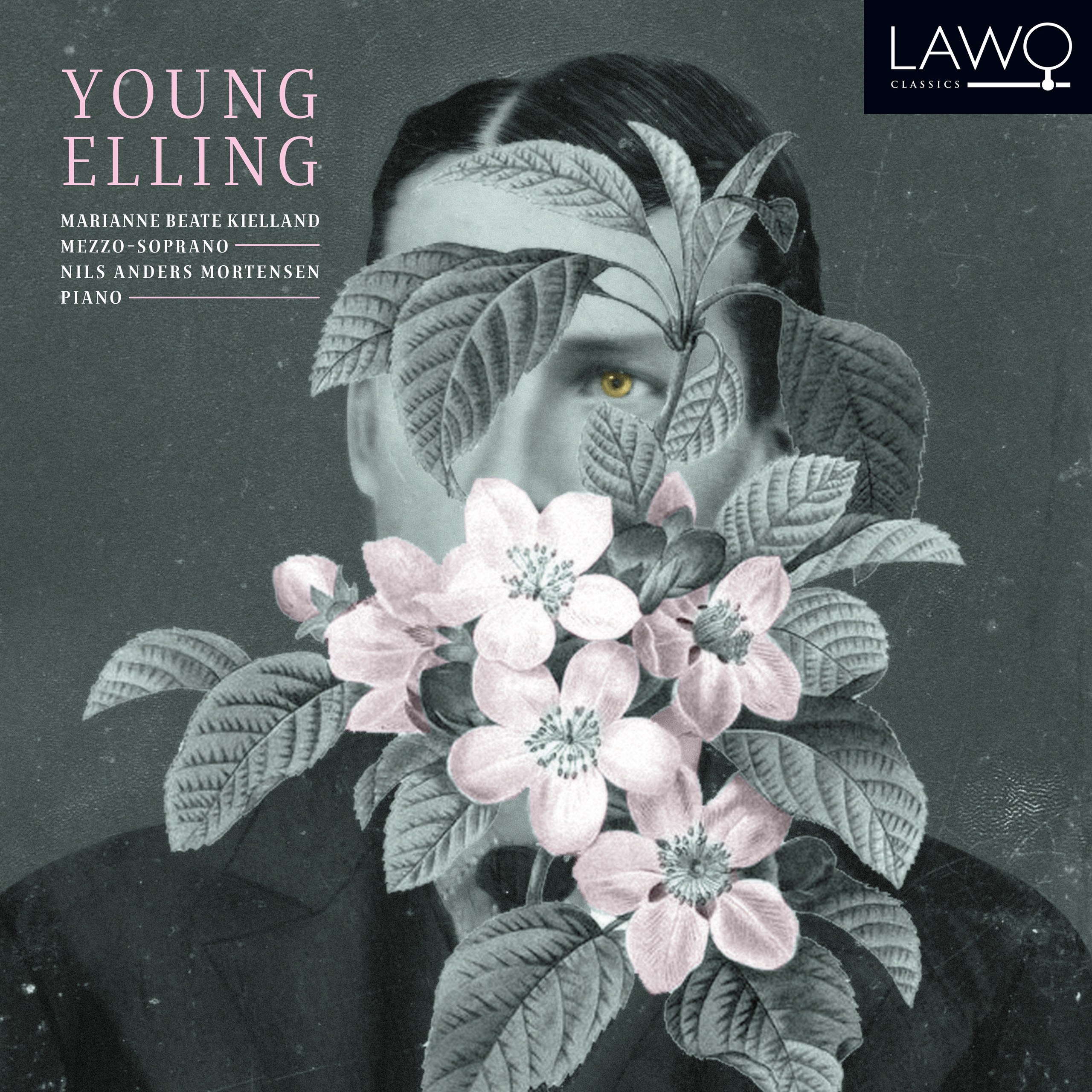
Young Elling
Marianne Beate Kielland (Mezzo-soprano) | Nils Anders Mortensen (Piano)
Stream & download
Tracks
Catharinus Elling (1858–1942)
Reviews
The songs have a conventional, at times delicate, and at times downright everyday feel to them.…
Show more Show less
The songs have a conventional, at times delicate, and at times downright everyday feel to them. Marianne Beate Kielland has a keen ear for this latter dimension; her approach is uncomplicated and straightforward, yet she never loses control. The sound is rich and polished, whilst at the same time Kielland is immediate in a way that suits Elling’s refined simplicity well. Mortensen accompanies her with attentive and impeccable piano playing.Show original
Sangene har et konvensjonelt, tidvis forsiktig, og tidvis nettopp hverdagslig preg. Marianne Beate Kielland har et presist øre for denne siste dimensjonen; tilnærmingen er ukomplisert og like frem, men uten at kontrollen glipper. Klangen er rund og velpleiet, samtidig er Kielland umiddelbar på en måte som passer Ellings dannede enkelhet godt. Mortensen følger opp med oppmerksomt og uklanderlig klaverspill.
 Morgenbladet
Norwegian
All are first recordings and form part of an important Norwegian musical heritage.…
Show more Show less
All are first recordings and form part of an important Norwegian musical heritage. Today, the result is a playful ease – and increasingly exciting musical encounters. There is a vitality to their expression that is well worth following. They are so well-rehearsed that they can afford to challenge one another without it sounding out of place. It is simply refreshing and creates an elegant dynamic between two musical souls who know each other’s rhythm.Show original
Alle er førsteinnspillinger og del av en viktig, norsk sangskatt. I dag er resultatet en leken ledighet – og stadig mer spennende, musikalske møter. De har en spenst i uttrykket som er verdt å følge. De er så samspilte at de kan tillate seg å utfordre hverandre, uten at det skurrer. Det er bare forfriskende og skaper en elegant dynamikk mellom to musikalske sjeler som kjenner hverandres puls.
 Vårt land
Norwegian
Her response to Elling's elegant, fluent lyricism demonstrates her affection of his work, and Nils Anders Mortensen finds just the right tone and dynamics to accompany his soprano's readings.…
Show more Show less
Her response to Elling's elegant, fluent lyricism demonstrates her affection of his work, and Nils Anders Mortensen finds just the right tone and dynamics to accompany his soprano's readings. Recommended!
 SA-CD.net
Read at SA-CD.net →
The opening ‘Elskovsvise’ is exquisitely charming, the following ‘Elegie’ deeply moving, ‘Irmelin Rose’ as warm and innocent as Nielsen’s setting, ‘Den gang jeg var’ and ‘Min…
Show more Show less
The opening ‘Elskovsvise’ is exquisitely charming, the following ‘Elegie’ deeply moving, ‘Irmelin Rose’ as warm and innocent as Nielsen’s setting, ‘Den gang jeg var’ and ‘Min Skat’ are light and folk-song-like – whilst songs such as ‘Du trykker mig Kys’, ‘Fiskaren og Sonen sin’, ‘Fjukande Skyer’, ‘Synden, døden’ and ‘Min Stolthet’ delve deep into the furnace of human emotions, each a microcosm of understated passion, made all the more poignant by their restrained delivery. Marianne Beate Kielland tackles these miniature masterpieces with the same effortless intensity that you hear in recordings by Kathleen Ferrier, and in Nils Mortensen she has a partner with the same sensitivity.Show original
Den innledende «Elskovsvise» er utsøkt sjarmerende, den pâfølgende «Elegie» dypt gripende, «lrmelin Rose» like varm og uskyldig som Nielsens consetting, «Den gang jeg var» og «Min Skat» lys og folketoneaktig - mens sanger som «Du trykker mig Kys», «Fiskaren ãt Sonen sin», «Fjukande Skyer», «Synden, døden» og «Min Stolthet» dykker langt ned i de menneskelige følelsers brenn, hver av dem et mikrokosmos av underdrevet lidenskap, ytterligere gripende gjennom det tilbakeholdne uttrykket. Marianne Beate Kielland takler disse mesterverkene i miniatyr med samme uanstrengte intensitet som du hører i innspillinger med Kathleen Ferrier, og i Nils Mortensen har hun en partner med samme følsomhet.
 Klassisk musikkmagasin
Norwegian
Elling is known for a number of things, not least his collection of Norwegian folk tunes.…
Show more Show less
Elling is known for a number of things, not least his collection of Norwegian folk tunes. And on this release, we sense how he has grasped something new when it comes to Lieder, and is tentatively embracing a slightly less restrained approach to eroticism and sensuality. [...] Marianne Beate Kielland handles this beautifully. She has a powerful voice, but takes care not to overplay it in relation to the material. In this way, she gets right up close to the music. And Nils Anders Mortensen is assured, as always.Show original
Elling er kjent for flere ting, ikke minst for sin innsamling av norske folketoner. Og på denne utgivelsen fornemmer vi hvordan han har tak i noe nytt når det gjelder Lieder, og tar fatt, litt blygt, i et litt mer uforstilt forhold til erotikk og sanselighet. [...] Det tar Marianne Beate Kielland seg fint av. Hun har en stor stemme, men passer seg for å overdimensjonere den i forhold til materialet. Slik kommer hun tett innpå musikken. Og Nils Anders Mortensen er sikker, som alltid.
 Dagbladet
Norwegian
Show all 9 reviews
Catharinus Elling’s music is pleasant and easy to listen to.…
Show more Show less
Catharinus Elling’s music is pleasant and easy to listen to. But it never gets boring, thanks to one of our talented singers here on the mountain. It is not without reason that Marianne Beate Kielland is attracting increasing international attention. For what she conveys is of the highest quality. [...] A big bouquet of flowers must also go to pianist Nils Anders Mortensen, who is Kielland’s highly responsive musical partner.Show original
Catharinus Ellings musikk er behagelig og enkel å lytte til. Men det blir aldri kjedelig takket være en av våre dyktige sangere her på berget. Ikke uten grunn at Marianne Beate Kielland får økt oppmerksomhet internasjonalt. For det hun formidler er av høy kvalitet. [...] En god blomsterbukett må også gå til pianist Nils Anders Mortensen som er Kiellands meget lydhøre medmusiker.

If you like Grieg’s songs, you’ll probably like these.…
Show more Show less
If you like Grieg’s songs, you’ll probably like these. They have grown on me with repeated hearing. Kielland’s tonal luster is a pleasure to hear. Her phrasing and shaping of the vocal line is elegant. Mortensen is a fitting partner, and his nimble accompaniment of ‘Fjukande Skyer’ (Swift Moving Clouds) is impressive. The SACD sound is excellent.
 American Record Guide | 2015-07
Treat yourself to this disc and you will find new favourites you didn’t know existed.
 MusicWeb International
Read at MusicWeb International →
[...] for collectors interested in 19th-century songs, and in discovering material that they have not encountered before, these songs will provide pleasure.…
Show more Show less
[...] for collectors interested in 19th-century songs, and in discovering material that they have not encountered before, these songs will provide pleasure. There is considerable variety of mood throughout the group. I know that I will listen to them again. That reaction is certainly assisted by the fine performances. Kielland and Mortensen are not just going through the motions or giving dutiful exposure to this material. They are inside the music and do their utmost to bring it to life, and Kielland has a lovely and flexible mezzo-soprano voice.
 Fanfare Magazine, sept/ | okt 2015
Credits
- Performer
- Marianne Beate Kielland (Mezzo-soprano) | Nils Anders Mortensen (Piano)
- Composer
- Catharinus Elling
- Producer
- Vegard Landaas
- Engineer
- Thomas Wolden
- Editing
- Vegard Landaas
- Mastering
- Thomas Wolden
- Liner notes
- Marianne Beate Kielland
- English translation
- Jim Skurdall
- Executive producer
- Vegard Landaas
- Booklet editor
- Hege Wolleng
- Design
- Anette L’orange | Blunderbuss
- Recording country
- Norway
- Original source
- 192 kHz, 24 bit
- Discs / tracks
- 1 disc | 25 tracks
- Release year
- 2014
- Label
- LAWO Classics
- Duration
- 43:11
- EAN
- 7090020180847
- ISRC
- NOEHX1415010/250
Booklet text
Foreword — Marianne Beate Kielland
It simply is the way it is: Grieg has been and remains the most important composer of Norwegian classical music. It is why many other composers — Grieg's contemporaries in particular — are, to some extent, overlooked.
Elling was twenty-six in 1884 when he wrote the first songs on this recording: Songs to Shakespeare's «Twelfth Night». The first public performance of one of his works had been in 1881, and he had studied a year in Leipzig. Now he was a music critic for the newspaper Dagbladet.
Catharinus Elling lived around the same time as Grieg, he studied in Leipzig as did Grieg, and the two shared an abiding interest in documenting Norwegian folk music.
Grieg composed many magnificent songs; we know them well. Elling penned approximately 200 songs, and very few of them are heard today. Previous recordings of Elling's songs are, to the best of my knowledge, the albums of Ann-Helen Moen and Gunilla Süssmann (2009) and Åse Krystad and Sergej Osadchuk (2011).
With this release we wish to add to the songs of Catharinus Elling available as recordings. None of these songs have been recorded before. And they include many gems! Among my favourites are Elskovsvise, Irmelin Rose, Ho Astrid, Nordmannen (a text well known by a different melody), and, not least, Jeg vil ud!
Elling's songs are simpler than those of Grieg's from the same time. Yet many of them are so extremely beautiful in their simplicity, and certain piano or vocal phrases inspire the urge to conduct or sing along with the music.
But Elling returned to Germany, where in 1887-88 he composed the songs to texts from Des Knaben Wunderhorn. It seems natural that he should have been inspired by these well-known German texts while he was there, and the songs are simple compositions — as if wanting them to suitably match the German folk melodies that Mahler used for his own Knaben Wunderhorn songs.
Elling was still living in Berlin when he composed the next songs in the chronological sequence: The songs to texts of Janson and Aasen op. 40, together with Fire romanser op. 41, date from 1888-89. The songs to texts of Randers op. 45 are from 1893. Then he moved back to Norway and became a central person in Norwegian musical life.
Although our selection of songs may not present the composer Catharinus Elling at his most mature, they belong nonetheless to the Norwegian treasury of song, and we hope that each of our listeners will lend an ear and find delight in the lovely melodies.
— Marianne Beate Kielland
Catharinus Elling — Between German Romanticism and Norwegian Folk Tunes
Norwegian composer Catharinus Elling (1858-1942) had a long and varied career. Of the significant contributions he made in a number of areas, his collection of folk melodies has been the longest-lasting. This recording presents a selection of the approximately 200 songs he composed for solo voice and piano accompaniment.
Elling received piano lessons from his mother, and music filled his childhood home, with a father who played cello and a sister who became a singer. He began the study of philology, completing a degree in history, English, and French. At the same time, he felt the call of music, writing his first compositions at the age of eighteen. Deciding to pursue a musical education in Germany, he travelled first to Leipzig, as Grieg and other Norwegian composers had done. The late 1880s found him in Berlin, following his breakthrough in Kristiania with performances of his songs and orchestral works. His success was aided in no small measure by a flattering review published in 1885 by Edvard Grieg in the newspaper Bergens Tidende, in which he used expressions such as lyrical gift, vigorous to the core, and possessing a distinctive character. Grieg also included songs of the much younger Elling in his own concert programmes.
Berlin
In the 1890s Elling was in Berlin together with his wife, Ulrika, who supported them working as a massage therapist. He was writing nothing less than an opera, which was performed in Kristiania in 1897 by a Swedish opera company. The Cossacks was described by the music critic for the newspaper Morgenbladet as the first great Norwegian opera on Norwegian soil and, as such, a ground-breaking work.
During this time, Elling also composed two symphonies, and, later, a violin concerto, and he wrote chamber music and choral works, including those penned while he was conductor of the male chorus Drammens Sangforening.
The time in Berlin provided Elling with new insights into the German tradition of Mendelssohn, Schumann, and, above all, Johannes Brahms (1833-1897). The Norwegian composer was deeply influenced by contact with Brahms and his circle, which is especially evident in his piano music. Elling wrote as music critic, and a hard-hitting one, for a number of newspapers, including Dagbladet and Morgenposten, and his reviews of Brahms were most favourable. The Clarinet Quintet, he wrote, was one of the most powerful and well-integrated works of contemporary chamber music.
At the turn of the century, Elling taught composition and counterpoint at the conservatory of music in Kristiania, where he counted Fartein Valen among his students. From 1910-1926, he served as organist of Gamlebyen Church.
Folk Tunes
From 1898-1911, on his many journeys to Western Norway, Telemark, and Northern Norway, Elling wrote down the folk tunes he heard, approximately 1,400 in number. In Berlin, Brahms had responded enthusiastically to the folk songs Elling's sister, Jacoba, had sung for the German master and his friends. Now Elling wanted to continue the work begun by L. M. Lindeman. In addition to his instrumental arrangements and those for solo voice and for choir, he authored a number of publications on Norwegian folk music.
Elling's more compositional/practical-pedagogical approach was opposed by the younger collector of folk tunes, O. M. Sandvik (1875-1976), whose work was more scientifically focused. Elling wanted to give the melodies legs to stand on, and it was because of their simpler, accessible form in his editions of religious folk tunes that they could be used as church hymns and admitted into the revised edition of Landstad's Norwegian hymn book in 1926.
Sandvik himself wrote in Norsk Koralhistorie (The History of Norwegian Choral Music, 1930) that the scope of folk tunes for use in the church was greatly limited until C. Elling began his work as a collector, writing down the many lively melodies of Brorson and others, which were published in 11 booklets under the title «Vore religiøse folketoner», and which opened up a new world for those with religious interests.
Elling's approximately 200 songs for solo voice and piano were composed in the 1880s and 1890s. In a Norwegian context, they have been overshadowed by the songs of Halfdan Kjerulf and Edvard Grieg. In Norges Musikkhistorie (The History of Norwegian Music, 1921) Trygve Torjussen wrote: It is the lyric poet Elling one makes the acquaintance of in these songs. The best of them reveal a fresh melodic ingenuity and, in their conservatism, a noble if somewhat rigid conception of music, which shuns cheap effects and avoids all trends. Yet a few of the many splendid texts, which show literary taste as well, would have benefitted from a somewhat cheerier, more colourful musical setting.
The young Elling took his first text in 1881 from the German Romantic, Johann Ludwig Uhland, whom Brahms, too, had used. His last choice of author was Arne Garborg and Haugtussa, which Edvard Grieg had also set to music. Might one say that the very popular Småsporven gjeng i tunet from Haugtussa is, perhaps, Elling's triumph over Grieg?
Selected songs of Catharinus Elling:
Drei Lieder von Uhland, Op. 7 (1881) · Vier Lieder von Heine, Op. 16 (1880/81) · Tre danske Sange, Op. 19 (1882) · Drei chinesische Lieder, Op. 20 (1883) · Fire Sange, Op. 25 (1883/84) · Sange til Shakespeares Helligtrekongersaften, Op. 42 (1884) · Drei Lieder (1883/85/86) · Lieder aus Des Knaben Wunderhorn I (1887/88) · Fire Romanser, Op. 41 (1888/89) · Fire danske Sange, Op. 44 (1890) · Vier Lieder, Op. 46 (1891) · Nye Digte av Kr. Randers, Op. 45 (1893) · Tre Sange, Op. 56 (1889/95) · Fire Sanger til tekster av Nils Collett Vogt, Op. 51 (1895) · Seks Digte til Arne Garborgs «Haugtussa», Op. 52 (1895) · Sange til Bjørnstjerne Bjørnsons «En Dag», Op. 55 (1895) · Sange til Joh. Jørgensens «Foraarsevangelium», Op. 57 (1895) · Nye Sanger til Arne Garborgs «Haugtussa», Op. 60 (1895)