
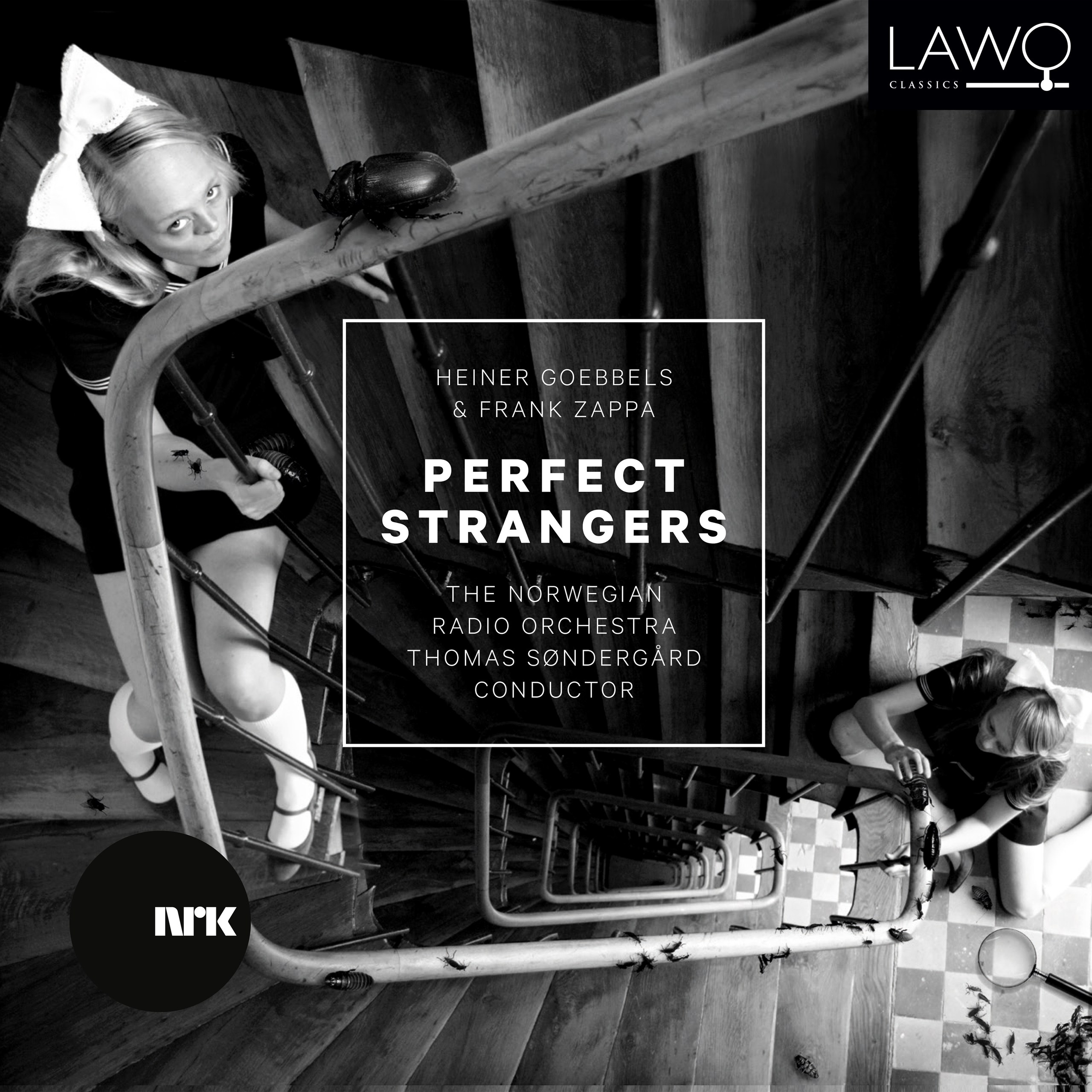
Frank Zappa | Heiner Goebbels
Perfect Strangers
Norwegian Radio Orchestra (Orchestra) | Thomas Søndergård (Conductor)
Stream & download
Tracks
Heiner Goebbels (*1952)
Suite for Sampler and Orchestra
Frank Zappa (1940–1993)
Credits
- Conductor
- Thomas Søndergård
- Performer
- Norwegian Radio Orchestra
- Orchestra (unspecified)
- Norwegian Radio Orchestra
- Composer
- Frank Zappa | Heiner Goebbels
- Producer
- Vegard Landaas
- Engineer
- Øystein Halvorsen | Morten Hermansen | Arne Kristian Dypvik | Jan-Erik Tørmoen | Per Ravnaas | Terje Hellem
- Mastering
- Thomas Wolden
- Executive producer
- Vegard Landaas
- Booklet editor
- Hege Wolleng
- Cover photo
- Anna-Julia Granberg
- Design
- Anna-Julia Granberg | Blunderbuss
- Recording location
- Rockefeller Concert Hall, Oslo
- Recording country
- Norway
- Recording year
- 2010
- Recording dates
- 00.02.2010
- Original source
- 44.1 kHz, 16 bit
- Discs / tracks
- 1 disc | 15 tracks
- Release year
- 2014
- Label
- LAWO Classics
- Duration
- 69:15
- EAN
- 7090020180663
- ISRC
- NOEHX1406010/150
Booklet text
Heiner Goebbels: Sampler Suite
While the music of Frank Zappa quite naturally seeks its inspiration in American pop culture, the references and spheres of activity of German composer, theatre director, and multi-artist Heiner Goebbels (b. 1952) are broad and varied.
Goebbels does not fit so easily into defined artistic categories, moving freely as he does within — and between — the realms and forms of expression of opera, theatre, and serious music. The basis of his works is the desire to 'deconstruct' these arenas with all their conventions and built-in expectations. Here he claims to be inspired by the legacy of Bertolt Brecht, who says, among other things, that theatre can also give us experiences and not only opportunities for evaluating — or, at worst, for passing judgement! It is an idea that has found its way into Goebbels's works, inasmuch as their points of departure, scenic as well as musical, are all fundamentally different.
With this in mind, he has been incessantly productive in the spheres of theatre and music. He has in a prolific way been able to extract musical elements and apply them musically, not only as composer, but also as a man of the theatre.
When awarding Goebbels the International Ibsen Prize for 2012, the jury called attention not only to the great mobility in his artistic projects, but also their far-reaching impact and their importance for theatre, opera, and serious music. Hence he is an artist who by dissolving the boundaries between traditionally separate realms of expression is always able to give us a new experience.
Likewise in Suite for Sampler and Orchestra, which together with The Horatian - Three Songs, D & C, Surrogate, and In the Country of Last Things, constitute his large work Surrogate Cities. Goebbels himself says about Surrogate Cities that 'it is an attempt to approach the phenomenon of the city from various sides, to tell stories of cities, expose oneself to them, observe them; it is material about metropolises that has accumulated over the course of time.'
Suite for Sampler and Orchestra is nicely arranged into a quasi-Baroque suite of ten movements of widely varying lengths, in which besides the traditional movements — Allemande, Courante, Sarabande, and Gigue — other movements from Baroque suites are freely introduced, such as Minuet, Gavotte, Bourée, and Air, in addition to two larger-scale movements from Baroque music, Passacaglia and Chaconne, usually not included in a suite. The suite's individual movements lend it the quality of a sequence of musical vignettes, something that makes the music more tangible.
In Suite for Sampler and Orchestra Goebbels creates striking individual sound images, in which the orchestra's functionality and facility for delineating distinct acoustic images is brought to the fore — rather than depicting 'the city' as metaphor by means of complex musical structures.
By taking 'the city' as his point of departure (and professing allegiance to technology through his use of the word 'sampler'), Goebbels, in the same breath, comments on the entire Austro-German symphonic tradition, which has 'the pastoral', as represented by 'the rural idyll', as one of its greatest sources of inspiration. One finds this from Beethoven's Pastoral Symphony to the opening of Brahms's Second Piano Concerto, in which the horns, rejoined by the piano, manage together with astonishing rapidity and in the course of exceptionally few measures to conjure up a rural idyll, an out-of-doors acoustic space with depth and perspective. This concept of the 'rural idyll' is somehow amassed in the entire tradition, waiting only to be released.
With the use of a sampler it is possible to incorporate sound material usually not heard from a symphony orchestra. Goebbels uses the sampler to reproduce both the sound of 'industrial noise' and what he calls 'sub-cultural noise', as well as 'the sound of history'. Perhaps one of the most poignant moments occurs in the seventh movement, called Chaconne, in which he introduces a human element using a recording of Jewish cantors played back over the sound of the orchestra's string section, as though wanting to remind us that the complex city also comprises islands of contemplation, reflection, and human longing.
One might well call this a collection of postmodern sound images, in which 'the city' has become for the postmodern human, paradoxically enough, 'the new forest' — vast, mystical, unfathomable, and impossible to apprehend. Where Beethoven lets us wake to birdsong and stirs us with storm scenes in his Pastoral Symphony, Goebbels in his Suite for Sampler and Orchestra has us awakening to sounds of machines and becoming more conscious of industrial noise.
The composition and contents of the different movements of Suite for Sampler and Orchestra seem to derive more from Goebbels the man of the theatre than from the technique and virtuosity of the professional musician. And it is at just this point of intersection that Heiner Goebbels has been instrumental in revitalizing elements of contemporary music by stripping away all superfluous ornaments and bringing to the fore music's greatest power, namely, its capacity for telling stories — whether they are set in the countryside by daylight or in the dark and confusing labyrinth of the city.
This is at times lovely music in all its directness; welcome to ten movements with arresting moments from the city's 'scrapbook'!
— Asbjørn Schaathun
Frank Zappa
Frank Zappa (1940–1993) was, for very many, a virtuoso guitarist with a voluminous output of R&B and rock albums. In the 1980s he also enjoyed enormous commercial success when he took on the role of pop artist. Moreover, he wrote jazz and electro-acoustic works, and the list of his compositions for orchestra is not insignificant. He cultivated an early appreciation of composers such as Edgar Varèse, Igor Stravinsky, and Anton Webern, and it was they, among others, who influenced the development of his captivating tonal language. Zappa had no formal musical education and was self-taught both as a composer and performer. Yet this in no way deterred him from writing complex music, richly nuanced and highly creative — music usually regarded as equally challenging for listeners and performers alike. Zappa was also typically thought of as a genre-crossing artist. His text-based music often made use of humour and satire, but the need to communicate was the basis of his instrumental works as well.
Now that the Norwegian Radio Orchestra has set out to record a choice bouquet of Zappa's classic works, everything from The Dog Breath Variations to Uncle Meat will be in the best of hands. There is no reason for either Zappa or his music to remain 'Perfect Strangers'. Let the tornado wreak what it will, for there's sure to be some celebrating when the orchestra, under the baton of Thomas Søndergård, offers up its renderings of Zappa, and assumes the role of 'Low Budget Orchestra' besides. Enjoy!
— Espen Beranek Holm
— English translation: Jim Skurdall