
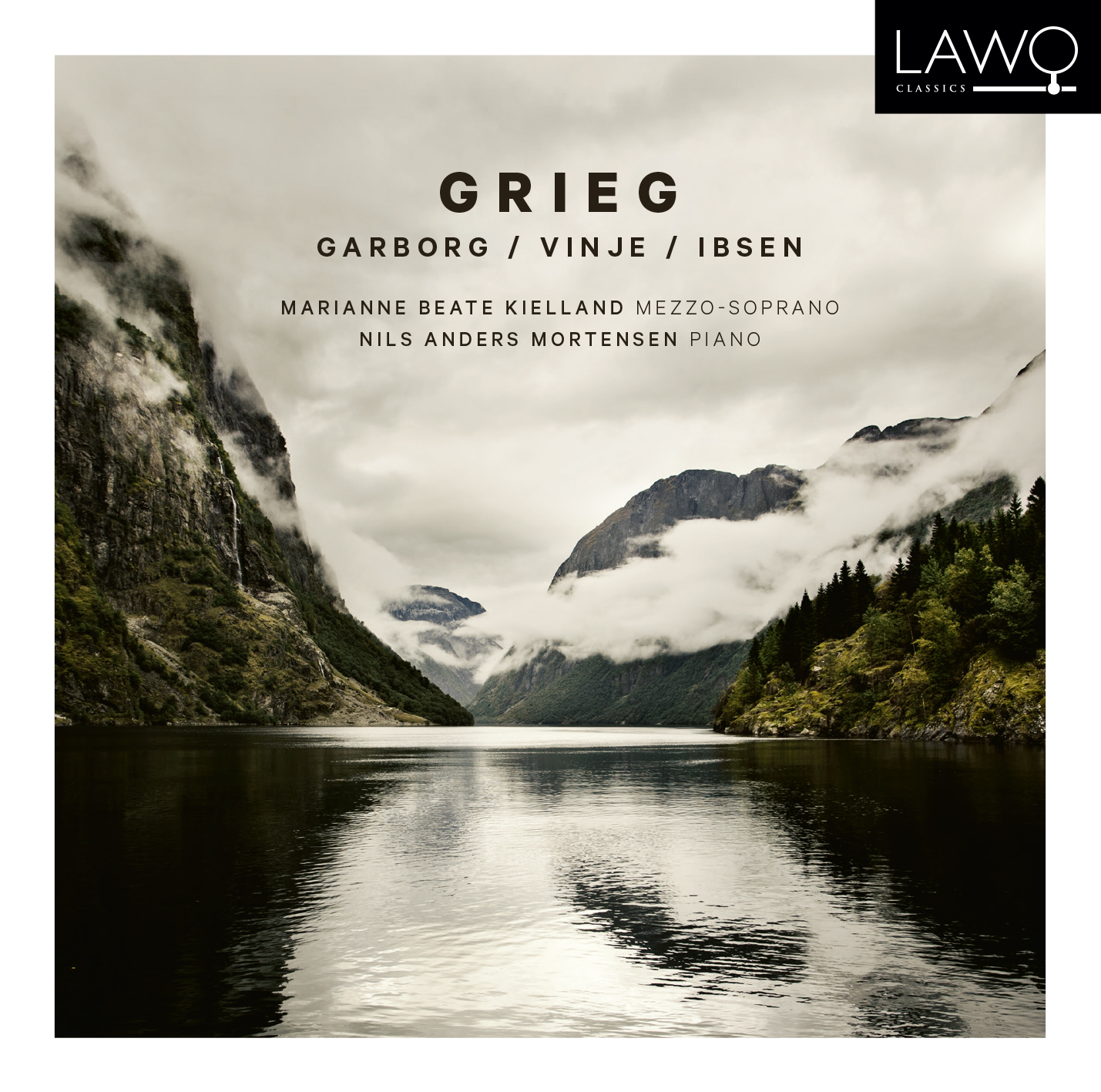
Grieg – Garborg / Vinje / Ibsen
Marianne Beate Kielland (Mezzo-soprano) | Nils Anders Mortensen (Piano)
Stream & download
Tracks
Edvard Grieg (1843–1907)
Haugtussa
Vinjesangene
Ibsensangene
Credits
- Performer
- Marianne Beate Kielland (Mezzo-soprano) | Nils Anders Mortensen (Piano)
- Composer
- Edvard Grieg
- Lyricist
- Arne Garborg | Aasmund Olavsson Vinje | Henrik Ibsen
- Producer
- Vegard Landaas
- Engineer
- Thomas Wolden
- Editing
- Vegard Landaas
- Mastering
- Thomas Wolden
- Piano tuner
- Eric Shandall
- Liner notes
- Marianne Beate Kielland
- English translation
- Jim Skurdall
- Executive producer
- Vegard Landaas
- Booklet editor
- Hege Wolleng
- Cover photo
- Anna-Julia Granberg
- Design
- Anna-Julia Granberg | Blunderbuss
- Recording location
- Vågan Church, Lofoten
- Recording country
- Norway
- Recording year
- 2013
- Recording dates
- 04.01.2013 | 05.01.2013
- Original source
- 44.1 kHz, 16 bit
- Discs / tracks
- 1 disc | 26 tracks
- Release year
- 2014
- Label
- LAWO Classics
- Duration
- 75:01
- EAN
- 7090020180632
- ISRC
- NOEHX1403010/260
Booklet text
The three great Norwegian poets, Garborg, Vinje, and Ibsen, meant a lot to Edvard Grieg. He drew inspiration from them, and in setting their texts to music, he created three of his most important opuses: «Haugtussa», Op. 67; the «Vinje Songs», Op. 33; and the «Ibsen Songs», Op. 25.
Over the years many lines have been written about this album's three opuses. And as it is also relatively easy to find scholarly articles on the music, we have elected to omit such monographs from this booklet. I have instead chosen to share a few personal reflections on the songs.
This is, to my knowledge, the first time these songs have been brought together on one recording. Is it perhaps because «Haugtussa» is often sung by women, and the «Vinje Songs» by men? I chose to disregard tradition. Grieg's songs are, after all, not so gender-based that they seem inappropriate when the sound is different from what one expects. I wish, therefore, to set my sights on the heart: I feel closest to these three opuses, to the music as well as to the texts.
There are still many relatively unknown Grieg songs one could bring to light. Ought they have been chosen when recording yet another Grieg album? The answer to the question is 'no', as it has not been my intention to call attention to lesser known aspects of Grieg (nor show that the less familiar songs have a certain quality), but rather present my versions of familiar songs. Music can be made in so many different ways. One interpretation will be to the liking of some; another interpretation pleases others.
Nils Anders Mortensen and I have endeavoured to take Grieg at his word. What are his tempo indications and dynamic markings? What is his desired interpretation? Many have been tempted to go far beyond Grieg's instructions in their interpretations, especially in «Haugtussa». Grieg is, of course, not a Mahler, who clearly writes out each and every sostenuto and rubato, but he is precise, nonetheless. Often he has clear tempo instructions, and he notates sostenuto and a tempo, when he wishes to have it. In our interpretations, we heed his intentions. When, for example, sostenuto is not in the score, it is not used, nor ritardando, when not written.
We do not claim to hold the key to how the songs on this album are to be interpreted. But maybe, just maybe Grieg would have nodded and said that it was this tempo he had in mind. All the same — one shall have artistic freedom, even when trying to follow Grieg's intentions, and an observant listener and reader of the score will naturally find a few places where Grieg's notations have been overridden by the artist's wish to draw attention to something in the text or give more space to the music.
The song cycle «Haugtussa» lives an active life. The song titles often grace posters on the rare occasions when Norwegian female singers perform lieder. At the same time, the cycle otherwise enjoys an almost cult-like status in Europe. I am often asked by colleagues, pianists, and audiences if I know the songs, or have performed them. When hearing my answer in the affirmative, colleagues tell me that they, too, have had a go at the songs, but have found them to be extremely difficult. Of course! — since the inaccessible and unfamiliar «nynorsk», a more rustic version of Norwegian, makes it virtually impossible for anyone other than a Norwegian to sing the texts properly. Yet others wish to try because «Haugtussa», in language and melody, instills a feeling of being something exotic, proto-Norwegian, and alluring. And knowing that Grieg regarded the songs as his best, it is not unusual that both Norwegian and other European singers wish to perform them.
Those familiar with the contents of the songs may feel they know Garborg's «Haugtussa» as well. Garborg's work of poetry, consisting of 71 poems, tells the story of Veslemøy, a psychic and an outcast, whose love for Jon is the luminous highpoint of her complicated life. It was precisely this love story Grieg selected, when, in 1895, he enthusiastically began composing his «Haugtussa» cycle right after having received the poem cycle from Garborg. Grieg basically tells nothing more of Veslemøy's life. I am thus inclined to regard the cycle more as a love story with nascent, youthful hope, ardent emotion, and, finally, betrayal and abandonment, rather than as essentially a presentation of Garborg's Veslemøy. In the work of poetry, her life encompasses so much more than Grieg presents.
«Haugtussa» is one of the most beautiful portraits of a woman in music history, and Norwegians are fortunate that they can both read and understand the message and content of the songs. I would recommend reading Garborg's entire work to gain greater knowledge of Veslemøy's dramatic life.
Grieg's «Vinje Songs», Op. 33, were composed after a two-year dry spell. From 1878 to 1880, he did not write a single work, but his meeting with the poet Aasmund Olavsson Vinje in Bergen in April, 1880, seemed to have a liberating effect, and the complete original manuscript of Op. 33 is dated 20 May 1880. In the course of one month, Grieg had completed 15 songs, three of which he discarded. The opus today thus consists of 12 songs, two of them among those of Grieg's songs most frequently performed: «Våren» and «Ved Rondane». The original texts, like «Haugtussa», are in «nynorsk», but Grieg added a Danish version of the songs, making them accessible to a larger audience.
The story told in «Haugtussa» is sad, but the songs have a simplicity and youthfulness about them, and the melody and text succeed in presenting the image of a young and tender woman. The «Vinje Songs» have another depth. These are serious texts about morality and melancholy, life's meaning, and the heartfelt loss of a loved one. And in «Våren» and «Ved Rondane» we find exquisitely beautiful descriptions of Norwegian nature. Only one or two of the songs are more outward, and often Grieg has indicated piano as the basic dynamic marking, while fluctuating up to forte or fortissimo to set the stage for an outburst of feeling.
The album concludes with the «Ibsen Songs». They, too, lack a textual context, alternating from the lyrical narrative «En fuglevise», via the waggish, yet secretive «Med en vandlilje», to the emotion and drama in «Spillemænd». The songs were composed right after «Ballade» in 1875, at a time when Grieg's life was filled with significant emotional challenges. Ibsen's short, evocative poems resonated with him — and two of them, «Stambogsrim» and «Borte!», are expressions of loss and bereavement. In the «Ibsen Songs», Grieg is uncommonly expressionistic, closer to ardent feeling than perhaps anywhere else in his songs.
Grieg's songs cannot be worn out. One can sing them over and over and always discover something new, see something not seen before. The listener will hopefully lend a friendly ear to our interpretations, while delighting in perspectives gained through versions of the same music by other singers. It is this which makes the field of music exciting and inexhaustible.
Enjoy!
— Notes: Marianne Beate Kielland · English translation: Jim Skurdall