
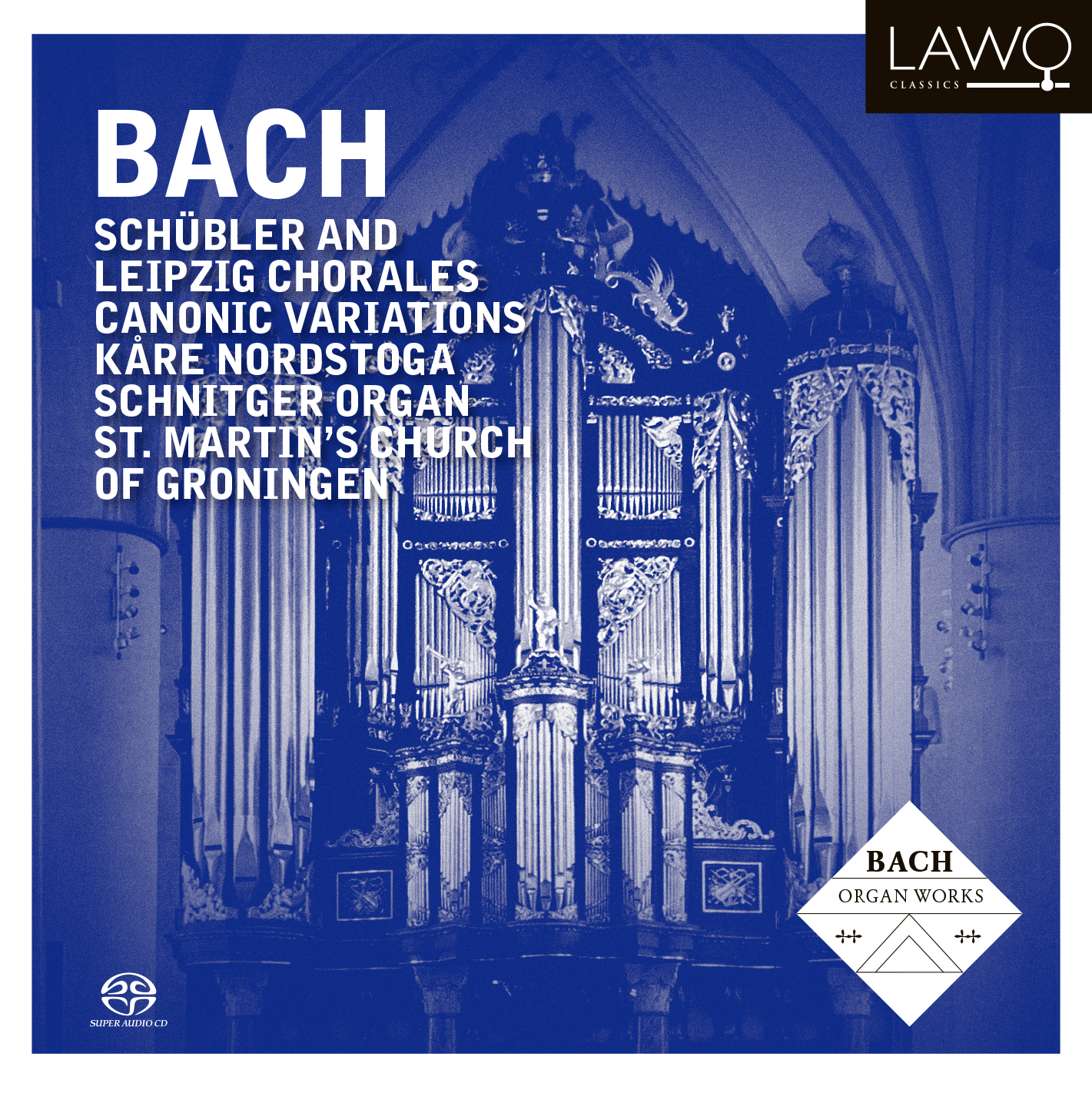
Bach: Schübler and Leipzig Chorales & Canonic Variations – Schnitger Organ St. Martin’s Church of Groningen
Kåre Nordstoga (Organ)
Cathedral Organist Kåre Nordstoga – chorale Preludes on a baroque organ
The fifth and sixth album in this series featuring Bach’s complete organ works were recorded in St. Martin’s Church in Groningen, on an organ representing the most noble qualities of the Baroque sound. The construction of the instrument is usually attributed to the well-known organ builder of the late 1600s, Arp Schnitger, although some stops date back to 1450.
Both discs are devoted to Bach’s chorale prelude adaptations, which, owing to the organ’s vocal timbre, distinctive temperament, and clear lines, are heard to good advantage. Here we find the eighteen Leipzig Chorale Preludes, which Bach wrote while serving as court organist in Weimar, but which he collected and adapted toward the end of his life. The six Schübler Chorale Preludes are adaptations for solo organ of movements from Bach’s own cantatas. They bear the name of the music publisher. Finally, in his Canonic Variations on the Christmas hymn “From Heaven Above to Earth I Come”, Bach seems to wish to demonstrate how much elaborate polyphony can be drawn out of a simple Christmas hymn in C major.
Stream & download
Tracks
Disc 1
Johann Sebastian Bach (1685–1750)
Disc 2
Disc 3
Reviews
Superb technique, a recording of the finest quality and interpretations that rank amongst the very best.…
Show more Show less
Superb technique, a recording of the finest quality and interpretations that rank amongst the very best. Not to mention the magnificent organ at St Martini’s Church in Groningen.Show original
Suveren teknisk, registrering av beste merke og interpretasjoner som tilhører de fremste blant innspillinger. For ikke å snakke om det fantastiske orgelet i St. Martini-kirken i Groningen.
 Stavanger Aftenblad | 07.03.14
Norwegian
Nordstoga guides us confidently and convincingly through these works.…
Show more Show less
Nordstoga guides us confidently and convincingly through these works. [...] He sketches out the contrapuntal structures with a sure hand. And creates resonant architecture – beautiful, magnificent and impressive, like the cruciform church in Groningen.Show original
Nordstoga guider oss sikkert og overbevisende gjennom disse verkene. [...] Han tegner opp de kontrapunktiske konstruksjonene med sikker hånd. Og skaper klingende arkitektur – vakkert, storslått og imponerende som korskirken i Groningen.
 Bergens Tidende | 12.02.14
Norwegian
In Nordstoga’s hands, we feel safe in the company of this music; he performs with a blessed calm that allows the music to resonate to the very end.…
Show more Show less
In Nordstoga’s hands, we feel safe in the company of this music; he performs with a blessed calm that allows the music to resonate to the very end. And he shapes each and every piece so beautifully that it is like a dream.Show original
I Nordstogas hender følger vi oss trygge på denne musikken, han foredrar med en velsignet ro, som gir musikken anledning til å klinge, helt ut. Og han former hver og ett av stykkene så vakkert, at det er en drøm.
 Dagbladet | 12.02.14
Norwegian
[...] Nordstoga delivers with a feeling for timbral definition and unhurried placement.
 Gramophone, sept. | 2014
This third double album in Kåre Nordstoga’s survey of Bach’s organ music is of the same exceptionally high standard as the previous releases.…
Show more Show less
This third double album in Kåre Nordstoga’s survey of Bach’s organ music is of the same exceptionally high standard as the previous releases. [...] The organ is situated in St Martin’s Church in Groningen, perfectly captured in this recording, as is Kåre Nordstoga’s utterly reliable performance.Show original
Dette tredje dobbeltalbumet i Kåre Nordstogas gjennomgang av Bachs orgelmusikk, er av samme skyhøye standard som de tidligere utgivelsene. [...] Orgelet står i St. Martins-kirken i Groningen, perfekt innfanget i denne innspillingen, i likhet med Kåre Nordstogas totalt pålitelige musisering.
Show all 9 reviews
Kåre Nordstoga is an outstanding organist; he puts the listener in exactly the right frame of mind from the very first note, and the richness of nuance is impressive.
Show original
Kåre Nordstoga är en utmärkt organist, han placerar lyssnaren i precis rätt stämning från den första noten, nyanserikdomen är imponerande.
 Norran | 20.08.14
Norwegian
One of Nordstoga’s undisputed highlights is BWV 653 (‘An Wasserflüssen Babylon’).…
Show more Show less
One of Nordstoga’s undisputed highlights is BWV 653 (‘An Wasserflüssen Babylon’). To me, this movement has always stood out as one of the very finest things Bach ever wrote, and Nordstoga captures it perfectly. The registration, articulation, tempo, expression – it’s all simply marvellous! [...] Given that this is both superbly played and features some unusual and, at times, surprising interpretations, this is something you absolutely must not miss. Not least when it comes to BWV 653, 656 and 664 – it simply couldn’t be done any better!Show original
Et av Nordstogas desiderte høydepunkter er BWV 653 (An Wasserflüssen Babylon). Denne satsen har for meg alltid ståt som noe av det ypperste Bach har skrevet, og Nordstoga treffer perfekt. Registrering, betoning, tempo, affekt – det hele er bare fantastisk nydelig! [...] I og med at dette både er drivende godt spilt og inneholder en del uvante og til dels overraskende tolkninger er dette noe du absolutt må få med deg. Ikke minst når det gjelder BWV 653, 656 og 664 – bedre kan det ikke gjøres!
I have played these discs frequently, marvelling each time at the affectionate and idiomatic performances and excellent sonics.…
Show more Show less
I have played these discs frequently, marvelling each time at the affectionate and idiomatic performances and excellent sonics. Often, long collections of many short pieces can evoke a listener's wandering attention. Nordstoga's collection indeed sets the tireless, encompassing mood of enlightened contemplation, whatever one's religious status. Highly recommended.
 HRAudio.net | 31.03.14
Read at HRAudio.net →
Are you crazy about Bach’s incomparable organ music?…
Show more Show less
Are you crazy about Bach’s incomparable organ music? Fortunately, there are musicians who can help you. [...] The pieces range from quiet, brief snippets to more majestic works. Nordstoga conveys both perfectly; he doesn’t rush through them, he listens.Show original
Har du dilla på Bachs uforlignelige orgelmusikk? Heldigvis fins musikere som hjelper deg. [...] Låtene spenner fra stille, korte snutter til mer majestetiske greier. Nordstoga formidler begge deler fullkomment; han raser ikke gjennom, han lytter.
 Østlendingen | 03.03.14
Norwegian
Credits
- Performer
- Kåre Nordstoga (Organ)
- Composer
- Johann Sebastian Bach
- Producer
- Vegard Landaas
- Engineer
- Thomas Wolden
- Editing
- Vegard Landaas
- Mastering
- Thomas Wolden
- Liner notes
- Torkil Baden
- English translation
- Jim Skurdall
- Executive producer
- Vegard Landaas
- Booklet editor
- Hege Wolleng
- Design
- Anette L’orange | Blunderbuss
- Recording location
- St. Martin’s Church, Groningen
- Recording country
- Germany
- Recording year
- 2012
- Recording dates
- 06.05.2012 | 07.05.2012 | 08.05.2012
- Original source
- 96 kHz, 24 bit
- Series
- Bach Organ Works
- Discs / tracks
- 2 discs | 29 tracks
- Produced with support from
- Fund for Performing Artists | Creo – The Union for Arts and Culture
- Release year
- 2013
- Label
- LAWO Classics
- Duration
- 130:53
- EAN
- 7090020180588
- ISRC
- NOEHX1316010/290
Booklet text
BACH'S SUMMING UP
Toward the end of his life as a composer, J.S. Bach had more time at his disposal than during his early Leipzig years beginning in 1723. He could now fall back on a repertoire he had built up within numerous genres, not least the library of cantatas for Sunday worship services.
The short-term routine of creating new works from week to week was replaced by a more long-term process.
Giving private lessons to gifted students required a repertoire for the study of the noble art of composition and polyphony. And Bach himself had a need for the systematic and comprehensive exploration of the material at hand. This recording features such a repertoire represented by three works based on chorales.
Orgelbüchlein from the Weimar years had a pedagogical aim: «Dem höchsten Gott allein zu Ehren, dem Nächsten, draus sich zu belehren.» («To honour God alone, for fellow man his craft to hone.») In the same way, the late works are a compendium, a textbook, in which the possibilities of varying a chorale prelude are elaborately and exhaustively demonstrated.
CANONIC VARIATIONS ON «FROM HEAVEN ABOVE TO EARTH I COME», BWV 769
Martin Luther is both the author and composer of «Vom Himmel hoch» (1535). The first verses are spoken by the angel on Christmas Eve, and the congregation responds with thanksgiving, welcoming the Christ Child as a guest on Earth. Verse one reads — in the translation of Catherine Winkworth: «From Heaven above to Earth I come/To bear good news to every home;/Glad tidings of great joy I bring/Whereof I now will say and sing.»
Bach had arranged the chorale melody several times, and he did so again at the end of his life. In 1747 he was to become a member of «Korrespondierende Societät der musikalischen Wissenschaften» («The Society of the Musical Sciences»). The founder was Bach pupil Lorenz Mizler, and the list of members already included Telemann and Handel.
The musical contributions were to be of scholarly quality, but not «impractically theoretical.» Rather they were to «arouse or gratify human emotion».
As his entrance examination, Bach submitted his variations on «From Heaven Above», together with his well-known portrait by official Leipzig artist Haussmann. The word «canonical» implies that one voice follows the other exactly as in a canon, but at different intervals from variation to variation.
Variatio 1. Canone all' ottava (Canon at the Octave) Variatio 2. Alio Modo in Canone alla Quinta (Canon at the Fifth) Variatio 3. Canone alla Settima, cantabile (Canon at the Seventh) Variatio 4. Canon per augmentationem (Augmentation Canon; the bass plays in octaves with lengthened note values.) Variatio 5. L'altra Sorte del'Canone all'rovercio (Canon with Inversions), 1) alla Sesta, 2) alla Terza, 3) alla Seconda è 4) alla Nona. Dimunitio. Alla Stretta
Mastery of canon technique is related to mathematical aptitude. It has been asserted that had Bach not become a musician, he might have been a mathematician at the highest level. Studying the written music with its elaborate counterpoint is a special experience. It is not only «ear music», but «eye music» as well!
Bach's genius was in combining intellect with musical temperament. He became in this way a worthy member of Mizler's society: Not impractical theory, but passion.
LEIPZIG CHORALE PRELUDES (EIGHTEEN CHORALE PRELUDES OF VARIOUS KINDS)
During the Leipzig years (1723–1750), Johann Sebastian Bach returned to his organ chorale preludes composed while serving as court organist in Weimar from 1708–1717. Some go further back perhaps, to his early years in Arnstadt or Mühlhausen. No. 16 and 17 were written down between 1744 and 1747 by his pupil and son-in-law, J. C. Altnikol, and no. 18 even later.
This Leipzig work became a more sophisticated equivalent of «Orgelbüchlein», with its short chorale prelude arrangements from the earlier Weimar period. Techniques from German tradition (Pachelbel and Buxtehude) are refined and elevated to a new plane.
The manuscript opens with the letters «J.J.», «Jesu juva» («Jesus, help»).
1. Fantasia super Komm, Heiliger Geist, BWV 651 2. Komm, Heiliger Geist, BWV 652
The Pentecost hymn «Come Holy Spirit, God and Lord/Be all Thy graces now outpour'd» (The Chorale Book for England, #72) can be traced back to the Gregorian «Veni sancte spiritus», one of the central sequences in the Pentecost mass. Like many other medieval hymns of worship, it found its way into the Lutheran Church after the Reformation. In the first organ chorale prelude, «Fantasia», the melody lies in the pedal below the «rushing wind» of the Holy Spirit in the upper parts, a worthy celebration of Pentecost. The hymn assumes a completely different lyrical quality in the following three-part movement, a beautifully embellished, swaying sarabande.
3. An Wasserflüssen Babylon, BWV 653
The German hymn text is based on the Jewish lament «By the Rivers of Babylon» in Psalm 137. The chorale prelude is used in German with the Passion text «Ein Lämmlein geht und trägt die Schuld» («A Lamb Goes Forth Our Griefs to Share»).
The celebrated North German organist, Johann Adam Reinken, said, after hearing Bach improvise on this hymn for half an hour in St. Catherine's Church in Hamburg: «I thought that this art was dead, but I see that it lives on in you.»
Like the pieces preceding and following it, the chorale prelude's melodic embellishments are embedded in a sarabande rhythm.
4. Schmücke dich, o liebe Seele, BWV 654
«Soul, Adorn Yourself With Gladness» (Luther Service Book, #636, tr. Catherine Winkworth) has been an important communion hymn since Johann Franck and Johann Crüger wrote it in the mid-1600s.
It is no wonder that Robert Schumann called Bach's lovely movement «a wreath of golden leaves», and Mendelssohn is known to have said that if life was bereft of all hope and faith, this one piece would restore them.
5. Trio super Herr Jesu Christ, dich zu uns wend, BWV 655
There are exultant upper parts in the 17th-century hymn «Lord Jesus Christ, Be Present Now» (Evangelical Lutheran Hymnary #23), and the chorale melody is first heard in the pedal towards the end.
6. O Lamm Gottes unschuldig, BWV 656
The age-old «Agnus Dei», «Oh Innocent Lamb of God», has a long tradition both in communion liturgy and as a Passion hymn. Bach develops the hymn's first three verses with a heightened last verse. Then the pedal takes over the chorale melody, and the text of Christ's suffering is portrayed with somewhat strident and dramatic harmonization.
7. Nun danket Alle Gott, BWV 657
The powerful 17th-century hymn «Now Thank We All Our God» falls naturally into eight sections. In the tradition of Pachelbel, but on a larger scale, Bach introduces the fugal theme in the lower voices of each section, before the melody appears in the soprano part.
8. Von Gott will ich nicht lassen, BWV 658
Bach has set the 16th-century French melody to a text pledging devotion to God (English: «From God Shall Naught Divide Me», tr. Catherine Winkworth), effectively conveyed by the tenor voice, which carries the chorale melody.
9. Nun komm' der Heiden Heiland, BWV 659 10. Trio super Nun komm' der Heiden Heiland, BWV 660 11. Nun komm' der Heiden Heiland, BWV 661
«Veni redemptor gentium» is the great 4th-century Advent hymn by St. Ambrose. The English title is «Saviour of the Nations, Come» (tr. William M. Reynolds), based on Luther's German version of 1524. In Weimar, Bach used it in a cantata for the first Sunday in Advent (1714).
The three very different ways of treating the chorale prelude demonstrate the broad scope of Bach's mastery, from the celestial mood of the first, a meditation on God's coming down to Earth, to the complex polyphony of the latter two.
12. Allein Gott in der Höh' sei Ehr, BWV 662 13. Allein Gott in der Höh' sei Ehr, BWV 663 14. Trio super Allein Gott in der Höh' sei Ehr, BWV 664
The angels' song on Christmas Eve became the Gloria of Christian liturgy, and a hymn of praise, known in English as «All Glory Be To God Alone» (tr. W. G. Pollack). As with the preceding Advent hymn, Bach presents the hymn of praise in three variations.
The first, curiously enough, is marked «Adagio», and, as with BWV 659, it is a meditation on the relationship of Heaven and Earth, concluding with a hymn of praise. The second is in French style with the chorale melody in the tenor voice. The hymn of praise builds in the last variation. It is in the style of the organ sonatas, with a modulating development, and it ends with a reminder of the chorale melody in the pedal.
15. Jesus Christus, unser Heiland, BWV 665 16. Jesus Christus, unser Heiland, BWV 666
«Jesus Christus nostra salus» goes back to John Hus («Jesus Christ, Our Savior» in English), and below the title Bach wrote «sub communione» («during the Eucharist»). Bach clearly regarded Holy Communion as a celebration of joy, since the first powerful variation with pedal seems almost too formidable to be played for the Eucharist. It is followed by its «little brother» for manual to the rhythm of an elegant dancing gigue.
17. Komm, Gott, Schöpfer, heiliger Geist, BWV 667
With what originally was the last chorale prelude in the collection, the thread leads back to the introductory Pentecost hymn in BWV 651 and 652. «Come, Holy Ghost, Creator Blest» (The Lutheran Hymnal, #233, tr. Edward Caswall) is a Lutheran version of «Veni creator spiritus» from the ninth century.
Bach begins by drawing on his own organ chorale prelude from «Orgelbüchlein», before letting the pedal hammer out the lofty Pentecost hymn with the full power of the Holy Spirit.
18. Vor deinen Thron tret' ich hiermit, BWV 668
Bach's eye operations and failing health did not prevent him from remaining active to the last. On his deathbed he took an organ chorale prelude from «Orgelbüchlein», «Wenn wir in höchsten Nöten sein» («When in the Hour of Utmost Need», The Lutheran Hymnal, #522, tr. Catherine Winkworth) and dictated an expansion. And the title he chose for it, «Before Thy Throne I Now Appear» (Evangelical Lutheran Hymnary, #564), poignantly expressed his own situation.
SIX CHORALE PRELUDES OF VARIOUS KINDS (THE SCHÜBLER CHORALE PRELUDES)
The collection is among the few works that were printed in Bach's lifetime. The music publisher was Johann Georg Schübler, who resided in the small town of Zella, 140 kilometres from Leipzig and somewhat south of Eisenach, Bach's birthplace.
The publication contains a number of printing errors, suggesting that Bach did not supervise the typesetting.
The title page correctly lists Bach as «Royal Polish and Saxonian Court Composer, Kapellmeister and Director of Music at Leipzig» and informs us that the music «may be obtained in Leipzig from Kapellmeister Bach, from his sons in Berlin and Halle, and from the publisher in Zella.»
In 1747 Schübler had printed «Das Musikalische Opfer». The Six Chorale Preludes were probably published in 1748, and the publisher's name has been associated with the work ever since.
The six movements (no. 2 is uncertain) are organ versions of cantata movements from the early Leipzig years, 1724–1731, with focus on the chorale melodies.
1. Wachet auf, ruft uns die Stimme (Wake, Awake for Night is Passing), Canto fermo in Tenore, BWV 645
The source is Cantata No. 140, composed in Leipzig in 1731. The Schübler version is from the cantata's fourth movement, in which the tenor soloist (or all the tenors) sings against the irresistible counter-melody in the strings.
The melody is Philipp Nicolai's hymn dating from 1599, the text of which describes the Day of Judgement. But in the verse in question a wedding mood prevails: «She wakes, she rises from her gloom / For her Lord comes down all glorious.» (tr. Catherine Winkworth)
2. Wo soll ich fliehen hin (Whither shall I flee?), BWV 646
The movement has the sub-title «Auf meinen lieben Gott» and the melody is associated with the Danish hymn «Fryd dig, du Kristi Brud», found in the Lutheran Hymnal under the title «O Bride of Christ, Rejoice» (English by Victor O. Petersen). The movement is related to another organ chorale prelude of the same title (BWV 694), but thus far a corresponding cantata movement has not been found. The chorale melody is played in the pedal.
3. Wer nur den lieben Gott lässt walten (If Thou But Suffer God To Guide Thee), BWV 647
Georg Neumark's hymn of 1641 gave the name to a Leipzig cantata dating from 1724. In the fourth movement, the soprano and alto sing the text: «Er kennt die rechten Freudenstunde» («God knows full well when times of gladness / Shall be the needful thing for thee.» Lutheran Hymnal, tr. Catherine Winkworth).
In the cantata, the chorale is played by the strings, while the counter-melody of the soloists in thirds, sixths, and imitations exults in the joy of faith. In the Schübler version, the chorale melody is played in the pedal.
4. Meine Seele erhebt den Herren (My Soul Doth Magnify the Lord), BWV 648
Bach wrote a cantata for the Feast of the Visitation in 1724, BWV 10, using the Magnificat from the Gospel of Luke, «My soul doth magnify the Lord». The text of the cantata's fifth movement contains the words: «He hath received Israel his servant, being mindful of his mercy, as he spoke to our fathers». It is sung as a counter-melody by alto and tenor, while a trumpet plays the chorale, a hymn to the Virgin Mary with roots in Gregorian chant.
In the organ version, the trumpet melody is played on the upper manual. The alto and tenor voices of the left hand and pedal have the quality of an ostinato, as steadfast and unfailing as God's promise to the fathers of Israel.
5. Ach bleib bei uns, Herr Jesu Christ (Lord Jesus Christ, With Us Abide), BWV 649
The biblical text for Easter Monday tells of the disciples who met a man they did not know. In the end, they recognized him as the resurrected Christ and said: «Stay with us, for it is toward evening and the day is now far spent.» (Luke 24, 29: English Standard Version). Bach's Easter cantata of 1725 uses a hymn based on the text of the day. In the cantata's third movement, a soprano sings the chorale to a counter-melody played by a cello.
In Bach's organ version the chorale melody is heard in the upper manual, as in the preceding BWV 648.
6. Kommst du nun, Jesu, vom Himmel herunter (Come Thou, Jesu, From Heaven To Earth), BWV 650
The original version draws on a cantata of 1725 based on the 17th-century hymn, «Lobe den Herren», «Praise to the Lord, the Almighty», and the second verse, «Praise to the Lord, who o'er all things is wondrously reigning. And, as on wings of an eagle, uplifting, sustaining.» (Lutheran Hymnal, #444, tr. Catherine Winkworth)
Bach chose another title for the organ version, yet it follows the cantata movement, in which the alto soloist sings the chorale over an exultant solo violin reminiscent of the soaring flight of the eagle in the text. The chorale melody is played in the pedal over the two manual parts.
— Notes: Torkil Baden · English translation: Jim Skurdall
Biographies
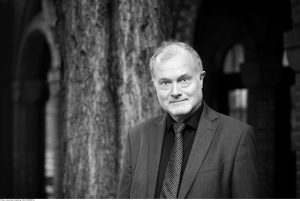
Kåre Nordstoga
Kåre Nordstoga (b. 1954) studied at the Norwegian Academy of Music under Søren Gangfløt, Bjørn Boysen and Kaare Ørnung, among others. Following his debut concert in 1978, he continued his studies under David Sanger in London, and was for a time organist at Ullern Church before coming to Oslo Cathedral in 1984. He has also been associated with the Norwegian Academy of Music, where he was appointed professor in 1994.
As cathedral organist at Oslo Cathedral, Nordstoga frequently performs a large repertoire, which has included two popular concert series with Bach's complete organ works. His recordings include the organ music of Bach, Brahms, Franck, Widor and Liszt, all of Bach's violin sonatas recorded on the cathedral's chancel organ in collaboration with violinist Geir Inge Lotsberg, as well as several recordings of Norwegian organ music. Nordstoga is an active concert organist.
In recent years he has been soloist with the symphony orchestras of Oslo, Bergen and Trondheim, and he has been invited to organ festivals abroad, including Aarhus, Notre Dame in Paris, and the Musashino Cultural Center in Tokyo. In 2006 he was awarded the Lindeman Prize for his active contribution to musical life.
Johann Sebastian Bach
Johann Sebastian Bach was born on 21 March 1685 in Eisenach into an extensive family of musicians. Orphaned by the age of ten, he was raised by his elder brother Johann Christoph in Ohrdruf before receiving a scholarship to the Michaelisschule in Lüneburg in 1700. His first appointment, in 1703, was as a court violinist to Duke Johann Ernst of Saxe-Weimar, but within months he became organist at the Neue Kirche in Arnstadt, composing his first significant organ works and, in 1705, travelling to Lübeck to study with Dietrich Buxtehude. In 1707 he became organist of St Blasius's Church in Mühlhausen and married his cousin Maria Barbara; the following year he entered the service of Duke Wilhelm Ernst in Weimar as court organist, rising to concertmaster in 1714 and building a reputation as an organ virtuoso.
In 1717 Prince Leopold of Anhalt-Köthen appointed him Hofkapellmeister, a productive period that yielded much of his instrumental output, including violin concertos and orchestral suites, though it was also marked by the death of his wife in 1720; he remarried the following year to Anna Magdalena Wilcke. In 1723 Bach was elected Thomaskantor in Leipzig, a post he held for the rest of his life, composing there his great vocal works, including the St John and St Matthew Passions and over two hundred cantatas, until his death on 28 July 1750.