
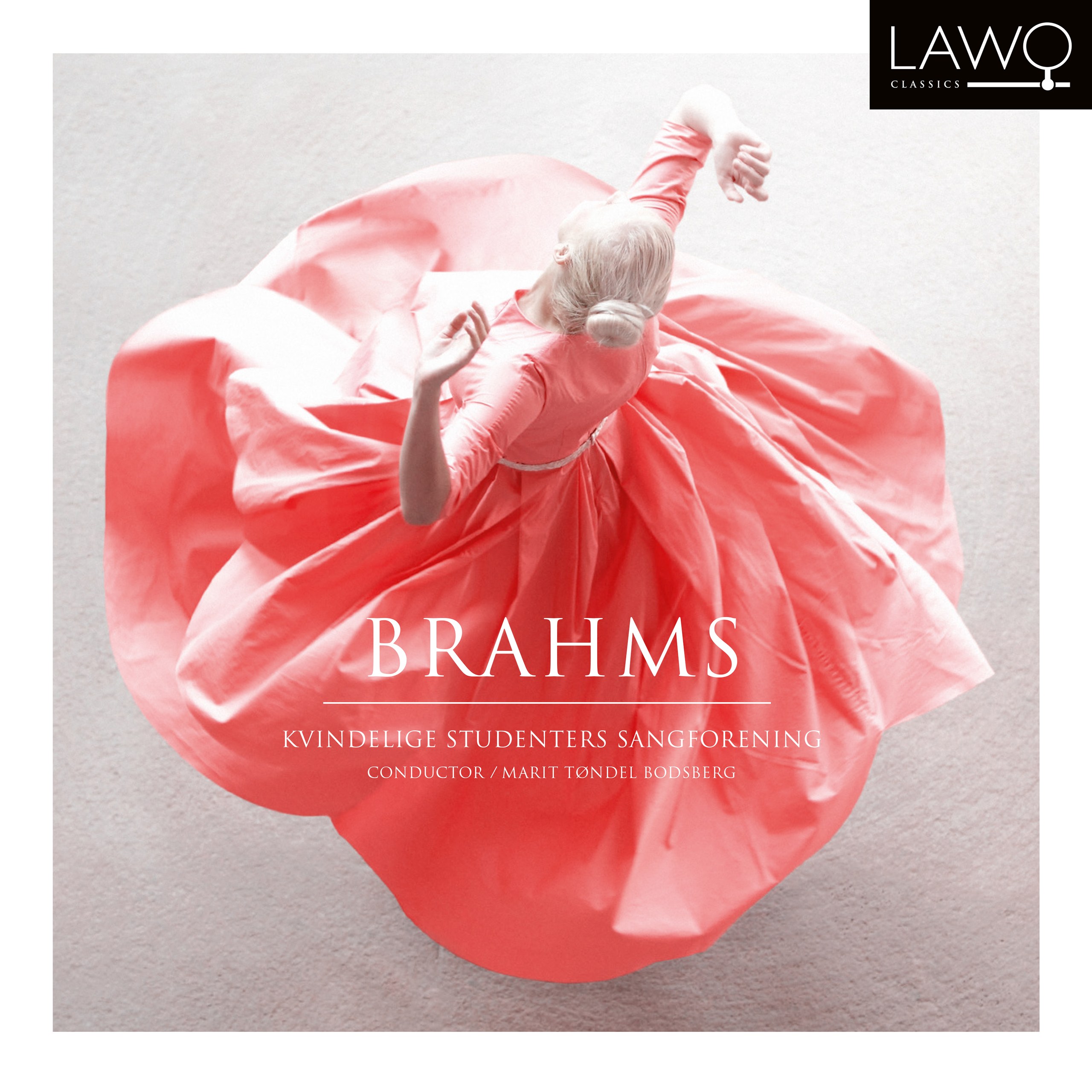
Brahms
Kvindelige Studenters Sangforening (Women's choir) | Marit Tøndel Bodsberg (Conductor) | Marianne Beate Kielland (Mezzo-soprano) | Berit Norbakken (Soprano)
Stream & download
Tracks
Johannes Brahms (1833–1897)
Drei geistliche Chöre, Op. 37 No. 1
Marit Tøndel Bodsberg (conductor) | Kvindelige Studenters Sangforening
Drei geistliche Chöre, Op. 37 No. 2
Marit Tøndel Bodsberg (conductor) | Kvindelige Studenters Sangforening
Drei geistliche Chöre, Op. 37 No. 3
Marit Tøndel Bodsberg (conductor) | Kvindelige Studenters Sangforening | Berit Norbakken | Marianne Beate Kielland
Zwölf Lieder und Romanzen, Op. 44
Marit Tøndel Bodsberg (conductor) | Kvindelige Studenters Sangforening | Sara Aimée Smiseth
Vier Lieder aus dem Jungbrunnen, Op. 44
Marit Tøndel Bodsberg (conductor) | Kvindelige Studenters Sangforening | Sara Aimée Smiseth
Zwölf Lieder und Romanzen, Op. 44
Marit Tøndel Bodsberg (conductor) | Kvindelige Studenters Sangforening | Sara Aimée Smiseth
Vier Gesänge, Op. 17
Marit Tøndel Bodsberg (conductor) | Kvindelige Studenters Sangforening | Bente Rognsaa | Ida Aubert Bang | Inger Besserudhagen
Reviews
The Female Students’ Choral Society (founded in 1895!) deserves credit for having produced a commendable recording of this piece by Brahms.
Show original
Kvindelige Studenters Sangforening (stiftet i 1895!) skal ha ros for å ha gitt en hederlig dokumentasjon av denne siden ved Brahms.
 Stavanger Aftenblad | 21.01.14
Norwegian
It is a delight to hear such a free-sounding soprano group.…
Show more Show less
It is a delight to hear such a free-sounding soprano group. [...] The Female Students’ Choir, the accompanying instrumentalists and the conductor Marit Tøndel Bodsberg can look forward to Christmas with confidence, safe in the knowledge that their latest CD release is a brilliant addition to a repertoire we do not encounter all that often. And with such a rich soundscape, it is all the more welcome.’ Kjell Hillveg – Dagsavisen, 14 December 2013 LWC1054_dagsavisen.pdf
A magnificent choral
experience ‘It’s absolutely brilliant. Lovely arrangements combined with a particularly well-balanced and, to the ear, simply beautiful vocal sound. [...] There can be no doubt that Tøndel Bodsberg is a gifted choir director and possesses enormous artistic capacity. [...] Female students are capable of more than just attending lectures and revising for exams; they can certainly sing their hearts out too.Show original
Det er deilig å høre en så frittklingende soprangruppe. [...] Kvindelige Studenters Sangforening, de medvirkende instrumentalistene og dirigenten Marit Tøndel Bodsberg kan gå jula trygt i møte i forvissning om at deres seneste CD-utgivelse er et begavet tilskudd til et repertoar vi ikke altfor ofte konfronteres med. Og i et lekkert lydbilde, er den derfor desto mer velkommen.» Kjell Hillveg – Dagsavisen, 14.12.13 LWC1054_dagsavisen.pdf
Stor koropplevelse
«Det er knakende godt. Nydelige arrangementer i kombinasjon med en særdeles balansert og for øret rett og slett nydelig vokal klang. [...] Det kan ikke herske tvil om at Tøndel Bodsberg er en begavelse som korleder og besitter enorm kapasitet kunstnerisk. [...] Kvinnelige studenter kan mer enn å gå på forelesning og å lese til eksamen, de kan sannelig også være hjertelig vokale.
 Gudbrandsdølen | 22.01.14
Norwegian
It is rare to come across a CD that is as skilfully and thoughtfully designed as this one.…
Show more Show less
It is rare to come across a CD that is as skilfully and thoughtfully designed as this one. [...] Everything is beautifully sung [...]Show original
Det er sjelden man ser en CD som er så dyktig og omsorgsfullt designet som denne. [...] Alt er vakkert sunget [...]
This recording presents Brahms with a distinctive, Nordic timbre.
Show original
Innspillingen gir Brahms med en kledelig, nordisk klangfarge.
 Bergens tidene | 04.12.13
Norwegian
The choir has received well-deserved attention in recent years, and this recording of Brahms songs is a sonic delight, with a flexible and engaging rhythm in the performance.…
Show more Show less
The choir has received well-deserved attention in recent years, and this recording of Brahms songs is a sonic delight, with a flexible and engaging rhythm in the performance. A beautiful and important insight into a rarely performed repertoire.Show original
Koret har fått fortjent oppmerksomhet de siste årene, og platen med Brahms-sanger er en klanglig nytelse med fleksibel og engasjerende puls i fremføringen. Et vakkert og viktig glimt inn i et sjelden fremført repertoar.
 Vårt Land | 03.12.13
Norwegian
Credits
- Conductor
- Marit Tøndel Bodsberg
- Performer
- Kvindelige Studenters Sangforening | Berit Norbakken (Soprano) | Marianne Beate Kielland (Mezzo-soprano) | Sara Aimée Smiseth (Piano) | Ida Aubert Bang (Harp) | Inger Besserudhagen (Horn) | Bente Rognsaa (Horn) | Inger-Lise Ulsrud (Organ)
- Women's choir
- Kvindelige Studenters Sangforening
- Composer
- Johannes Brahms
- Producer
- Vegard Landaas
- Engineer
- Thomas Wolden
- Editing
- Vegard Landaas
- Mastering
- Thomas Wolden
- Liner notes
- Torkil Baden | Sara Aimée Smiseth
- English translation
- Jim Skurdall
- Executive producer
- Vegard Landaas
- Booklet editor
- Hege Wolleng
- Cover photo
- Anna-Julia Granberg
- Artist photo
- Kvindelige Studenters Sangforening by Anna-Julia Granberg
- Design
- Anna-Julia Granberg | Blunderbuss
- Recording location
- Sofienberg Church, Oslo | Uranienborg Church, Oslo
- Recording country
- Norway
- Recording year
- 2012–2013
- Recording dates
- 19.10.2012 | 20.10.2012 | 21.10.2012 | 07.02.2013 | 08.02.2013 | 09.02.2013
- Original source
- 96 kHz, 24 bit
- Discs / tracks
- 1 disc | 21 tracks
- Release year
- 2013
- Label
- LAWO Classics
- Duration
- 51:12
- EAN
- 7090020180557
- ISRC
- NOEHX1314010/210
Booklet text
Brahms and Women
That Johannes Brahms (1833–1897) had a complicated relationship with the opposite sex would not occur to someone listening to 'Ave Maria', his homage to the most exalted of all women. Brahms's very first choral song was for women's chorus, and it exudes a sense of harmony and spiritual excitement. His own relationship with women often ended with the initial physical excitement.
He grew up in the poor quarter of Hamburg, where his father played double bass in the opera orchestra, and for entertainment. Young Johannes was well-acquainted with the seamier side of life in Hamburg's harbour district.
Brahms debuted as a child prodigy pianist at age fifteen. He met the Schumann family for the first time while on a concert tour as a twenty-year-old. His love for Clara Schumann grew in correlation with her husband's increasing symptoms of mental illness. Johannes proposed marriage after Schumann's death, but was rejected. Clara was fourteen years his senior and the mother of seven children.
This did not extinguish the ardent feelings they felt for one another. In a letter many years later, Johannes called Clara 'an angel'. When Clara died in 1896, one year before Johannes, he immediately left for Bonn to attend her funeral.
Johannes Brahms bestowed his circumscribed affections on many others, not least prostitutes, and he never married.
While he lived in Hamburg, up until 1862, he conducted a number of choruses, the most important being the Hamburger Frauenchor with forty singers. The choruses became his workshop for composing, alongside his studies of the scores of early masters such as Palestrina and Schütz.
Choral music remained important for Brahms after his years in Hamburg. When he moved to Vienna in 1862, he did so to assume his appointment as conductor of the Wiener Singakademie, the chorus of Vienna's concert hall.
This CD shows that Brahms often chose church-related texts, both biblical and liturgical. Was it only because this musically important genre ensured that his works would be performed? What did Brahms think of these texts, he who composed one of most moving requiems ever written ('Ein deutsches Requiem') with his very personal selection of biblical texts?
He has been called a 'biblicist heretic'. The devout Dvořák visited Brahms on his deathbed and said: 'Such a great soul, and still he believes in nothing.'
It is a paradox in any case that Brahms was, at the same time, so familiar with church tradition. He used his Children's Bible all his life and set religious texts to music with exceptional sensitivity.
In his very last compositions he continues the legacy of Johann Sebastian Bach and the German hymn tradition. Brahms's final opus is 'Choralvorspiele' ('Chorale Preludes'), with chorales that are at the centre of the worship service. It concludes with the melancholy 'O Welt ich muss dich lassen' ('O World, I Must Leave Thee').
Most of the works on this album were composed by the young Brahms for his Hamburg chorus, for example, the first two Latin motets in 'Drei geistliche Chöre' ('Three Sacred Choruses'). They are composed for four-part women's chorus and were premiered by the Hamburger Frauenchor in St. Peter's Church in Hamburg in September, 1859, with the composer conducting.
The second motet with its fugal style serves as a contrast to the pure mellifluence of the first. The last is a homage to Mary as Queen of Heaven, and its origin is more difficult to trace with its old Venetian antiphony. Here master Schütz lurks in the background. All three were printed in a pamphlet in 1865 and published in the music metropolis of Leipzig.
The 'Mary' theme of this album continues with 'Ave Maria' from 1858. The classic liturgical text is based on the homage to the Virgin Mary found in the first chapter of the Gospel of Luke.
'Psalm XIII' is the text of David's Psalm 13, whose despairing lament invites great dramatic tension. Brahms's three-part arrangement is from 1859. The gravity of the psalm points toward the much later motets, for example, 'Warum ist das Licht gegeben dem Mühseligen' ('Wherefore is Light Given to Him That is in Misery') for mixed chorus.
The twelve songs in Opus 44 (1859) are a charming contrast to the ecclesiastical seriousness of the other works from the Hamburg years. Here the themes are love and nature, and the elegant arrangements, each a small gem, range from strophic folk song to a more through-composed form. Thus, number 3 (and to some extent number 4) are folk poetry, while the others bear the names of well-known authors of the time.
Love is often a sad affair, largely yearning and disappointment. Did the twenty-six-year-old composer perhaps recognize himself…?
In 1860 Brahms composed 'Vier Gesänge' ('Four Songs') for his women's chorus in Hamburg. The harp accompaniment sounds forth naturally in the first of the four songs, 'Es tönt ein voller Harfenklang' ('A Full Harp Sound Rings'), describing how love and yearning swell in the heart. The use of the horn further accentuates the Romantic idyll of nature.
The second song is one of the few times Brahms set Shakespeare to music, here from the second act of 'Twelfth Night'. The original title is 'Come away, come away, death' and is sung by the luckless Feste. He longs for death and the grave because a cruel maid does not reciprocate his love.
The third song, 'The Gardener', typically tells not of working in the garden, but of unrequited love. He digs not only in flowerbeds; he is digging his own grave!
The fourth song draws on Ireland's Homer, Ossian, and Ossian's poem of Fingal, which also meant a lot to the Norwegian poet, Henrik Wergeland. Brahms composed music for a lament, a powerful funeral march for the fallen hero, Trenar. In this last song, the roles are reversed: it is the woman who mourns the lost love.
— Torkil Baden
The Women's Choral Society of the University of Oslo
Today there are female choirs in almost every nook and cranny of the country, and it seems long ago that Norwegian choral singing was dominated by male choruses. Toward the end of that time, only eleven years after Norwegian women were given access to higher education, three medical students met to found a university choir for women only. The year was 1895, and Kvindelige Studenters Sangforening (KSS) was a reality.
KSS has never striven to be a political choir, yet its founding had a political impact nonetheless. On the road to women's suffrage and equal rights for women, KSS became a noteworthy link in the process — the world's first academic female choir.
KSS has existed for well over one hundred years as a vibrant and influential choral group, and from the outset it has played a prominent role in the musical life of the university and the entire city. Notable examples have been the centennial celebration of Norwegian independence in 1914; the funeral of Fridtjof Nansen in 1930; King Olaf's radio address on Constitution Day 1945; the opening ceremonies of the 1952 Winter Olympics; and the celebration of the centennial of women's suffrage in Norway in 2013.
An important part of KSS's activities have always been its concert tours abroad, one of the highlights being a three-month tour of the USA. The warm reception it was given can be found in one of the many concert reviews: 'It is the best choral singing we have heard, and we don't expect to hear anything better, this side of heaven'. Traveling abroad means raising the standard, musically and socially, and KSS has returned home on numerous occasions with prizes from international competitions. For long periods of time KSS has remained Norway's leading female choir.
The continual high level of activity, then as today, requires committed singers. They do all the organizational work themselves, and their accomplishments are impressive. KSS is not only a hobby, it is a life style. For some it has been their life, and certain individuals, among them Kristine Bonnevie, Norway's first female professor, have served on the board for a decade, even two.
Today, the choir as an organization consists of a board of directors and five permanent committees, in addition to ad hoc committees for tours, CD projects, etc. This means that a large proportion of the membership is engaged at all times in planning the activities of the choir at a number of levels. The members involve themselves beyond regular rehearsals in the planning and decision-making process. What does this give a choir? Primarily two things: Dedicated singers, and a congenial social environment — elements whose importance in making good music cannot be underestimated.
Good music in KSS often has meant Norwegian music. When performing abroad, the choir naturally likes to promote choral music from its homeland. And although the repertoire has varied with the different conductors, there has been a clear thread: A predominance of Norwegian composers. The prevalence of arrangements for male chorus early on has given way to an ever-increasing list of works composed for female choir. A number of composers have dedicated pieces to KSS, and the choir has regularly commissioned works. Among the composers who have written for the choir are Geirr Tveitt, Knut Nystedt, and Ludvig Irgens-Jensen. In the course of almost 120 years, KSS has contributed significantly to the expansion of the repertoire for female choir.
Norwegian composers have always featured prominently in concert programmes of KSS, but names such as Mendelssohn, Gade, Britten, Bartók, Kodály, Poulenc, Debussy, and Stravinsky can be found as well. Johannes Brahms, on the other hand, is conspicuous by his absence. Yet, oddly enough, Brahms played an important role during two periods of the choir's history: In the early decades, while led by Olaus Andreas Grøndahl and Per Winge, and in recent years, especially under the leadership of Britt Karin Wetteland, and the present conductor, Marit Tøndel Bodsberg. In that respect, the new album represents a return to the repertoire that played an important role for the choir at the beginning of the last century. Based on records kept by the choir, Brahms's opus 44 has been sung by KSS on two occasions: For an anniversary concert in the University Great Hall in 1920, and for this CD recording in 2013 — a span of almost 100 years.
Brahms has been reintroduced into the repertoire only in recent years, but in this brief time KSS has succeeded in developing a musical understanding of these works for female choir. For the past several years, a number of the works on this album have been part of the choir's concerts and other performances. And KSS has achieved a sound that distinguishes itself from that of existing recordings of the same works. When Anne Karin Sundal took over as conductor in 2004, the choir began a journey that has led to its readily identifiable clear, Nordic, non-vibrato sound.
This CD is part of the LAWO Classics collection of new recordings of Brahms. KSS has had the pleasure of collaborating with a group of very accomplished female musicians. Some have accompanied the choir in the past; with others, it is a first-time collaboration. This is the choir's second recording for LAWO Classics — the first, 'Arme jord ha jolefred' (2009), was picked as the Christmas CD of the year by a number of Norwegian newspapers.
Marit Tøndel Bodsberg (b. 1981), choral director since 2008, conducts all the works on this album. She has a Bachelor's degree in flute performance from the University of Agder. In 2005 she was accepted to pursue a Master's degree in flute at the same institution. At the same time, she was admitted as the only student to a Master's programme in conducting at the Norwegian Academy of Music, where she concluded her studies in the spring of 2008. During these years, she also served as assistant to Grete Pedersen of the Norwegian Soloists' Choir.
Marit has worked with a number of Norway's leading choirs and ensembles, among them, the Norwegian Soloists' Choir, Gjøvik Sinfonietta, and the chamber choir of the Norwegian Academy of Music. In addition to serving as artistic director and conductor of Kvindelige Studenters Sangforening, she is choirmaster of Ringsaker Opera and artistic director and conductor of Vestoppland Chamber Choir.
In 2010 Marit Tøndel Bodsberg was honoured with the Knight, First Class, by Kvindelige Studenters Sangforening's chapter, Bene de Cantu Meritae, for her professional accomplishments and for the choir's musical development under her resolute leadership. In the autumn of 2012, she was awarded the Conductor's Prize at Norway's national choral competition. KSS has achieved a number of victories and high placings in national and international competitions under Marit's guidance.
Kvindelige Studenters Sangforening's first recording presented Norwegian folk tunes in a Christmas setting, while this album features sacred classical music — a wide span perhaps, yet representative of the range of music comprising the KSS repertoire. Works for female choir by Brahms are not often performed in a Norwegian context, and this CD can help perhaps to put the repertoire on the map here at home. In addition, this recording can be a contribution to presenting Brahms's vocal music in a more Scandinavian timbre.
— Sara Aimée Smiseth
(English translation: Jim Skurdall)