
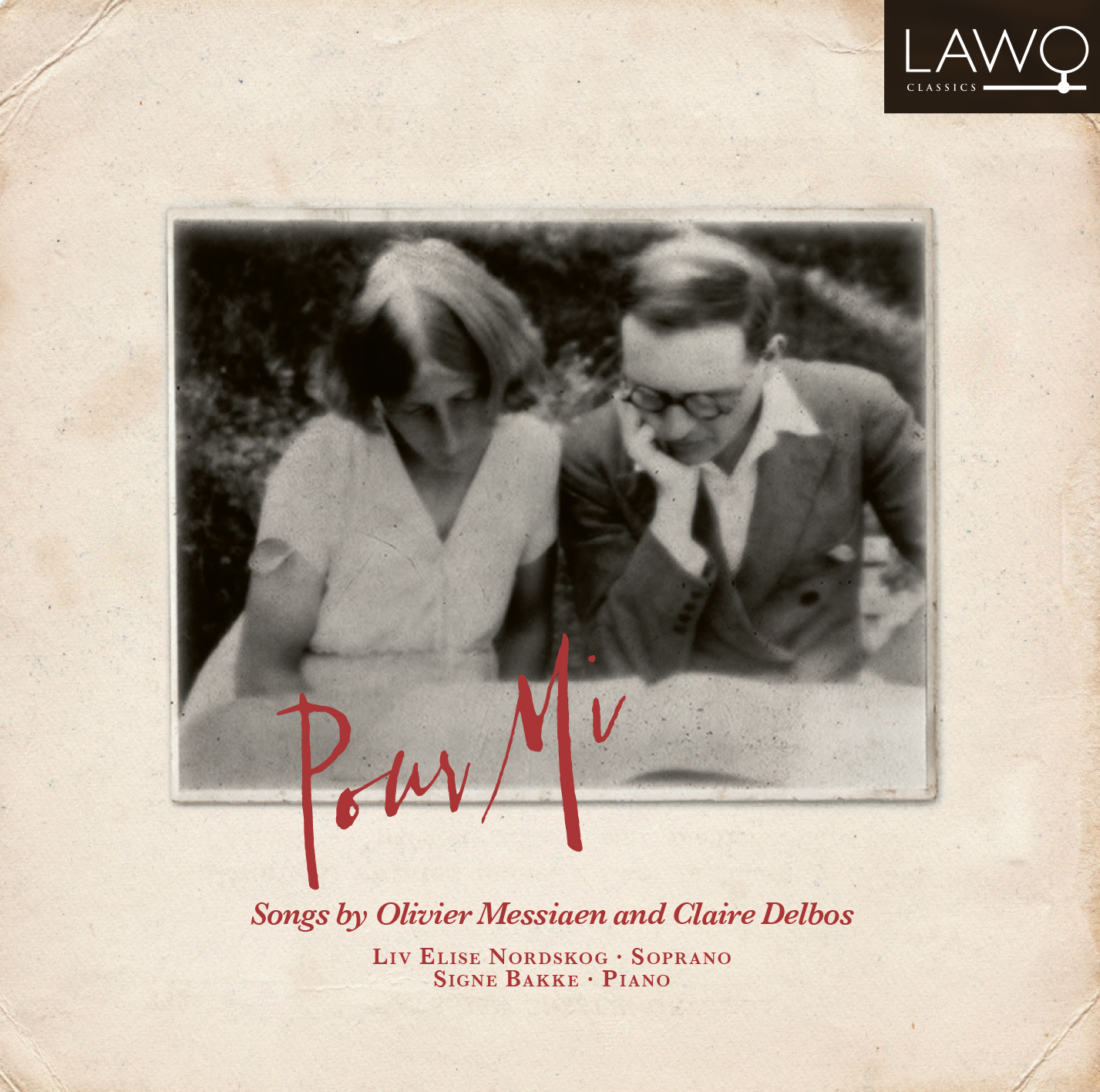
Olivier Messiaen | Claire Delbos
Pour Mi – Songs by Olivier Messiaen and Claire Delbos
Liv Elise Nordskog (Soprano) | Signe Bakke (Piano)
POUR MI – TO MI
Who was ”Mi”, she who inspired Messiaen to write the lovely and intricate work Poèmes pour Mi? This was one of the questions Liv Elise Nordskog and Signe Bakke asked when they began work on this album, after having immersed themselves in Messiaen’s rich and diverse tonal world for many years.
The poet Cécile Sauvage was Messiaen’s mother. Her cycle of poems dating from 1908, L’Âme en Bourgeon (The Soul in Bud) was written while she was awaiting the birth of her son. Almost thirty years later, Olivier Messiaen and his wife, violinist and composer Claire Delbos, were themselves expecting a child. During this time, Delbos set to music the poem cycle of her deceased mother-in-law. At the same time, Messiaen composed a song cycle entitled “Poèmes pour Mi”. Mi was his pet-name for his wife Claire.
L’Âme en Bourgeon and Poèmes pour Mi were premiered at the same concert in Paris in 1937. It is the only time the two works are known to have been performed together — until the recording of this CD.
Listen
Tracks
Olivier Messiaen (1908–1992)
Claire Delbos (1906–1959)
Credits
- Performer
- Liv Elise Nordskog (Soprano) | Signe Bakke (Piano)
- Composer
- Olivier Messiaen | Claire Delbos
- Producer
- Vegard Landaas
- Engineer
- Thomas Wolden
- Editing
- Vegard Landaas
- Mastering
- Thomas Wolden
- Piano tuner
- Eric Shandall
- Liner notes
- Hild Borchgrevink
- English translation
- Jim Skurdall
- Executive producer
- Vegard Landaas
- Booklet editor
- Hege Wolleng
- Cover photo
- Archives Yvonne Loriod | ACDA
- Artist photo
- Liv Elise Nordskog by Trygve Schønfelder | Signe Bakke by Tore Hegdahl
- Design
- Anette L’orange | Blunderbuss
- Recording location
- Sofienberg Church, Oslo
- Recording country
- Norway
- Recording year
- 2012
- Recording dates
- 22.02.2012 | 23.02.2012 | 24.02.2012 | 25.02.2012
- Original source
- 44.1 kHz, 16 bit
- Discs / tracks
- 1 disc | 20 tracks
- Produced with support from
- University of Bergen | Municipality Of Bergen | Creo – The Union for Arts and Culture
- Release year
- 2013
- Label
- LAWO Classics
- Duration
- 51:34
- EAN
- 7090020180526
- ISRC
- NOEHX1311010/200
Booklet text
To try to understand music in the light of composers' lives may seem speculative. Then again, two of the song cycles on this recording are interconnected in ways that might make it seem unnatural not to do so.
The poet Cécile Sauvage (1883–1927) was composer Olivier Messiaen's mother. Her cycle of poems dating from 1908, «L'Âme en Bourgeon», explores the experience of giving birth. It was written while she was awaiting the birth of her son who was to become an important name in twentieth-century classical music.
Almost thirty years later, Olivier Messiaen and his wife, violinist and composer Claire Delbos, were themselves expecting a child. During this time, Delbos set to music the poem cycle of her deceased mother-in-law. At the same time, Messiaen composed a song cycle entitled «Poèmes pour Mi», for which he wrote both words and music. Mi was his pet-name for his wife Claire.
These two works for voice and piano, «L'Âme en Bourgeon» and «Poèmes pour Mi», were premiered at the same concert in Paris in 1937 as part of Concerts de la Spirale, a concert series that Delbos and Messiaen had established together with other composers. The singer was the dramatic soprano Marcelle Bunlet, with Messiaen himself at the piano. Since then, the two works are not known to have been performed together. Bringing them together again has been an important incentive for making this recording.
The third composition on this album is «Trois Mélodies», a song cycle written by Messiaen as early as 1930, before he took over as organist of the Sainte Trinité church in Paris, and, perhaps, before he met Claire Delbos, whom he married in 1932.
In «Trois Mélodies» Messiaen sets to music his mother's poem «Le sourire» («The Smile»), enclosing it between two of his own texts. Many musical features that will return in «Poèmes pour Mi» are sketched in this early work. «Pourquoi?» («Why?») begins with ascending open octaves, in the way natural resonance later becomes the basis of much of Messiaen's harmonic structure. The piano alternates between following the vocal line closely and commenting on it briefly, like a concentrated psalmody. In the centre of the little triptych is Sauvage's poem about two faces that meet. In contrast to the outpouring in the opening song, it is subdued, and sustained by carefully chosen chords. In the last piece, the poet grieves for his lost betrothed, on top of agitated, erratic runs on the piano, until the song, like in the outer movements of «Poèmes…», leads into an ardent prayer. All along, the melodies appear distinctively modal.
Claire Delbos studied violin and composition at the Schola Cantorum in Paris with, among others, Vincent D'Indy. She managed to write three vocal works, four works for organ, and a biblical hymn, before she was stricken with a mental illness, which, if her biographers are to be believed, led to a loss of memory. The illness afflicted her gradually and worsened around 1949. After entering a sanatorium some years later, no more music came from her pen.
«L'Âme en Bourgeon» is thus an important work in Delbos's limited oeuvre. The eight songs based on poems of Cécile Sauvage are freely fashioned, both in harmony and rhythm. The metre closely follows the syllables of the text in a manner reminiscent of Messiaen's rhythmic structures from the same period. The tonality is free and often based on tritones. The couple are said to have discussed their work ardently, and the two cycles do share a number of features, even though Delbos worked more associatively and without the underlying system of scales found in Messiaen's music.
But Delbos also makes distinct structural choices. In the opening poem «Dors» («Sleep»), the song and accompaniment are woven together organically in a tranquil, triad-based movement. In the closing poem, on the other hand, the voice and piano are completely separate as two isolated solo parts just barely connected by a brief, unstable tritone interval. The third and seventh song both close with long solo parts, the former in the voice, the latter in the piano. The composer may have imagined the relationship between soloist and instrument as an image of how the narrator and her child, in the course of the cycle's eight movements, go from being one and the same body to becoming two distinct individuals. On a number of later occasions, the piano seems to represent the living child.
In «Sleep», the voice barely moves, as though tiptoeing about, not wanting to waken the sleeping child. The poem's lines are sung on two different pitches only, the voice following the syllables of the text. During this simple recitative, an organic pulse is suggested by repeated arched progressions on the piano. The song closes on a major chord with an additional note, a chord structure that often appears in Messiaen's music. Here it sounds almost incompatibly balanced, considering that the poem's last line speaks of how the child's heart will tremble when it senses death.
The next song contains the text's title motif – the new soul as a bud about to blossom. The child is now compared to a baby bird carefully pecking on the inside of the egg. At the same time, the adult reminisces on her own childhood. The metre remains close to the text, but the piano dances nimbly with bright, open harmonies in sharp key signatures to words about spring and the ringing of lilies of the valley. Central pitches are continually altered, making the music tumble around in a space somewhat like a kaleidoscope.
In the third song, a diminished interval in the piano and voice introduces a feeling of doubt contradicting the text's affirmative «I am here, I am smiling». The mother wishes to tell her child of a world that holds both laughter and pain. The movement ends with four lines of unaccompanied voice.
This is the last time in the poem cycle that the narrator is alone; for when the fourth song opens, the child has been born. The mother feels emptiness and likens her body to a silent beehive which a buzzing swarm of bees has just abandoned. The first part of the poem has an ABA-form, rendered in the music by a change of key. In the section that follows, the mother reflects on her inadequacy as a parent. No matter what I do, she says, I can only offer you a reflection of the world. And when the child opens its eyes, there is a marked change of tempo in the music, as if suddenly another personality has joined the conversation.
A similar sense of loneliness appears in the sixth song, in which the woman describes her empty blood – the chromatic lament of the vocal line ambivalently moving through a bright major key harmonic landscape.
The second and seventh songs are related in a different way. Both express harmony and dialogue between mother and child, before and after the birth, respectively. The spring mood of «Mon coeur...» («My Heart...») may point towards the dancing piano picking up notes from the vocal line in «Te voilà…» («There You Are...»), as well as the word-painting sequence in the same song, in which mother and child watch the sunlight dance. A long, independent piano part brings the seventh song to an end.
Taken together, these tonal and textual symmetries give the cycle as a whole an arched form. As mentioned earlier, the last song consists of two independent solo parts, first in the voice, then the piano, only briefly connected by a simple, diminished interval. In this poem, the narrator asks if she has succeeded as mother in leading the child out of darkness. The answer is as ambiguous as the diminished intervals in the music. The child must find its own way in the world.
Olivier Messiaen's song cycle «Poèmes pour Mi» pays homage to marriage as a sacrament and a bridge between human and divine love, in keeping with his Catholic faith.
The cycle consists of nine poems organized in a pyramid structure, in which four poems are placed on either side of a central text – the poem «L'Épouse» («The Wife»). Using a familiar Biblical allegory, Messiaen compares the marriage bond between man and woman to the relationship between Christ and the Church.
Olivier Messiaen wrote the texts of «Poèmes pour Mi» himself, as he did for most of his other vocal works. From a theological perspective, this may come as a surprise to some. But the foundation of Messiaen's theological and aesthetic project was to integrate the human and the divine into a whole. He reasoned that if God is the cause of everything, then God must also embrace opposites: love poems and liturgical texts; Eastern and Western music traditions; natural sounds and abstract music; and, not least, marital and divine love. According to biographer Christopher Dingle, there was for Messiaen no boundary between the sacred and the secular.
The outer movements of the cycle, «Action de Grâce» («Act of Grace») and «Prière exaucée» («An Answered Prayer»), both end in supplication, to God and Christ, respectively. The first poem is built around reflections – clouds mirror in the water, and two persons follow one another as wave follows wave. Olivier Messiaen was a synaesthete; he saw concrete colours when he heard music, and he described the chords in «Prière...» as blue-violet, red-brown, orange, white, and gold-coloured. Musically, the passages in these two songs are inspired by psalmody: the singer declaims the words syllable by syllable around a central tone without accompaniment, and the piano answers with cascades of colours.
By constructing scales that return to the point of departure more often than chromatic scales do, Messiaen achieves a cyclical effect that curbs a sense of time. Key words, such as lumière (light) and étoile (star) in the first song, and âme (soul) or joie (joy) in the last, are wreathed in long vocal embellishments heard also in liturgical singing. «L'Action de Grâce» ends with a similar swelling hallelujah. In «Prière exaucée» the recitations open with forceful individual chords on the piano, which subsequently colour the phrases, while their sound dies out. And, toward the end, the music renders the text's metaphor of a heart ringing like a bell.
The score of «Poèmes pour Mi» has no fixed metre. As in liturgy, the syllables govern the rhythm. This taut relationship between word and music was to influence Messiaen's later rhythmic systems as well: His rhythms, rather than being subdivisions of a fixed basic pulse, are built up additively and grow out of a lowest common multiple, a kind of rhythmic chromaticism. This technique also helps check a conventional feeling of forward musical motion. Indian ragas, which Messiaen studied at the conservatory, are constructed in a similar manner.
The next step toward the centre of the cycle, the second and the eighth song, are examples of contrasts that Messiaen sought to reconcile: The worlds of nature and human beings. Both are characterized as jewellery. The second poem bears the title «Paysage» («Landscape»). A sea reflecting the heavens is likened to a large blue gem. The song opens with a tritone, repeated in turn by piano and voice. The eighth poem compares the wife's embrace to a rainbow and a necklace. It, however, hints at a paradox: The bracelet could also become a chain. Both the vocal line and the accompaniment move in arch-like structures, and the piano follows the voice closely. When the text describes a pearl necklace, the rhythm tightens, and the word cocasse, referring to uneven pearls, is embellished.
The third and seventh poems, «La Maison» («The House») and «Les deux guerriers» («The Two Warriors»), speak of the body as transitory and earthly existence as warfare. The body is compared to a house which the two souls know they one day will abandon. The two warriors march through a landscape that is toxic and shrill, but they do it together, in the certainty that truth, redemption, and a pure and sinless body await them at their destination. The gaze is the poetic image binding the two poems together. In the first, the narrator sees the pain in his partner's eyes. In the second, the two warriors march shoulder to shoulder, «eye by eye». The dynamics of the march of war are dramatic and expressive, in both vocal and piano part.
In the fourth and sixth poems, an inferno-like setting is juxtaposed against salvation and eternity. The text of «Épouvante» («Fear») opens with disquieting laughter and lines evoking a sense of nausea and the power of the flames. Conversely, the poem «Ta voix» («Your Voice») contrasts an everyday portrait of a woman with a prophecy that she will become an incorporeal angel. If the window «opened onto eternity», Messiaen writes, «I would see you, lovelier still.»
These poems have been criticized for devaluing women, love, and life as such. Yet if one takes as a point of departure a poet-narrator who believes in redemption and eternal life for his spouse and for himself, something that requires a little practice in our secularized age, then it goes without saying that eternity is superior to earthly existence.
Both «L'Âme en Bourgeon» and «Poèmes pour Mi» were completed before the apparent serious deterioration of Claire Delbos's health. In other words, the music of Delbos deserves to be understood independently of the illness she suffered. In the case of «Poèmes pour Mi», however, Olivier Messiaen's sense of obligation in the face of his wife's tragedy may perhaps help illuminate the uncompromising matter-of-factness with which the same man wrote poems that prioritize eternity over the present. From the time Claire became ill and apparently lost her memory, more than ten years passed before Messiaen moved her from their home. During this time, he met the woman he would later wed, pianist Yvonne Loriod. Messiaen wrote two large piano works for Loriod, one of them «Visions de L'Amen» for two pianos from 1943, which they played together. Claire Delbos died in 1959. In an obituary written for Yvonne Loriod in 2010, a British newspaper quoted her as saying «We wept for 20 years, before […] we finally could marry.» To break out of a marriage, formally or informally, was out of the question in Messiaen's religious universe.
In «L'Épouse» («The Wife»), the fifth and central poem of «Poèmes pour Mi», Messiaen juxtaposes marriage with the Church's relationship to Christ. In marriage, couples meet their spouses and their God. In the words of the poem, nothing can separate what God has joined together.
That Messiaen urges to unite the sacred and the profane does not mean, however, that his universe is free of conflict. On the contrary, it is where opposites collide that we find mysteries. Catholic tradition counts a large number of Biblical mysteries. For Messiaen, the greatest mystery is Christ, the incarnation. Following Messiaen's will to unite the spiritual and the earthly, another mystery to him is nature, which, in its deepest sense, conceals something that cannot be known to man.
The idea of mystery also found its way into Messiaen's composition techniques. The systems he created were often intended to introduce slight disruptions and shifts into otherwise predictable and established musical principles. It could be the prolongation of a rhythm that disturbs the symmetry, as, for example, on the word bijou (piece of jewellery) in the second song. Or it could be adding notes to traditional, stable major triads, such as the sixth chords constituting the long hallelujah at the end of the first poem.
Messiaen himself called this principle «le charme des impossibilités», implying something in the direction of «the allure of the impossible». It involves creating rhythmic and tonal limitations that conceal what is obvious and transparent and enable us to draw nearer to an experience of mystery.
— Notes: Hild Borchgrevink · English translation: Jim Skurdall
Biographies
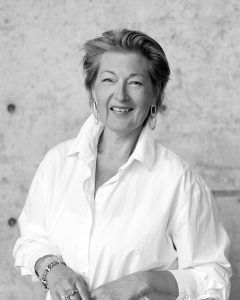
Liv Elise Nordskog
Liv Elise Nordskog obtained her master's at the Grieg Academy, University of Bergen, majoring in Richard Strauss's lieder. She has been a soloist with the Bergen Philharmonic Orchestra on numerous occasions, as well as with the Pori Sinfonietta in Finland and the musicians from the BIT20 Ensemble. In 2012 she sang with the Ottawa Brock Consort in Ottawa, Canada.
She has performed the Wesendonck songs by R. Wagner with various ensembles, as well as works by several other composers including Pergolesi, Andriessen and Crumb. She also has a keen interest in songs from the 20th century.
In addition to her achievements as a vocalist, Liv Elise Nordskog has been employed as a violinist in the Bergen Philharmonic Orchestra since 1987.
Signe Bakke
Signe Bakke is Professor of Piano and Accompaniment at the Grieg Academy, University of Bergen, where she has been employed since 1992. She gave her debut concert in 1981, and since then she has been active as a soloist, chamber musician and accompanist. She has been closely affiliated with the Edvard Grieg Museum — Troldhaugen in Bergen, where she has regularly given concerts for over twenty years.
Bakke has had engagements at the Bergen International Festival and has been featured at the Ultima — Oslo Contemporary Music Festival as well as many other festivals abroad. Bakke has collaborated with many composers and her premiere performances include works by Ketil Hvoslef, Morten Eide Pedersen, and the Japanese composer Karen Tanaka. The recording Crystalline — Piano Works by Karen Tanaka (2L, 2011) received excellent reviews internationally.
Bakke has also recorded several CDs featuring the works of Edvard Grieg. In 2021 she was honored together with James Clapperton, BIT-ensemble, René Wiik and Craig Farr, winning the Spellemannpris (The Norwegian Grammy Awards) in the category of contemporary music for the recording Soccorsi, featuring the music of the Norwegian composer Morten Eide Pedersen (1958–2014).