
Frédéric Chopin
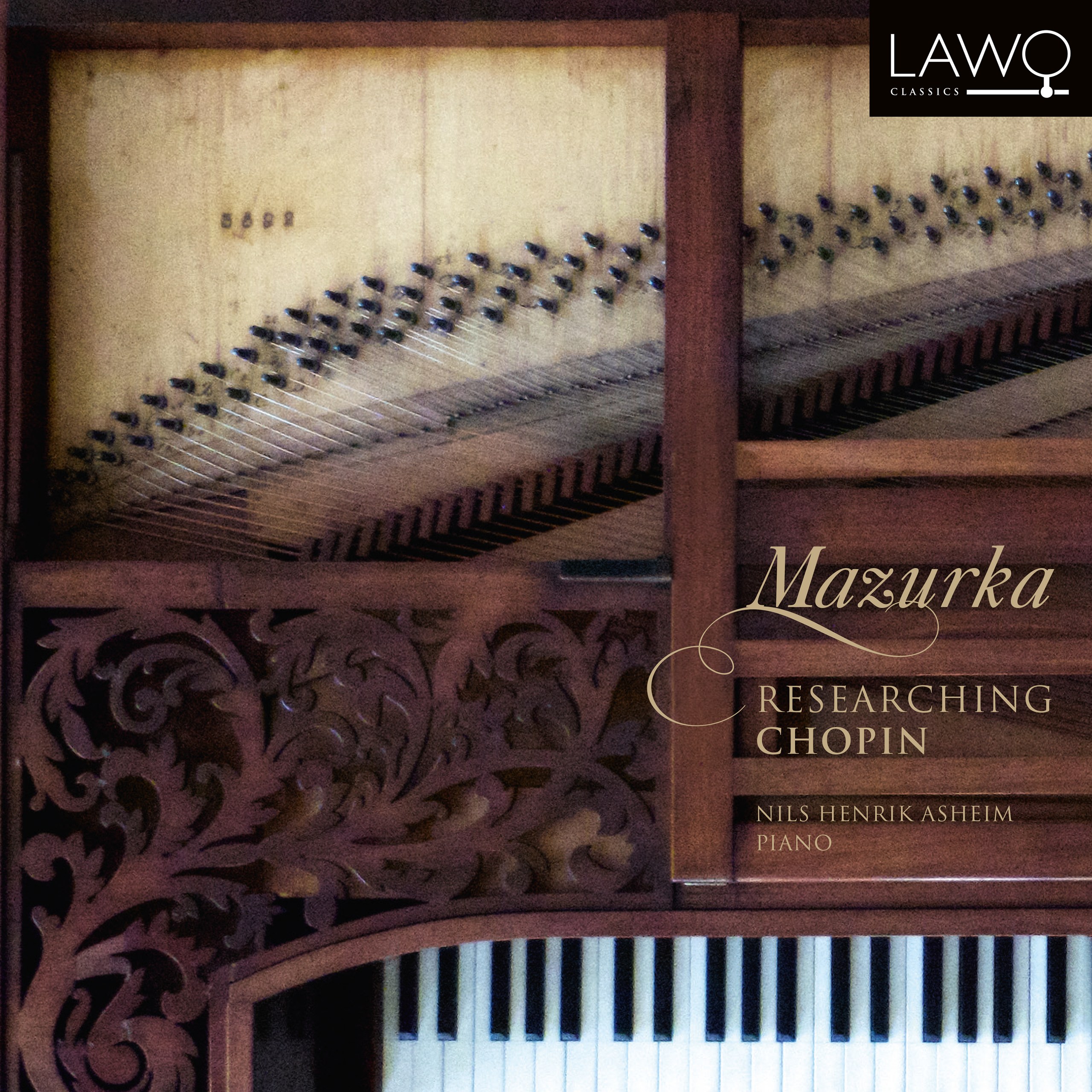
Mazurka – Researching Chopin
Stream & download
Tracks
Frédéric Chopin (1810–1849)
Mazurka, Op. 6
Mazurka, Op. 7
Mazurka, Op. 17
Mazurka, Op. 24
Mazurka, Op. 30
Mazurka, Op. 33
Mazurka, Op. 56
Mazurka, Op. 59
Mazurka, Op. 63
Mazurka, Op. 67
Mazurka, Op. 68
Reviews
Norwegian pianist Nils Henrik Asheim has been engaged in an ongoing — and maybe slightly mystical — search for the essence of Chopin’s piano music, focusing on his mazurkas.…
Show more Show less
Norwegian pianist Nils Henrik Asheim has been engaged in an ongoing — and maybe slightly mystical — search for the essence of Chopin’s piano music, focusing on his mazurkas. As a follow-up to his previous effort along these lines (Mazurka: Remaking Chopin, which found him creating new versions of the pieces) he has taken a new tack, this time interpreting them more strictly but using a period instrument: a 1830s Collard & Collard square piano. As is often the case with performances using period instruments, the unique sound of this one sheds new light on the sound and shape of Chopin’s music, and the recording is both historically interesting and aesthetically delightful. Highly recommended to all classical collections.
With every new turn, every masurka, different patterns came into view, with different elements magnified.
Show original
For hver nye dreining, hver masurka, kom ulike mønstre til syne, med ulike elementer forstørret.
 Aftenposten
Norwegian
Nils Henrik Asheim chooses a superb, characterful piano from the 1830s for his hour of Chopin mazurkas.…
Show more Show less
Nils Henrik Asheim chooses a superb, characterful piano from the 1830s for his hour of Chopin mazurkas. He also, happily, chooses many of my favourite pieces, creating a good, very worthwhile recital.
Asheim’s interpretations possess the free, improvisational drive and the declamatory gestures we expect from the music, but we also hear the resistance of the material, the effort…
Show more Show less
Asheim’s interpretations possess the free, improvisational drive and the declamatory gestures we expect from the music, but we also hear the resistance of the material, the effort required to make the old instrument obey and produce sound. There is something very physical about these interpretations, a sonic immediacy. And a poignant melancholy.Show original
Asheims tolkninger har det frie, improvisatoriske drivet og den deklamatoriske gestikken vi forventer av musikken, men vi hører også materialets motstand, anstrengelsene som må til for å få det gamle instrumentet til å lystre og gi lyd. Det er noe veldig fysisk over disse tolkningene, et klanglig nærvær. Og en sår melankoli.
 Bergens Tidene
Norwegian
In fact, this recording blows the dust off 200 years of ‘tradition’, and you hear the music as if for the very first time.
Show original
Faktisk blåser denne innspillingen bort støvet fra 200 års 'tradisjon' og du hører musikken helt på nytt.
 Klassisk Musikkmagasin
Norwegian
Show all 7 reviews
There are countless recordings of Chopin’s mazurkas.…
Show more Show less
There are countless recordings of Chopin’s mazurkas. Why should we listen to this one in particular? Well, there are actually several reasons for doing so. Firstly, the recording was made on an 1830 square piano, which puts the listener in a mood that can probably be compared to the sound Chopin’s own audience experienced. Secondly, Nils Henrik Asheim’s approach to the music is something special. He has called the album ‘In Search of Chopin’. And it is clear that Asheim has searched well. For he has found precisely the atmosphere in which this music fits so perfectly. He plays effortlessly, with vitality and great expressiveness. The beautiful little piano pieces become almost a revelation in his stylish interpretations. Put simply, ‘Researching Chopin’ is a lovely album to listen to.Show original
Det finnes mengder av innspillinger av Chopins mazurkaer. Hvorfor skal vi lytte til akkurat denne? Vel, det finnes faktisk flere argumenter for det. For det første er innspillingen gjort på taffelpiano fra 1830, noe som setter lytteren i en stemning som nok kan sammenlignes med den klangen som Chopins eget publikum opplevde. For det andre er Nils Henrik Asheims tilnærming til musikken noe spesiell. 'På leting etter Chopin' har han kalt platen. Og det er tydelig at Asheim har lett godt. For han har funnet akkurat den atmosfæren som denne musikken passer så uendelig godt i. Han spiller uten anstrengelse, levende og meget formidlende. De vakre små pianostykkene blir nesten som en åpenbaring i hans stilfulle tolkninger. 'Researching Chopin' er enkelt sagt en nydelig plate å lytte til.
 Smaalenene
Norwegian
Asheim Brings Chopin's Mazurkas to vivid life with fascinating rubato, intimate tone and rhytmic flair.
 BBC Music Magazine
Credits
- Performer
- Nils Henrik Asheim
- Composer
- Frédéric Chopin
- Producer
- Vegard Landaas
- Engineer
- Thomas Wolden
- Editing
- Vegard Landaas
- Mastering
- Thomas Wolden
- Piano tuner
- Arnfinn Nedland
- Liner notes
- Olaf Eggestad
- English translation
- Jim Skurdall
- Executive producer
- Vegard Landaas
- Booklet editor
- Hege Wolleng
- Cover photo
- Anna-Julia Granberg
- Design
- Anna-Julia Granberg | Blunderbuss
- Recording location
- Ulefos Hovedgaard, Telemark
- Recording country
- Norway
- Recording year
- 2011–2012
- Recording dates
- 13.09.2011 | 14.09.2011 | 15.09.2011 | 12.10.2012
- Original source
- 96 kHz, 24 bit
- Discs / tracks
- 1 disc | 23 tracks
- Produced with support from
- Fund for Performing Artists
- Release year
- 2013
- Label
- LAWO Classics
- Duration
- 64:23
- EAN
- 7090020180502
- ISRC
- NOEHX1309010/230
Booklet text
Les temps de Chopin – Chopin's Times
Inner Time, Present Time, and Text
Too much of an aristocrat and poet to be a leader — that is the conclusion of Eigeldinger regarding the complex personality of Frédéric Chopin — and perhaps on this score there is something to Liszt's "pauvre Frédéric" (vis-à-vis George Sand). Delacroix is said to have amended this to "too noble for this world"; he saw in his perfectionist friend the very embodiment of noblesse oblige — and a model for his own moralism.
Psychological shortcuts can lead us directly to several perhaps compensatory mechanisms of the pedantic, elitist, and, at times, icily ironic Chopin. But suffice it to say that, like all gifted persons who seek a comparable level of precision, he is full of contradictions. And in his case: aristocratically contradictory — on a tightrope; on a knife edge. The characteristically lean heroism of Chopin is double-natured: it is unstable in equilibrium like a bubble in a level. It incessantly changes colour and mode: now outgoing, now introspective; in one instant, bold, in the next, melancholy. Consider, for example, the Mazurka in B Minor, op. 33, no. 4. The melody vacillates unremittingly between defiance and submission. Above and below, below and above. No sooner has he established himself in the home key, than he slips quickly into the mediant. The piece swings between convex and concave, between demanding volume, proclaiming something to the world and claiming territory, and concealing its face, turning away and retreating into itself. Here, too, he is withdrawn in his typically distinguished manner, but more casually dressed — unmasked in the game he plays with all his selves.
Wilhelm von Lenz very vividly describes the scene in Paris at the time of his arrival in August, 1842 — when "Europe was celebrating Liszt from Madrid to St. Petersburg." He came to meet Chopin, who well into October of that year still remained sequestered on the estate of George Sand, southeast of Châteauroux in central France. Regardless of the season, however, it was not easy to arrange a meeting with Chopin. Much like Hollywood actors of today, he surrounded himself with an entourage, and a letter of introduction was needed to gain access to his inner circle. Von Lenz obtained his calling card from the highest echelon of the musical world, from none other than Liszt himself (with the inscription "Laissez passer, Franz Liszt"). He knew the composer from an earlier visit, and he continued to take lessons from him this time, too, while waiting for Chopin. In the course of these preparatory lessons, he played mostly C. M. von Weber, in addition to Chopin, and especially Chopin's mazurkas. In particular, he mentions the B-flat major and A minor, op. 7 (the first of these included on this recording), by means of which Liszt taught him, as he writes, "viel Klavierspiel im Allgemeinen" ("a lot about playing the piano in general"). Liszt added his own instructions to the score and commented that "only an ass could think these are easy to play."
Chopin's activity as a composer can never be regarded separate from the piano, both because he wrote almost exclusively for this specific medium of sound, and because he composed as a pianist. He always tried out his compositions on the piano before he sent them into the world. Nonetheless, writing was an essential part of the composing process, and his musical texts are weighty. This went in two directions: As composer he was a designer, and, not least, a contrapuntist, who worked out the music from within, with pen and paper. At the same time, he always impressed on his students that as performers it was essential for each and everyone of them to begin the learning of a new work with an analysis of the score. When it came to his own music, Chopin dogmatically demanded strict compliance with the score. This meant playing the music as written — neither adding nor omitting notes. Not even Liszt was exempted; Chopin, on several occasions, made no attempt to conceal his irritation with the liberties Liszt took. But this involved, to a large extent, "recomposing" the piece in a manner that would be unfamiliar to most performers of today. Chopin was, on the other hand, hardly very exacting of himself when playing his own compositions. His pupils recounted that he would often embellish open intervals, for example, between the upbeat and the first beat (especially in nocturnes and mazurkas), and usually with a chromatically coloured passage or scale movement. What they always emphasized, however, was that he did it very beautifully, with an extremely light and refined touch. His embellishments were always melodic, moderate, and tasteful. It was, in other words, a matter of exquisite taste — together with something else: an exceptional ability to reconcile melodic structure and ornaments, which are one of the principal hallmarks of his music (Chopin was always concerned about taste as such. During the last weeks of his life he specifically asked his bookseller friend, Charles Gavard, to read aloud to him the article on taste in Voltaire's Dictionnaire philosophique, which he admired as much for its content as for its finished form and clear and concise language — a congruency possibly reflecting the ideal of his own music).
Broken, Re-created, and Stolen Time
The backdrop to Chopin's exile is customarily dramatised in the sense that it is mistakenly seen in a political context. In reality, it had more to do with a career choice, and he left the country on his own initiative. During his Paris years, however, Chopin emphasized nonetheless that "a good deal of 'Kujaw' blood flowed through his veins", and that deep inside he was "a true Masurian". There is little doubt regarding his deep-felt patriotism — indicated not only by his Polonaises and other purely musical signs. Yet more important than reminding oneself of his feelings for his fatherland is knowing that when he arrived in France he already was a fully developed and mature composer. His artistic development did not happen in Paris. It occurred in Poland. And on his way to Paris he carried with him in his luggage the Mazurkas op. 6 and 7 (completed in Vienna), together with other masterpieces, including his two Piano Concertos and most of his Etudes, op. 10.
Although Chopin did not compose his first two Mazurkas until he was fifteen, he never stopped writing them — Mazurkas op. 67 no. 2 and op. 68 no. 4 from 1849, the year of his death, were the last compositions he completed. Incidentally, the lack of agreement between the opus number of a piece and its origin is rather the rule than the exception — op. 68 nos. 1–3, for example, originated in Warsaw. The Mazurkas are in some respects 'Chopin Off-Chopin', but one finds at least as much Chopin there as elsewhere in his work. They perhaps make up the laboratory in which the composer recreates his own time, in the sense that he bridges the divide between his existence before and after emigration. Despite occupying a thoroughly unique place in his oeuvre, the Mazurkas are the least performed works in concerts and often are missing in recordings of complete works — Claudio Arrau's recording being a noteworthy example. To some extent, this is because they are identified with a specific geographic region, in the manner of a type of early national romanticism, but also because they are not in line with most of the Romantic movement of that time and, consequently, with the rest of Chopin's production. This includes everything from melody, phraseology (musical sentence building), and harmony, to harmonic pulse and the formation of rhythmic units and pivots. There is a palpable contrast between the basic makeup of most of the Mazurkas and the somewhat nervous intensity one encounters so many other places in his compositions, typically in the middle section of the F Minor Piano Concerto's second movement. Here he is on more domestic ground and rather easy-going, but he is also vulnerable with a touch of resignation. Typical here are the chromatic descending chord sequences, which often form the after-phrase of the first section of each of the Mazurkas. The Mazurkas do not possess an urbane sophistication; they have a scent of soft loose earth. Here, too, a sense of Fata Morgana, of something intangible, manifests itself — a good example being the opening of op. 24 no. 4. But the temperature is quite different from the lyricism of, say, the melodic sections in both the piano concertos and other works. The energy of the Mazurkas is, simply put, of a different order from the Preludes and Scherzos, and it is emphatically different from that of the Waltzes — with which, one would think, they have the closest kinship. The pride they exude is of a different kind, and their sense of melancholy, as well. On the one hand, they are more direct, forged by the raw material of the emotions; on the other hand, they can often seem to hover over an oriental no man's land — influenced, most likely, by Jewish music Chopin heard in Warsaw, or elsewhere in Poland. They are of Polish soil, but not earthbound.
First-hand reports are legion that the master improviser Chopin never performed his notated works in the same manner twice in a row. Pupils and colleagues noted this with respect to the Nocturnes and the Mazurkas, in particular. Famous, too, were the collisions with Meyerbeer and Hallé, who claimed that Chopin played his three-quarter-time Mazurkas in two-four and four-four time, respectively. Von Lenz wrote that it was the only time he ever had seen Chopin really angry, when Meyerbeer refused to give in. Allowing for the relativity of such first-hand accounts, they nonetheless indicate that Chopin took astounding liberties with the rhythms of the Mazurkas — and probably different from the manner in which he played his other works. Thus Chopin's time, like many times, also embraces to an extreme degree, and perhaps most of all, musical time — and that time he steals and gives back, 'tempo rubato' meaning 'stolen time'. Chopin's rubato is a hot topic among music scholars and was already fiercely debated during his lifetime. In particular, one spoke of (and, later, remembered) with great admiration the suppleness with which he created melodies and ornaments on top of a rhythmically stable accompaniment — as "only the very best Italian opera singers were capable of". This is categorized as metric rubato in Neal Peres da Costa's comprehensive exploration of performing practices in Romantic piano playing, in particular, with a view to the use of rubato. He places these together with other rhythmic alterations and then regards tempo modifications as systematically separate from this. Chopin's pupils were inclined to emphasize diverse and, to some extent, contrary aspects of the liberties their teacher was known to have permitted. Some concentrated on describing with extreme fascination his rubati; others that he, in truth, did not allow any fluctuations in tempo whatsoever. Here one must, of course, take into consideration the differences in his pupils' need for guidance. Carl Mikuli points out that Chopin was a classicist in heart and mind and that "he never removed the metronome from his piano". All in all, comparing what has been written, there seems to be substance to Harold Schonberg's assumption that Chopin took significantly greater liberties in the "national pieces" than in the general genre-related pieces. Presumably, he used more tempo modifications in his Mazurkas than in, for example, the Nocturnes.
In summation: Chopin's art of the piano, based on his own instructions and his own playing, rests on two pillars that also support an approach to his distinctive Mazurkas: Structural analysis and declamatory performance. This is probably in keeping with the ideal of opera — notwithstanding the distance separating the Mazurkas from the realm of opera. Liszt's aforementioned "ass" comment is interesting. Initially, it would seem to imply that the Mazurkas are more challenging to play, though they may appear to be simple. That is to say, they do not present the same technical challenges as, for example, the supervirtuosic Rondos and the Grande Polonaise Brillante op. 22. And, with respect to the instrumental approach and their actual conception, the composite idea and groundwork, they exist in a different solar system from the Etudes op. 10 and 25. Arthur Rubinstein in his Chopin Collection for RCA Victor included the Mazurkas; however, he typically omitted the Etudes. So wherein do the difficulties of the Mazurkas lie? In his lessons with von Lenz, Liszt concentrated on two things: Articulation and harmonic development. Regarding the former, he stressed the importance of legato. In this aspect, he said, "erkennt sich der Virtuose!" ("the virtuoso reveals himself"). And this is a good starting point. We learned as a rule of thumb to accent the second beat in the Mazurkas, in order to keep them from, among other things, turning into waltzes. But usually we were not told in what manner the second beat was to be accented, nor what the consequences were for the rest of the rhythm, or accentuation, or what it could mean. In matter of fact, whoever wishes to really come to grips with the Mazurkas has far more to take into consideration than how to treat the second beat. The handling of the rhythm also depends on what type of mazurka it is, and, overall, how each is composed — especially with an eye to harmony and phrasal structure. Liszt's keyword "articulation" must therefore be interpreted within a much broader framework than simply paying attention to slurs, dots, and lines. It is, for example, a matter of articulating form and harmonic progression. After that come the more individual aspects, such as melodic contour and, eventually, embellishments, trills and grace notes, etc.
Present Time, Real Time, and Created Time
Nils Henrik Asheim's recording was made on a Collard & Collard square piano from the 1830s. This is exactly as it should be, not only because it dates back to the historic epoch and the milieu surrounding Chopin, but also because the acoustic format coincides with his aesthetic, which is fundamentally intimate, chamber-music-oriented. It is music for chambers, for rooms. In Asheim's recording, time and place merge, and the piano's sound chamber becomes the premise in its own right. Moreover, Asheim emphasizes the direct connection between this recording and his previous project with Chopin's Mazurkas and a gypsy orchestra, in which the basis for the interpretations was an exploration of the timbral and gestural archetypes of the pieces. The point of departure for this recording of the Mazurkas in their original versions (an odious concept in this context), that is to say, for solo piano, is thus radically performer-based: It is about the performer, the performers, and their encounter with the instruments. Asheim thus circumvents the significance of the doctrines linked to 'the intentions of the composer' and the performance practice protocols — in the sense of fidelity to the text, interpretation of treatises, and contemporary first-hand accounts of musicians' practice. Perhaps the exceptional composer and performer Chopin is a favourable case for acquiring intuitive hands-on knowledge about performance practice, and, not least, his highly personal Mazurkas.
Asheim employs, in the service of artistic expression, a wide range of techniques associated with what normally we would categorize as Romantic performance practice: Asynchronous touch, i.e. non-synchronous attack, especially between bass and treble, and arpeggiated chords — da Costa provides extensive documentation and discussions of this. As regards rubato and timing in general, which always is the most audible aspect of a performance, here in Asheim's interpretation one perhaps could also call it Romantic — in the sense of being freer and with gravitational points different from what we are used to hearing. But apart from a principle of greater leeway in general, it is not so easy to determine what can be designated as Romantic or not in relation to Chopin's Mazurkas. Pianists who had direct contact with the Romantic generation and who were instructed by teachers who even had encountered Chopin and, in any event, Liszt and his students, diverge significantly in their versions. Obvious examples are Moriz Rosenthal (himself a pupil of both Liszt and Chopin pupil Mikuli), Ignaz Friedman (student of Leschetizky), and Arthur Rubinstein — all Poles. What these three clearly do have in common, however, is that in their own interpretations, and despite the (legitimate) calling upon their apostolic authenticity, they largely draw on the idioms of elegance and concert hall rhetoric. This is primarily because it is de facto not a question of historically oriented performances, inasmuch as they use modern instruments. But beyond this (if such a "beyond" exists), their interpretations, with all their subtle rhythmic refinement, are first and foremost urbane, in their good taste, as well as in their virtues — among them, expectations of virtuosity, specific ideals of beauty, and a hint of coquetry. Asheim, on the other hand, settles down into the Mazurkas. He plays and presents them to a lesser extent than others; he is wholly present, attired in nothing other than the timbral dress and tonal world of the square piano — and with the rhythmic dimensions resulting from, for example, the piano tones' shorter period of oscillation. In contrast to many other interpretations, Asheim's are never — as paradoxical as it may sound — Chopinesque.
In his article on diverse approaches to interpretations of Chopin's Mazurkas, Alexander Tamir mentions that the mazurka of the day was a composite of three different original forms, all of which can be found in Chopin. These are mazur (mazurek), obertas (oberek), and kujawiak, and each is generally distinguished by an individual, recognizable rhythmic pattern and special quality. The mazur is a flowing, spirited dance with a dotted first beat, for example, op. 56 no. 2. In its display of unbridled energy, it often can border on something quite aggressive. The obertas is a quick-tempoed folk dance distinguished by powerful accents that are marked by the heels of the dancers. Now and then, the accent falls on the second beat, at other times on the third, or on both, but there can also be instances of a specially marked accented first beat. Examples of obertas can be found in op. 6 no. 3, and in the forceful major-mode sections of op. 33 no. 4. The kujawiak, which is melancholy in nature, contrasts sharply with the other two. It is slower, characterized by soft, consecutive eighth-note figures in minor mode with features of modality — an iconic example being op. 68 no. 4, Chopin's last composition. These three basic dances form the building blocks of most of Chopin's Mazurkas, but at times the rhythmic patterns are transposed into others by giving them other tempos. At other times the picture is complicated by the inclusion of elements from other Polish folk dances. Tamir condenses and arranges it all into what he calls an "interpretation lexicon", understood as a repertoire of elements provided in the score, but which deserve special attention when different features of an interpretation are to be clarified. These include monotones, often noted with drone figures or pedal points after dudy, bagpipe, for example, op. 68 no. 3; a flowing, light feature called fujarka, which often occurs as a row of similar figures in a chain, often either triplets or dotted eighth notes; a spirited, energetic, aggressive quality characterized by dotted rhythms; the rounded rhythm (triplets instead of dotted notes); tension, accents, e.g. leaping figures often over larger intervals, occur frequently — also found in op. 33 no. 4, but already abundantly present in op. 6, no. 1; soft, delicate vacillation, harmonically often indicated by modality, as, for example, the G-flat drone in op. 7 no. 1; symmetrical phrasings, wachadlowa, as in the third part, con anima section, of op. 24 no. 4; and a feeling of indeterminateness and confusion, often associated with swirling perpetuum mobile figures, which occurs a number of places in Chopin's music, not only in the Mazurkas. Typical examples are found in his Ballade in G Minor, and in what is called the "Minute Waltz". Synopses and compendiums of this kind can easily become rather schematic, and more nuanced qualities in the form of Chopin's own modifications, masks, parodies, and reinterpretations are easy to find in the notes. Vestiges of kujawiaks or perpetuum mobile figures can suddenly emerge as tails or episodes of small intrusions in another context (op. 6 no. 3). In particular, he can sometimes layer several of these elements on top of one another, as, for example, monotones and long leaps simultaneously, as in the scherzando section of op. 6 no. 1. And what about the combination and further development of these into something totally different, as in the slow Mazurka in A minor, op. 17 no. 4, in which monotones, chromatic harmonies, kujawiak features, and parlando ornaments are placed side by side, or woven together?
Mazurkas are not something for asses — on this point we can heartily concur with Liszt. In their concentrated and concise formats and their point of departure in non-academic traditions, they embody, on a purely compositional and conceptual level, some of the most advanced music Chopin ever wrote. In many respects, both compositional and emotional, the Mazurkas represent the choicest cuts of his oeuvre. And, perhaps, their specific qualities are, ultimately, accessible only through the musician's intuition and tacit knowledge — or, as amended at some time, through enlightened instinct (the biological notion of instinct is problematic in this context, but so be it). It is such considerations that distinguish this recording. And it is more than obvious that the enlightened composer has teamed up with a musician who intuitively experiences and creates with him. One can call attention to several clear priorities: In general, Asheim shows a preference for accentuating melodic high notes, thereby underscoring the tension in ascending figures. Otherwise, the attention he pays to special harmonic progressions is striking; from time to time, chromatic figures are produced with an almost insistent clarity, as, for example, in the aforementioned Mazurka in A minor, op. 17 no. 4. His use of time and accents is audacious, yet all throughout it seems congruent with the core and character of the pieces. Here he also demonstrates an exceptional sensitivity to Chopin's facility for directing his focus toward secondary elements, toward the periphery. As such, Asheim often obscures the tonic (the basic key) in favour of the dominant and subdominant (very obvious in op. 24 no. 1), and this can almost turn into a caricature — and was included in Chopin's repertoire of musical expression. Or, suddenly, Asheim can more or less pulverise the metre, as in the opening of op. 33 no. 1, in which Chopin, in self-contradictory fashion, lets the movement thin out up toward the high note, and, in many ways, the climax of the phrase. Correspondingly, asymmetrical phrases in the Mazurkas are just as important as the symmetrical. While the latter give the music a kind of pendulum character, the asymmetrical can, where four times three beats (four measures) is, for example, altered to 7 + 2 + 3, or 3 + 4 + 2 + 3 (here, Meyerbeer's grumbling is ringing in the back of my head), create a sublime feeling of losing one's footing — something in which the listener often can find delight on this recording.
Ultimately, however, it is the physics and sound, the roughness, the friction, and the bodily aspect of the instrument that are most present in Asheim's interpretations, as well as the contrasts between the almost painful exclamations and the elsewhere reveries. The most fiery obertases are dripping with perspiration, while the sense of resignation of op. 68 no. 4 stirs us deep within. When he allows the character of this kujawiak to spill over into something peculiarly mechanical-metaphysical — an unrelenting, uninvited, and unseen hereafter — it fades away like a death rattle; not embellished, but humanly and dizzyingly, inescapably beautiful. Not only are the interpretations situated on the Mazurka's inner side; the listener, too, is absorbed into them.
— Notes: Olaf Eggestad · English translation: Jim Skurdall