
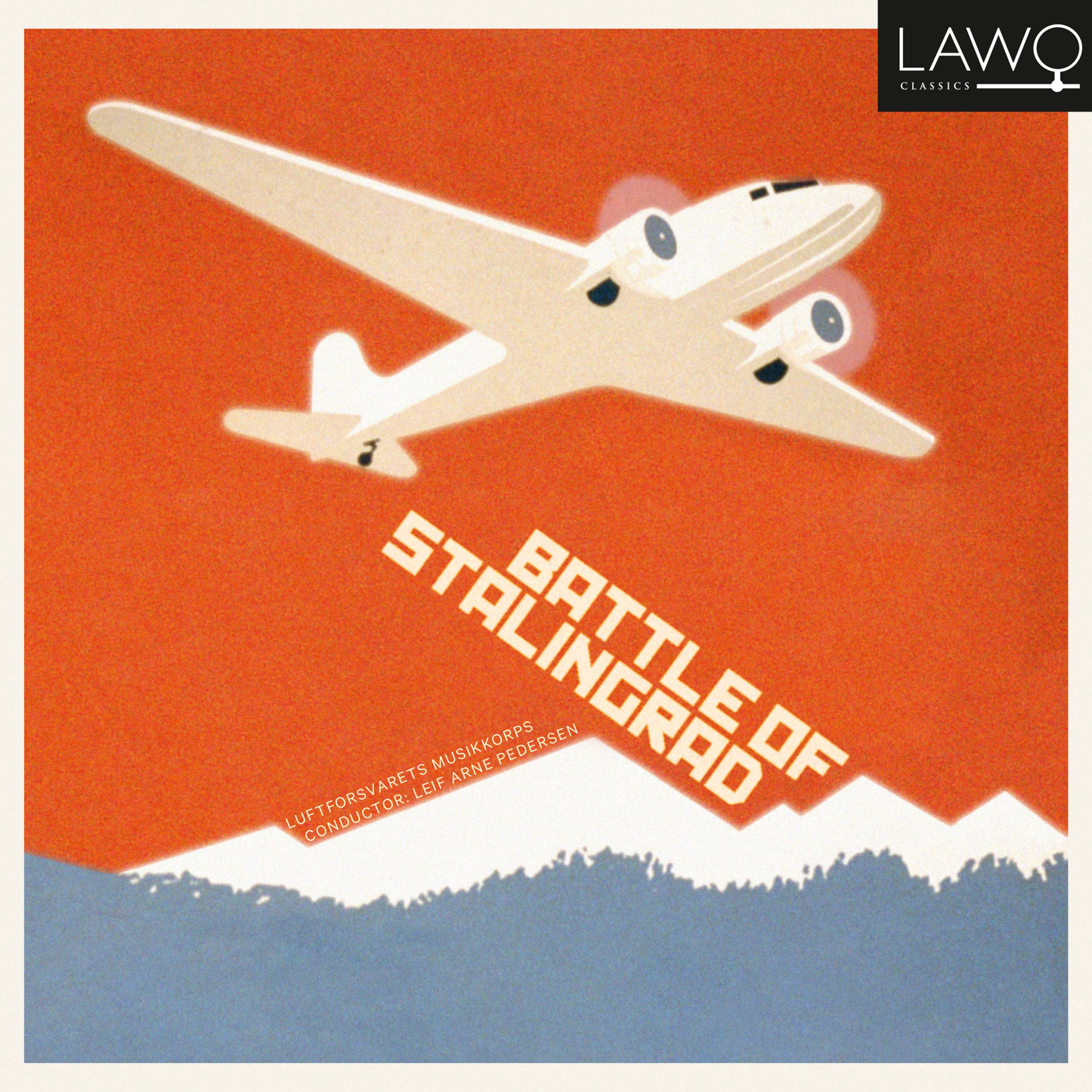
Battle of Stalingrad
The Royal Norwegian Air Force Band (Wind band) | Leif Arne Pedersen (Clarinet)
Listen
Tracks
Reinhold Glière (1875–1956)
Nicolai Rimsky-Korsakov (1844–1908)
Aram Khachaturian (1903–1978)
Armenian Folk Song and Dance, I. Dancing Song
Uzbek March and Dancing Song, I. Uzbek March
Dmitry Kabalevsky (1904–1987)
Aram Khachaturian (1903–1978)
Battle of Stalingrad, Op. 74A, I. The City on the Volga
Credits
- Conductor
- Leif Arne Pedersen
- Performer
- The Royal Norwegian Air Force Band | Leif Arne Pedersen (Clarinet)
- Wind band (military)
- The Royal Norwegian Air Force Band
- Composer
- Reinhold Glière | Nicolai Rimsky-Korsakov | Aram Khachaturian | Dmitry Kabalevsky
- Producer
- Vegard Landaas
- Engineer
- Thomas Wolden
- Editing
- Vegard Landaas
- Mastering
- Thomas Wolden
- Liner notes
- Mikal Engen
- English translation
- Jim Skurdall
- Executive producer
- Vegard Landaas
- Booklet editor
- Hege Wolleng
- Cover photo
- Anette L'Orange / Blunderbuss
- Artist photo
- The Royal Norwegian Air Force Band by Lasse Berre
- Design
- Anette L’orange | Blunderbuss
- Recording location
- Byscenen, Trondheim
- Recording country
- Norway
- Recording year
- 2012
- Recording dates
- 21.05.2012 | 22.05.2012 | 23.05.2012 | 24.05.2012 | 25.05.2012
- Original source
- 96 kHz, 24 bit
- Discs / tracks
- 1 disc | 17 tracks
- Release year
- 2013
- Label
- LAWO Classics
- Duration
- 54:56
- EAN
- 7090020180465
- ISRC
- NOEHX1305010/170
Booklet text
Reinhold Moritsevitsj Glière (1875–1956) was born in Kiev, Ukraine, and studied violin at the Kiev Conservatory. In 1894 he was admitted to the Moscow Conservatory, where he studied violin, counterpoint, and composition. From 1905–1907, he studied orchestra conducting in Germany. He debuted as conductor in Russia in 1908, the same year he made his breakthrough as composer with his symphonic poem "The Sirens". Glière's music has been performed mainly in Russia and the former Soviet Union, but some works, among them his Symphony No. 3 "Ilya Muromets" and the ballet "The Red Poppy", are frequently performed in the West. Glière later taught composition at Moscow Conservatory and had both Sergei Prokofiev and Aram Khachaturian as his pupils.
Glière spent longer periods of time in remote regions of the Soviet Union and studied folk music in Azerbaijan and other Soviet republics. His interest in the roots of the Soviet Union's national music put him in good stead with the regime and led to many commissions of his works for Communist red-letter days. Among many such works composed for band instrumentation is one entitled Solemn Overture for the Twentieth Anniversary of the October Revolution. It was written in 1937 and consists of an opening fanfare followed by a majestic hymn. Midway in the piece, a lively scherzo emerges in 6/8 time, before the work concludes with the repetition of the opening fanfare and a sparkling coda. Glière's compositions for band are not often performed, but it is easy to understand why this overture has remained in the band repertoire.
Aram Khachaturian (1903–1978) had his first contact with band music while he attended commercial school, and, in his free time, played tenor horn in a band comprised of his fellow students. He moved to Moscow in 1921 to begin studying cello—he had not been admitted as piano student, his first wish. In 1925 he began studying composition at the Gnessin Institute, and in 1929 he was admitted to Moscow Conservatory, where he studied composition under Nikolai Myaskovsky. From the perspective of the Royal Norwegian Air Force Band, it is interesting that Myaskovsky, who composed a total of 27 symphonies, wrote his Symphony No. 19 strictly for band instrumentation, and that in his Symphony No. 16 the final movement is based on the official song of the Red Air Force.
In 1932, while still a student at Moscow Conservatory, Khachaturian wrote Uzbek March and Dancing Song and Armenian Folk Song and Dance. Both works were composed for festivities celebrating the Red Army's fifteenth anniversary. The pieces are based on Armenian and Uzbek folk melodies, and Khachaturian liked the material so well that he later used the theme for "Uzbek Dance" in his "Trio for Clarinet, Violin, and Piano". Large parts of the material were also reorchestrated for orchestra and incorporated into his "Dance Suite".
Khachaturian wrote his Soviet Police March in 1973. There is a somewhat apocryphal story connected with this march: In his later years, Dmitri Shostakovich was asked to write a march for Nikolai Shchelokov, the Soviet Minister of Police. Shostakovich composed an ironic and witty march, his next-to-last opus, which was hardly the ostentatious style the minister had in mind. As the story goes, the minister then approached Khachaturian, asking him to write a march to replace Shostakovich's effort. Khachaturian accepted, and the minister got his march. Whether he was satisfied with it is up to the listener to contemplate.
Toward the end of his life, Khachaturian received an inquiry from the treasurer of the British Federation of Bands, Robert Peel. Peel asked for permission to write a band arrangement of Khachaturian's ballet "Gayane". Khachaturian then sent Peel the score to a suite he had written based on his music for the film The Battle of Stalingrad from 1949. The version for wind instruments was arranged by Grigori Kalinkovich. Khachaturian must have thought highly of it, considering that he sent it to Peel in the hope that it might be performed in the West.
The film for which the music was written was directed by Vladimir Petrov and is a feature film based on events surrounding the Germans' attack on Stalingrad during the Second World War. The suite consists of eight movements with the following titles:
I. The City on the Volga II. Invasion III. Stalingrad in Flames IV. The Enemy Is Doomed V. Into Battle for the Motherland VI. Eternal Fame to the Heroes VII. Forward to Victory VIII. There Is a Cliff on the Volga
Although the music on this album was mainly written originally for band instrumentation or, in the case of "Stalingrad", arranged in collaboration with the composer, there is no getting around that there is a strong tradition of playing transcriptions in band music. Before recorded music became a mass consumer item, the free outdoor concerts held by the military bands were the average person's only opportunity to hear a performance by professional musicians. Concerts of this type presented a programme combining transcriptions of classical pieces, arrangements of popular music of the time, and quite a few marches. The Royal Norwegian Air Force Band keeps this tradition going during the summer months, regarding it as a matter of course to include transcriptions of some of the most brilliant Russian and Soviet music.
Khachaturian's piece Lezginka is taken from the ballet "Gayane", which was written in 1942. A "Lezginka" was originally a folk dance that took its name from the Lezgian people of the Caucasus Mountains. The dance is known in large parts of the former Soviet Union, and in Khachaturian's version it is probably just about as demanding to play as it is to dance.
Comedians' Galop by Dmitry Kabalevsky (1904–1987) is taken from the orchestra suite "The Comedians". Kabalevsky wrote the suite in the context of the incidental music he composed for the children's play "The Inventor and the Comedians". This piece, too, really takes off — listen for our dazzling xylophonist.
The Flight of the Bumblebee clearly is Nikolai Rimsky-Korsakov's (1844–1908) most familiar work, and it has been performed on every conceivable instrument to showcase the musician's technical prowess. It is interesting for us that from 1873 to 1884 the composer was employed as Inspector of Bands in the Russian Navy. During this time he wrote solo pieces for trombone, clarinet, and oboe, all with band accompaniment, and he wrote numerous band arrangements believed to be lost to posterity.
— Notes: Mikal Engen (per Excel — verify credit against printed booklet) · English translation: Jim Skurdall
Biographies
The Royal Norwegian Air Force Band
The Royal Norwegian Air Force Band was established in 2006, yet it celebrates its bicentenary in 2018. Founded in 1818 as the Band of the Trondhjem Brigade, and later called the Band of the Fifth Division and the Band of the Armed Forces Trøndelag, it was for over one hundred years Trondheim's only professional ensemble. After the transition to the Air Force, the band has expanded its arena of activity from Central Norway to the entire country.
At its main venue, Byscenen in Trondheim's city centre, the band has performed with Elise Båtnes, Hilde Louise Asbjørnsen, Randi Stene, Tora Augestad, Australian jazz trumpeter James Morrison and the jazz-rock band PELbO. Other projects have included the children's theatre performance Musika Mobile, together with the free theatre group Cirka Teater, and the stand-up concert Lufta er for alle (The Air Is For Everyone), in collaboration with Åsleik Engmark.
The band performs under the motto "No genre unfamiliar to us." The Royal Norwegian Air Force Band collaborates closely with the Royal Norwegian Air Force Academy and Ørland Main Air Station, and gives regular guest performances at air force bases and centres around the country.
Leif Arne Pedersen
Leif Arne Pedersen, principal conductor and artistic director of the Royal Norwegian Air Force Band, began his professional career as clarinettist of the Staff Band of the Norwegian Armed Forces. After performing for a time with the Bergen Philharmonic Orchestra, he joined the Oslo Philharmonic Orchestra in 1988 and has been principal clarinet since 1990. In recent years, Pedersen has fashioned a career as conductor.
He has guest-conducted all the Norwegian military bands, and served from 2003 to 2008 as principal conductor of the Royal Norwegian Navy Band. Leif Arne Pedersen has made a number of recordings, both as conductor and as clarinettist. In 1996 he premiered Rolf Wallin's clarinet concerto, a work for which Wallin received the Nordic Council Music Prize, and he won a Spellemannspris (Norway's Grammy) for his recording of this concerto.
Leif Arne Pedersen has been principal conductor and artistic director of the Royal Norwegian Air Force Band since January 2011.