
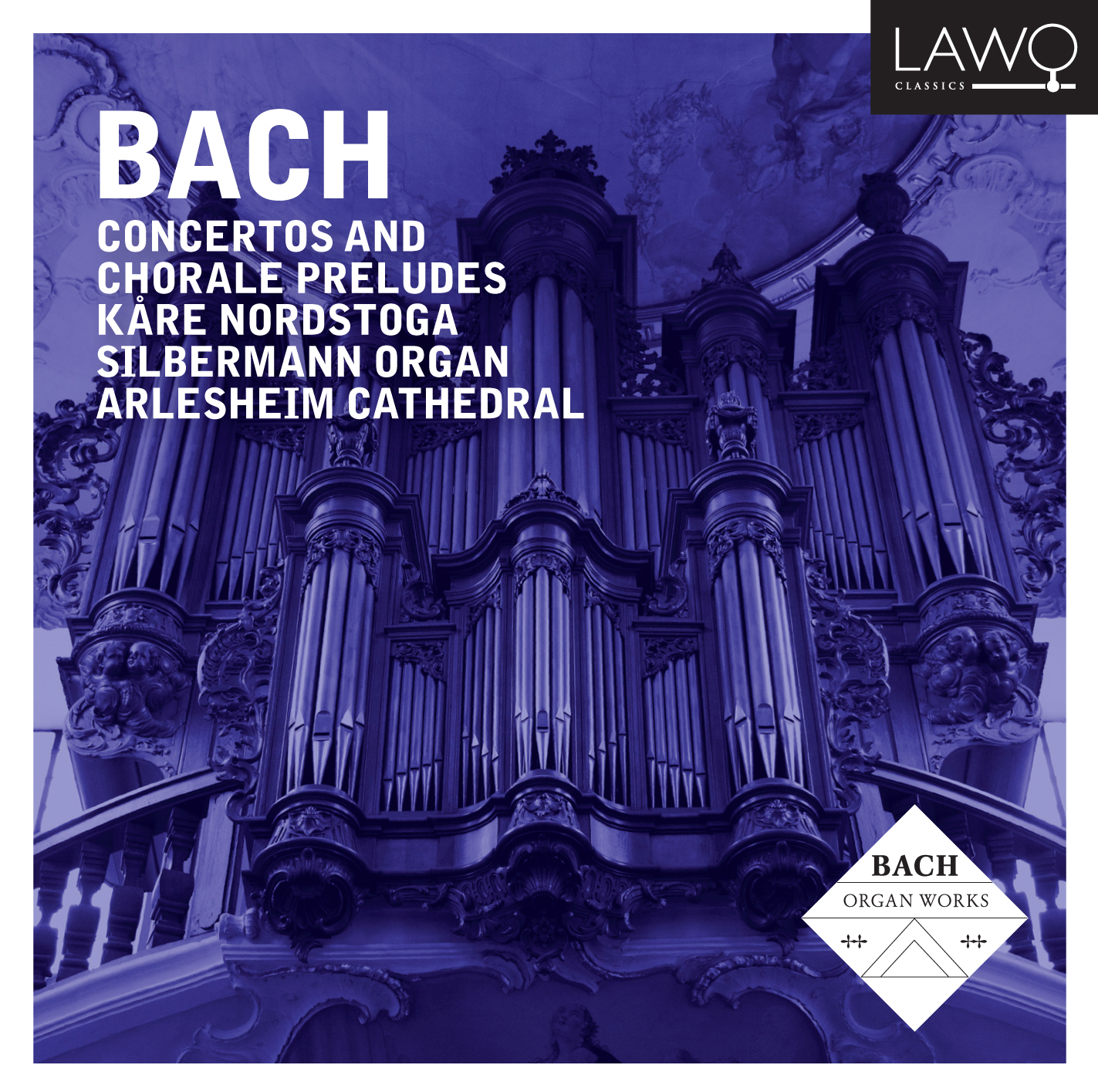
Bach: Concertos and Chorale Preludes – Silbermann Organ Arlesheim Cathedral
Kåre Nordstoga (Organ)
Listen
Tracks
Disc 1
Johann Sebastian Bach
Disc 2
Johann Sebastian Bach
Credits
- Performer
- Kåre Nordstoga (Organ)
- Composer
- Johann Sebastian Bach
- Producer
- Vegard Landaas
- Engineer
- Thomas Wolden
- Editing
- Vegard Landaas
- Mastering
- Thomas Wolden
- Liner notes
- Torkil Baden
- English translation
- Jim Skurdall
- Executive producer
- Vegard Landaas
- Booklet editor
- Hege Wolleng
- Artist photo
- Kåre Nordstoga by Thomas Carlström
- Design
- Anette L’orange | Blunderbuss
- Recording location
- Arlesheim Cathedral, Switzerland
- Recording country
- Germany
- Recording year
- 2011
- Recording dates
- 10.10.2011 | 11.10.2011 | 12.10.2011
- Original source
- 96 kHz, 24 bit
- Series
- Bach Organ Works
- Discs / tracks
- 2 discs | 42 tracks
- Produced with support from
- Fund for Performing Artists | Creo’s Remuneration Fund
- Release year
- 2012
- Label
- LAWO Classics
- Duration
- 127:61
- EAN
- 7090020180366
- ISRC
- NOEHX1205010/420
Booklet text
Five Organ Concertos BWV 592–596
Here for once is a Bach opus that is easy to date. The organ concertos are from the Weimar period and probably written from 1713-1714. They are linked to the contact court organist and concertmaster Bach had with Prince Johann Ernst of Saxe-Weimar (1696-1715). Already at age fifteen the prince had studied in Holland, and from Amsterdam, then a European centre for trade in sheet music, he had sent an abundant supply to Weimar, including Antonio Vivaldi's new opus 3 consisting of twelve concertos published in 1711. Vivaldi, as he was prone to do (cf. The Four Seasons), had given the opus an extra title, Estro Armonico, or Harmonic Inspiration.
In Weimar, the Prince studied composition with city organist Johann Gottfried Walther (1684-1748), a second cousin of J. S. Bach and a prominent composer. His musical lexicon published in 1732 remains today an important source of information, also with respect to Bach's organ concertos. Under the guidance of Walther, Prince Johann Ernst arranged and published six concertos for orchestra. Some arrangements conform to Vivaldian inspiration, but others were composed by the Prince himself.
It was no easy task having them performed by the orchestra, which was under the control of his uncle, Duke Wilhelm Ernst of Saxe-Weimar, the same power-hungry ruler who in 1717 had Bach imprisoned for four weeks owing to his obstinate attempt to force his own dismissal.
To give the Prince's concertos greater likelihood of being performed, they were arranged for organ (some for cembalo), and Bach was assigned the task. These works often are referred to as transcriptions. Bach, however, did more than simply rewrite the Italian-influenced music for keyboard. He left his own mark based on his German polyphonic reference and a tighter structure than is found in the Italian ideal.
During his next period as director of court music in Köthen (1717-1723), Bach continued to work even more with the Italian concerto form as found in his violin concertos. In these, as in the organ concertos from his Weimar period, the prevalent structure is a slow middle movement surrounded by rondo movements alternating between ritornell and solo, and tutti and solo.
CONCERTO IN G MAJOR BWV 592. After Concerto for Violin, Strings, and Basso Continuo by Prince Johann Ernst.
CONCERTO IN A MINOR BWV 593. After Concerto for 2 Violins, Strings, and Basso Continuo, opus 3 no. 8 by Vivaldi.
CONCERTO IN C MAJOR BWV 594. After Concerto for Violin, Strings, and Basso Continuo, RV 208. Vivaldi composed this work in D major, but Bach transposed it to C major to accommodate the range of the organ. Vivaldi's title, Grosso Mogul, alludes to India (!).
CONCERTO IN C MAJOR BWV 595. After a concerto by Prince Johann Ernst (the Prince's manuscript has been lost).
CONCERTO IN D MINOR BWV 596. After Concerto for 2 Violins, Cello, Strings, and Basso Continuo, opus 3, no. 11 by Vivaldi. The D minor concerto is the only one for which we have Bach's manuscript. His meddlesome son, Wilhelm Friedemann, brazenly claimed to be the composer.
Chorale Partita Sei gegrüsset, Jesu gütig — Partite diverse sopra: Sei gegrüsset, Jesu gütig BWV 768
This greatest of Bach's organ partitas and the most significant in all of organ literature (Gunther Hoffmann) is based on the following German Passion hymn:
Sei gegrüsset, Jesu gütig, Über alles Mass sanftmütig! Ach! wie bist du so zerrissen, Und dein ganzer Leib zerschmissen! Lass mich deine Lieb ererben Und darinnen selig sterben!
CHRISTIAN KEIMANN, Gotha Hymnal, 1666
Hail to Thee my Jesu, Holy, None as Thou, the meek and lowly. Ah! how art Thou torn and hated, All Thy Body lacerated! On Thy love, dear Lord, relying, So shall I be blest when dying.
Translation: Edith Munro Fowler
The melody Bach uses was first registered in 1682 in Leipzig to an unknown composer. It was used as well in organ works by Bach's contemporaries such as Johann Pachelbel and Johann Walther. The hymn is included in the Schemelli Song Book published in 1736 in Leipzig, in which Bach is known to have helped with harmonizations. There it is found together with other Passion hymns grouped together under the heading Vom Leiden und Sterben Jesu Christi (From the Passion and Death of Jesus Christ). Sei gegrüßet is, however, not included in the popular collection deriving from it entitled Geistliche Lieder.
Because Bach worked on these eleven variations for a number of years, both as a young man and later, we find a rich diversity of compositional methods. He may have begun as early as the Mühlhausen years (1707-1708), when he was in his early twenties, or in any case during the following years as organist and concertmaster at the ducal court in Weimar (1708-1717). We do not know for certain when he brought the work to a close. Perhaps it was in Weimar. Bach research is still fraught with questions with respect to dating this work.
Bach's original manuscript is lost, and the oldest copy (first version?) only comprises variations 1, 2, 4, and 10. There are a variety of copies which differ as well in the order of movements. Bach's partita, at a certain stage, may have been a collection of loose, unnumbered sheets of music. But the sequence as it exists today is the result of careful preparation, from the simpler variations at the beginning to the last and longest movement (no. 10) with its swaying dance rhythms—a sarabande! Such instances of Bach's use of triple metre in a Passion hymn anticipate the dance-like rhythms in the great chorale movements of the Passions composed in Leipzig, including Wir setzen uns, Ruht wohl, and Kommt, Ihr Töchter. The partita concludes with an intensified echo of the opening, a grand five-part chorale movement.
Because the hymn has seven verses and the partita twelve movements, there is no natural correspondence between Bach's music and the text. In these variations he explores the vast possibilities of the organ. In the words of one Bach scholar: Here Bach has achieved all that is possible with a partita (Ulrich Meyer).
Organ Chorales
A large number of Bach's chorale-related works have survived individually or as copies and are difficult to date. This pertains as well to the selections on this recording. Some are from the collection bearing the name of Bach's pupil (?), Johann Philipp Kirnberger (1721-1783), but when and in what context they were written is uncertain.
Allein Gott in der Höh sei Ehr (All Glory Be to God on High) is an important traditional hymn and was also used as a hymn of praise in the worship service.
BWV 717 manualiter is a movement in three-part harmony, BWV 711 Bicinium (from the Kirnberger collection) is two-part. Both are written for the manual.
BWV 715 belongs to the Arnstadt Chorales, even though these six presumably were written down later in Weimar. It is easy to understand why the parish council complained about organist Bach's accompaniment of the hymns. Following his trip to Lübeck in 1705, twenty-year-old Johann Sebastian was filled with his impressions of the master, Dietrich Buxtehude. Parishioners in Arnstadt were not accustomed to concertizing by the organist between the lines of the hymn they were singing. Likewise, the ever more richly coloured harmonies did their part to confuse the congregation. Bach is known to have regretted these sins of his youth. In a newspaper article published in 1770, long after his death, a former pupil, Agricola, quoted Bach as having said:
The organist demonstrates his art and skill in the preludes. During the hymn he accompanies the singing of the congregation using full-sounding but pure harmonies to sustain the proper melody.
Christ lag in Todesbanden (Christ Lay in the Bonds of Death) dates back to medieval times to the Gregorian sequence Victimae paschali laudes. Luther translated it into German, and Bach used it in 1707 in one of his first cantatas ever.
BWV 718 à 2 claviers et pédale and BWV 695 choralis in alto, manualiter (from the Kirnberger collection) were developed as chorale fantasies over the lofty Easter hymn.
Erbarm dich mein, O Herre Gott (Have Mercy Upon Me, O Lord) Bach's expressive BWV 721 manualiter (and Kåre Nordstoga's interpretation) convey the intensity of this prayer of mercy.
Erbarm dich mein, o Herre Gott, nach deiner gross'n Gnade Wasch ab, mach rein mein Missetat Ich kenn mein Sünd und ist mir leid
ERHART HEGENWALT 1524
Herr Jesu Christ, dich zu uns wend (Lord Jesus Christ Be Present Now) The two very different movements show the scope and possibilities of Bach's fantasy using one and the same text. It is ascribed to Duke Wilhelm II of Saxe-Weimar (1648), the paternal grandfather of Bach's employer in Weimar. BWV 709 à 2 claviers et pédale (from the Kirnberger collection) communicates the humble prayer of the text. BWV 726 is from the Arnstadt Chorales (cf. Allein Gott in der Höh sei Ehr) and expresses the same youthful vigour.
Herzlich tut mich verlangen (Fervent Is My Longing) is one of the chorales most often associated with Johann Sebastian Bach. In St. Matthew's Passion the melody is used five times in ever new harmonizations. Many will recognize BWV 727 à 2 claviers et pédale as a cherished number in the repertoire of students and performers.
Fantasia super Jesu, meine Freude, manualiter BWV 713 (from the Kirnberger collection) is based on Johann Crüger's chorale of 1643.
Jesu, meine Freude Meines Herzens Weide, Jesu meine Zier. . .
Bach's organ fantasy bears a resemblance to the choral movement in a motet of the same name.
Liebster Jesu, wir sind hier à 2 claviers et pédale In BWV 731 Bach conveys the text's emotional entreaty to be united with the divine. The organ chorale resembles the style of Orgelbüchlein with its embellished melody.
Meine Seele erhebt den Herren (Fuga sopra Magnificat pro organo pleno) BWV 733 uses an old melody to the Magnificat in Luke 1,46: My soul doth magnify the Lord, and my spirit hath rejoiced in God my Saviour. The powerful fugue is presumably an early work, perhaps from Bach's time as organist in Weimar (1708-1717).
Nun freut euch, lieben Christen gmein (Dear Christians, One and All, Rejoice) BWV 734 has choralis in tenore manualiter below an upper part exulting in the form of a perpetuum mobile.
Valet will ich dir geben BWV 735 is a multi-section fantasia cum pedale obligato, while BWV 736 is a magnificent dancing gigue from the Leipzig period over a powerful choralis in pedale.
— Notes: Torkil Baden · English translation: Jim Skurdall
Biographies
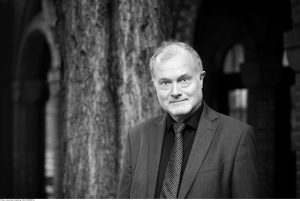
Kåre Nordstoga
Kåre Nordstoga (b. 1954) studied at the Norwegian Academy of Music under Søren Gangfløt, Bjørn Boysen and Kaare Ørnung, among others. Following his debut concert in 1978, he continued his studies under David Sanger in London, and was for a time organist at Ullern Church before coming to Oslo Cathedral in 1984. He has also been associated with the Norwegian Academy of Music, where he was appointed professor in 1994.
As cathedral organist at Oslo Cathedral, Nordstoga frequently performs a large repertoire, which has included two popular concert series with Bach's complete organ works. His recordings include the organ music of Bach, Brahms, Franck, Widor and Liszt, all of Bach's violin sonatas recorded on the cathedral's chancel organ in collaboration with violinist Geir Inge Lotsberg, as well as several recordings of Norwegian organ music. Nordstoga is an active concert organist.
In recent years he has been soloist with the symphony orchestras of Oslo, Bergen and Trondheim, and he has been invited to organ festivals abroad, including Aarhus, Notre Dame in Paris, and the Musashino Cultural Center in Tokyo. In 2006 he was awarded the Lindeman Prize for his active contribution to musical life.
Johann Sebastian Bach
Johann Sebastian Bach was born on 21 March 1685 in Eisenach into an extensive family of musicians. Orphaned by the age of ten, he was raised by his elder brother Johann Christoph in Ohrdruf before receiving a scholarship to the Michaelisschule in Lüneburg in 1700. His first appointment, in 1703, was as a court violinist to Duke Johann Ernst of Saxe-Weimar, but within months he became organist at the Neue Kirche in Arnstadt, composing his first significant organ works and, in 1705, travelling to Lübeck to study with Dietrich Buxtehude. In 1707 he became organist of St Blasius's Church in Mühlhausen and married his cousin Maria Barbara; the following year he entered the service of Duke Wilhelm Ernst in Weimar as court organist, rising to concertmaster in 1714 and building a reputation as an organ virtuoso.
In 1717 Prince Leopold of Anhalt-Köthen appointed him Hofkapellmeister, a productive period that yielded much of his instrumental output, including violin concertos and orchestral suites, though it was also marked by the death of his wife in 1720; he remarried the following year to Anna Magdalena Wilcke. In 1723 Bach was elected Thomaskantor in Leipzig, a post he held for the rest of his life, composing there his great vocal works, including the St John and St Matthew Passions and over two hundred cantatas, until his death on 28 July 1750.