
Yngve Slettholm
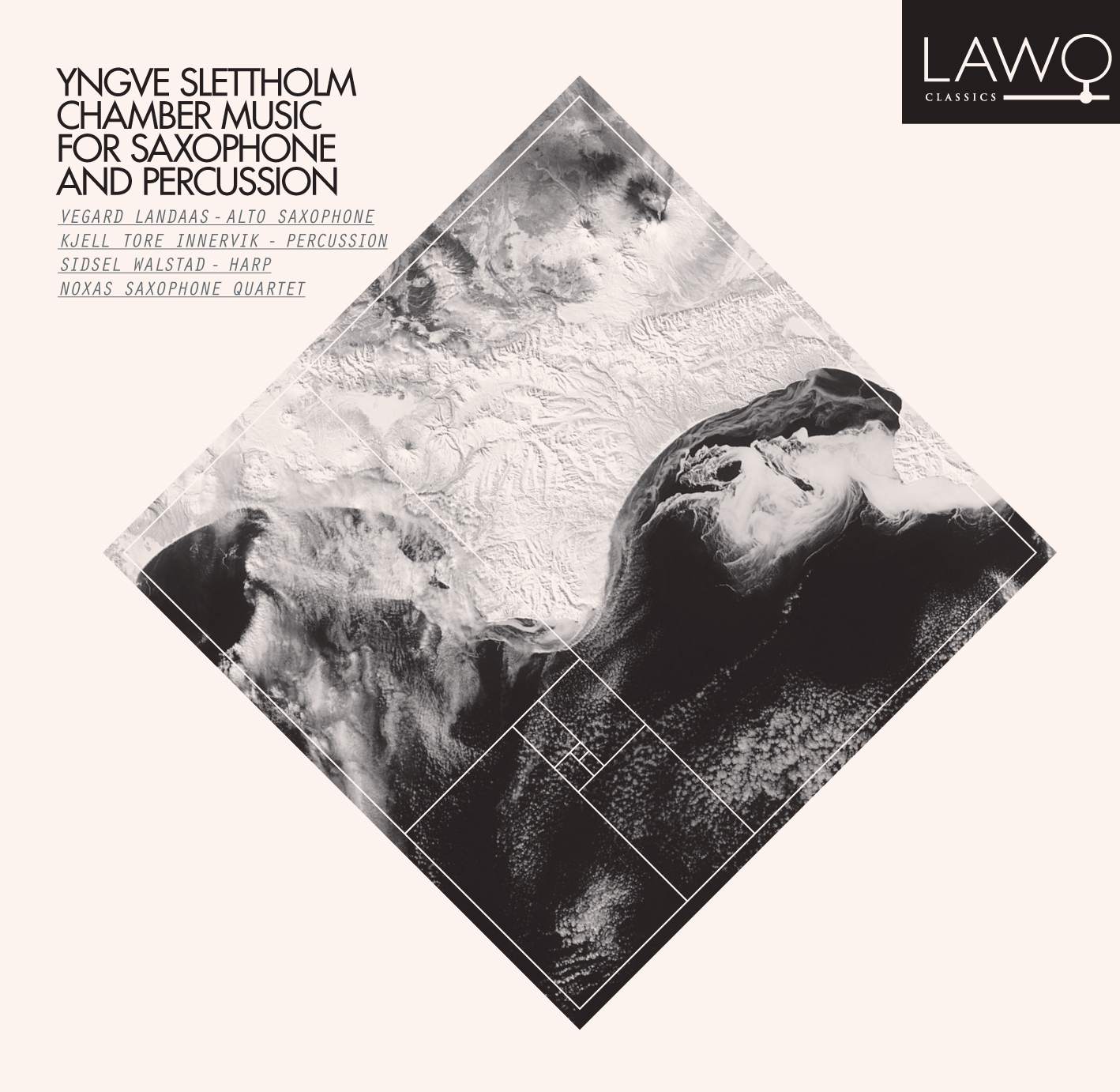
Yngve Slettholm: Chamber Music For Saxophone And Percussion
Vegard Landaas (Saxophone) | Kjell Tore Innervik (Percussion)
Stream & download
Tracks
Yngve Slettholm (*1955)
Blå Skygge - Blue Shadow
Vegard Landaas | Sidsel Walstad
Two Movements For Marimba
Kjell Tore Innervik
Fire Profiler - Four Profiles
Introduksjon Og Toccata
Kjell Tore Innervik | Vegard Landaas
Credits
- Performer
- Vegard Landaas (Saxophone) | Kjell Tore Innervik (Percussion) | Sidsel Walstad (Harp) | René Wiik (Saxophone) | Rolf-Erik Nystrøm (Saxophone) | Lars Lien (Saxophone)
- Composer
- Yngve Slettholm
- Producer
- Vegard Landaas
- Engineer
- Thomas Wolden
- Editing
- Vegard Landaas
- Mastering
- Thomas Wolden
- Liner notes
- Yngve Slettholm | Ida Habbestad
- Executive producer
- Vegard Landaas
- Booklet editor
- Hege Wolleng
- Cover photo
- Blunderbuss
- Design
- Anette L’orange | Blunderbuss
- Recording country
- Norway
- Original source
- 44.1 kHz, 16 bit
- Discs / tracks
- 1 disc | 13 tracks
- Release year
- 2010
- Label
- LAWO Classics
- Duration
- 1:18:11
- EAN
- 7090020180182
- ISRC
- NOEHX1008010/130
Booklet text
CHAMBER MUSIC FOR SAXOPHONE AND PERCUSSION
The works on this CD span a long period of my life as a composer – more than 20 years – and mirror exceedingly diverse phases. In retrospect, one can see musical features common to the successive stages, but differences in form and expression may seem greater than the similarities. The six works reflect this.
With my background as a flute player, it has been natural for me to compose for wind instruments, even though it has led to very few works for solo flute. Saxophone is the solo instrument for which I have composed most often. This is not merely a result of chance, but can be explained musically. It may have been coincidental that in 1977, owing to the fact that there was very little Norwegian "classical" music for saxophone, I began a close collaboration with Erik Tangvold, one of Norway's leading saxophonists and an ardent advocate of contemporary music. But it is not a coincidence that throughout different phases I have continued to compose for saxophone. The instrument's great range of expression and its unique dynamics and technical capabilities are most inviting.
The earliest of the works, Fire profiler (Four Profiles, 1978), was my first work written while at the Norwegian Academy of Music studying with Finn Mortensen, who has meant a lot to me. One could perhaps regard Fire profiler as showing some degree of mastery of composition for melodic solo instrument, and at the same time it is my last composition based on a clearly defined neoclassical tonality. The work, inspired in part by Finn Mortensen's solo sonata for flute, is dedicated to Erik Tangvold, who premiered it in 1979 during the International Saxophone Congress at Northwestern University in Illinois. The four movements profile different sides of the saxophone's character and each represents clearly delineated musical forms, which are subordinated to the cyclical nature of the work as a whole. Through different forms of expression the attempt is made to utilize the saxophone's technical and musical potential over a broad spectrum.
After completing my studies at the Norwegian Academy of Music, there followed a series of expressive, dynamic works in the early 1980s, including Introduksjon og toccata (1981), written for Erik Tangvold and Per Melsæther. The introduction is short with a powerfully dynamic structure, providing a foretaste of the elements and forces to be released in the sweeping toccata. Besides melodic and dynamic contrasts, various rhythm and phase shifts play a key role in the work, and toward the end there is a fragmentation of the saxophone part similar to that found in the last movement of Fire profiler. Implicit in the word toccata is a double meaning: on the one hand a virtuoso, free-style musical piece, on the other, derived from the Italian word toccare, to touch or strike, alluding to the role of percussion instruments in the work (timpani, cymbals, tam-tam, bass drum).
Feeling the need for artistic reorientation, my studies with Morton Feldman from 1986-1987 had a momentous impact and led to a marked change in the way I viewed composition and esthetics, with strong focus on tonal nuances, and sound and instrumental quality. At the same time, I was keenly inspired by the notion of cyclical time and the idea that the West's linear concept of time was not alone valid. This led to a series of works more static and introspective in character, in which dynamic formal development yields to segments of repetitive (but never entirely similar) patterns. Little by little, mirror constructions and proportions arising from the Golden Section became major elements of the techniques of composition which I developed during the 1990s.
...wie ein Hauch... (Like a Breath, 1989) represents the refinement of a number of key perspectives acquired while studying with Feldman. The work, written for Harald Bergersen's saxophone quartet, opens us to a musical experience and logic of time different from a traditional "beginning" and "end." It creates instead the illusion of an extended moment, or, conversely: a fraction of eternity, where the limiting of effects is necessary for achieving concentration. As perhaps the most homogeneous of all chamber ensembles, the saxophone quartet is an ideal medium for attaining such intense concentration on tonal nuances. At the same time, small tonal differences, for example, the playing of D4 (the opening tone) by alto saxophone, are important for being able to move inwards into the centre of the ensemble and experience the timbral riches found in the quartet's inner landscape. In contrast to most works for saxophone quartet, the dynamics in ...wie ein Hauch... have been toned down considerably. The work confines itself in the main to a dynamic range from piano down to what is barely audible. The title, Like a Breath, is taken from the violin part in the fourth of Anton Webern's Five Pieces for Orchestra Op. 10.
Air II (1992) is the second in a series of works for diverse solo instruments written from 1991-1993. The common thread is a static formal structure based primarily on the proportions of the Golden Section. Air II also makes significant use of harmonic aggregates (i.e. pitch-classes fixed to certain octaves) which remain unchanged throughout large parts of the work. Various examples of textural condensation at the macro and micro level play a key role, and in place of purposefulness and forward progress we find different static sections pitted against each other in present time as an invitation to immersion in the distinctive tones of the vibraphone.
Likewise, in Two Movements for Marimba (1998) we find extensive use of the proportions of the Golden Section, but also more virtuoso and dynamic features than in Air II. The ambiguity in the title is mirrored in the expression of the work. Movement is not only a structural unit, but alludes to motion as well. The work is perhaps more accessible than others from the early 1990s, owing to more movement than inaction at the beginning. Two Movements for Marimba was written for the American percussionist Sigurd Johnson and takes its point of departure in relatively rich harmonic material. Well concealed in the composition are melodic and harmonic elements from Grieg's Piano Concerto in A Minor, and the two movements form a cycle in which A is the first and last tone.
Blå skygge (Blue Shadow, 2000-01) was originally composed for soprano and harp. It consists of a very short harp prelude and two vocalises. On the occasion for which it was written, Hans Børli's poems "Tørst" and "Jordens kvinne" were recited between the movements. The title is taken from the first of the two poems. The soprano part in Blå skygge was later arranged in two versions, for alto saxophone and English horn. The work is lyrical and melodic, and in this respect it differs to some extent from the other works. Yet many elements of composition from the 1990s are still present: repetitive motifs, tonal repetitions, phase shifts, mirror structures, and the proportions of the Golden Section. Nevertheless, Blå skygge, the most recent work on this CD, has a close kinship of melody and expression with Introduksjon og toccata and Fire profiler, which were written 20 years earlier.
— Yngve Slettholm
STRUCTURE AND TIMELESSNESS
Yngve Slettholm is familiar to many as Executive Director of Kopinor. Others know him as chairman of the National Media Finance Committee or as an active board member. Slettholm served as State Secretary under former Minister of Culture Valgerd Svarstad Haugland. He held the position of Associate Professor at the Norwegian Academy of Music, which he also served as Pro-Rector. Moreover, he has maintained a life-long involvement in the Salvation Army, currently as conductor of the Oslo Temple Brass Band, an activity he himself characterized as demanding alongside his day-to-day activities. And in 2010 he became the Norwegian champion for marathon running in his age group.
Slettholm points out that one's life can unfold in many arenas. And indeed it is this breadth one finds in his music, with the need to explore forms, relationships, and structures as its focus. In our discussion of this CD – which features chamber music for saxophone – the composer feels that it is not necessary to create connections that do not exist.
Contrasts, contrasting conditions, and wholly unique openings exemplify the works on this recording, which were written over a period of 20 years. Not least, the pieces are characterized by the terms under which they were commissioned: Who commissioned the piece, where would it be performed for the first time, and what would be its scope.
In talking about the music, we can make some connections, for example, between the ideas which are closely tied to the inspiration Slettholm found in working with his two teachers, Finn Mortensen and Morton Feldman. Perhaps it is not so surprising to discover contrasts in these works?
– I have thought a lot about the unusual convergence of having worked with these two teachers whose initials were FM and MF. They were in many respects complete opposites as human beings. Finn was the gentle personality who wrote expressive and dynamic music. Morton Feldman was loud and brash but could write some of the most tender, introspective music I know. As such, they were far apart, but each was exactly what I needed at the time, Slettholm says.
The expressive aspect can serve perhaps as an entrance into the composer's early work. Introduksjon og toccata (1981) is filled with yearning, solemnity, and ebullience. That it draws inspiration from historical works is obvious from the title. Fire profiler (1978), on the other hand, is influenced by elements found in Mortensen's flute sonata.
After completing the latter work, Slettholm turned away from the tonal, neoclassical idiom and has never returned. Yet he does not distance himself from that which preoccupied him earlier, nor does he count himself among those who do not like to have their early work performed.
– I have withdrawn a few works along the way, but I stand behind the compositions that are in circulation today. They reflect where I stood, he says.
– I don't believe that the world is always moving forward. I wouldn't have written the same music today, but I'm not sure the music I write now is better than 30 years ago, just different.
From the Linear to the Cyclical
In 1986 Slettholm traveled to the USA. He studied with Morton Feldman and received his doctorate in 1989. Among the ideas he brought home with him was that time can be viewed as something other than a linear phenomenon. His years in the USA freed him from viewing formal structure in terms of something hectic, hurried, and purpose-directed, and it seems a shrewd paradox that Slettholm can speak of a time before and after Feldman as one of the most clear-cut delineations in his compositions as a whole.
Slettholm himself has used the flute concerto Possible Selections (1989) as an important example of his thinking at that time. One could no longer speak of a traditional structure of climax and resolution. Instead, we find a more ascetic approach based on repetitive figures. Not that of a minimalist such as Steve Reich, but rather a general transition from linear to cyclical thinking. In Slettholm's view, one discovers in the search for this form of asceticism many of the paradoxes of modern society.
– At a time when so much is characterized by a hectic pace, oversimplification, and superficiality, we find a counter trend reflected for example in the popularity of Arvo Pärt in some circles. A number of persons are taking the time to focus on themes and parameters other than those which are purpose-directed and frenetic.
– Yet, although you were preoccupied in the 1990s with gaining distance from what was purpose-directed, you nonetheless accepted the position of State Secretary, with all the stress it entailed.
– Yes, that just shows in how many different arenas our lives are played out. I see no contradiction in doing this and in simultaneously trying to create a timeless space in one's life. Perhaps we do so precisely because we often lead hectic lives. I don't believe my time as State Secretary was much busier than other periods in my life. When I wrote Possible Selections I was the father of two small children with a third on the way, we were building a house, I was finishing up a dissertation, had begun a new position at the Oslo Conservatory of Music, had a number of time-consuming positions of trust, and, all in all, became well acquainted with what is called a time squeeze today. At times we tend to extend ourselves to the limit, and even beyond. Under such circumstances I need a space in which I can suspend time. I like to run. Here, too, it means getting away from being purpose-directed and letting your body go and your thoughts flow freely. This is perhaps also reflected in the music I like to listen to, which is often contemplative in nature.
The year 1989 also saw the completion of the saxophone quartet ...wie ein Hauch..., as a slice of time, an extended moment. And there is perhaps an even greater emphasis on the ascetic in ...wie ein Hauch... than in Possible Selections, since the possibilities of sound variation are fewer in a quartet than in an orchestra.
– One of Morton Feldman's favorite anecdotes was about Sibelius, who, when asked to explain the difference between an orchestra and a piano, answered that the orchestra has no pedal. And Slettholm adds with a smile that most of the piece could be played on the piano.
The ideas are sparing and often coupled with pianistic effects, as for example when chords are struck and certain tones resonate longer with the help of the pedal. Slettholm notes that it is equally important to experience the ensemble as a whole.
– The ensemble is so homogeneous that it is difficult to discern which instrument is playing what. I have been more preoccupied with the quartet as a medium than with the instrumentalists as soloists. In many respects, the work is an immersion in the sound of the saxophone, in the quartet as a meta-instrument.
Contrasts, Numbers, and Structures
Slettholm regards the compositions of the late 1980s as chiefly intuitive.
In the next piece on this recording, Air II (1992), we find something of the same immersion, striking a chord and then modulating it by dampening one or more individual tones.
But the piece is shorter. The ascetic aspect is further augmented – which introduces a paradox. Having searched for the timeless, the composer now wishes to structure time – or what is timeless. In Air, which is a collection of pieces for diverse solo instruments, Slettholm begins to explore the Golden Section and the proportions of the Golden Section, using the Fibonacci sequence as the point of origin. It consists of the numbers 1, 2, 3, 5, 8, 13, etc., whereby each subsequent number is the sum of the previous two in an infinite progression.
– What really fascinates me is that the further you go in the sequence, the closer you come to the Golden Section. When you take 8/13, for example, you are close, but a little under, and with the two subsequent numbers, 13/21, you are closer yet, but a little over. Then we have 21/34, which is under, but still closer – and so on. Another thing which is fascinating and which not many know about is that you can begin a sequence with any two numbers and when you arrive at a subsequent number by taking the sum of the previous two, you will always have a sequence which approaches the Golden Section in the same way, but not as quickly as the Fibonacci sequence.
He says that, above all, the structures provide a sensible framework.
– The principles help me conceive of form and structure. It has become quite simply a natural part of the vocabulary. Of course I do not always calculate down to the closest microsecond, but when I begin something new, it is always tempting to explore how the principles can be used.
– Do you believe that your listeners are able to hear these minute differences?
– No, not with any precision. Therefore, I don't believe that fulfilling these requirements is necessarily a criterion of quality, neither for music nor the visual arts. For me it is simply a technical aid – in the same way it can be used by a painter to compose a picture and place a dot where several lines intersect.
But it is remarkable to analyze a number of important compositions in which the Golden Section was not intentionally used as a technical principle. In many you find that they nonetheless tend toward the proportions of the Golden Section. For example, I have read analyses of all the movements of Mozart's sonatas, or I have seen sketch books in which composers who scarcely would have had knowledge of this have scratched out or added measures in order to achieve a more organic flow – with the result that they have come closer to the Golden Section. And yet a Mozart sonata which matches precisely is not necessarily better than a sonata which is not a perfect match. One cannot achieve artistic quality by measuring.
In the beginning, Slettholm used the principle to structure time. In Air II for example it governs the length of the sections and of individual phrases. In later pieces, such as Blå skygge (2001-2002) and Two Movements for Marimba (1998), he has a different approach.
– It need not always be an additive process with a subsequent section always larger than the previous one. You can reverse a Fibonacci sequence in the form of an inversion, or you can work with different series at the level of phrases and form. I have also built chords based on the same numbers. And I have often been interested in coupling parameters in unusual ways – such that one is always playing fast and loud, or soft and slow. In a number of pieces I have worked with soft but very fast passages which create a fluttering sound. And loud passages can stand still. The same is true for harmonic and rhythmic parameters. For example, it is effective to have tight, crass harmonic complexes when things are slow, and, when the rhythm tightens, for example close to the Golden Section, less complex harmonies.
Shorter Moments
In 2006 the Oslo Philharmonic Orchestra recorded three of Slettholm's orchestral works¹ – and the comment was made that the works were exceptionally long to be written for orchestra. At that time, Slettholm responded by saying that time is needed to develop cyclical time.
– On this recording we have sketches of shorter moments. What does this mean for the aspect of time?
– It is always difficult to talk about things in general terms. But, again, I can turn to Morton Feldman, who wrote some exceptionally long works. He said that the longer the work, the less material required. And conversely: the shorter the work, the more material needed. It sounds like a paradox, but when you cross a certain threshold, let's say 15 minutes, then you can allow yourself to linger on a limited amount of material over a longer period of time. But you cannot establish the same situation in a short time. You can suggest something of this, but then you have to let it go and bring the work to a conclusion. The need for a conclusion and for achieving a sense of completeness within the given framework is stronger in a shorter work. A work lasting eight minutes can never be what I call an extended moment or a fraction of eternity.
– Is the consequence of this that the works on this recording have more material than your orchestral pieces?
– Again, it is difficult to give a general answer. But yes, if we look at the works on this recording, disregarding the first ones, which are based on a different approach, then Feldman's claim is correct. Two Movements for Marimba contains considerably more material than ...wie ein Hauch... And even the short movements in Blå skygge introduce more varied and diverse material than we find in the course of the longer time span in ...wie ein Hauch...
Ideas of the Beautiful
– Having spoken so much about the structures: Is there something you wish to express apart from all these formal aspects?
– Of course there is something I want to say, but I do not attempt to tell concrete stories. That which I wish to express can perhaps best be described by a perception – the wonder I associate with beholding something beautiful. We often think of music as expressing something emotional, as creating a situation in which we can let ourselves be carried away. When I experience something beautiful, I wish to linger there – for some time. For example, imagine a diamond, which you can look at from so many angles, always regarding it anew. It is like that with a number of things, images or natural phenomena, which are always changing, e.g. depending how the light falls on them. In general, I am preoccupied with how all things have a number of different sides. There is always a night side, a dark side, an undercurrent, the subconscious – which in a composition can be reflected in many ways.
In later works Slettholm has more than ever lingered on the beautiful, on certain lovely tones – resulting from Fibonacci proportions perhaps – or inspired by Olivier Messiaen and his modes, where major and minor chords are extended with "the most unusual intervals, and where," as he says, "colours are continually lying in wait."
But music is, above all, a passage in time, Slettholm asserts. It is time and reflections regarding it to which he constantly returns and wishes to be present in.
– Someone more dramaturgically inclined might perhaps become impatient listening to some of the works, wondering what is intended. For me it is not always so important where something is leading. I can sit for a long time fascinated by the same phenomenon – also musically speaking – without necessarily feeling that I must move on to another place.
This text is based on conversations with Yngve Slettholm in 2006 and 2010. Parts of the interview were published earlier at the website Ballade.no.
¹ Possible Selections, Aurora, ACD5030
— Ida Habbestad · English translation: Hege Wolleng