
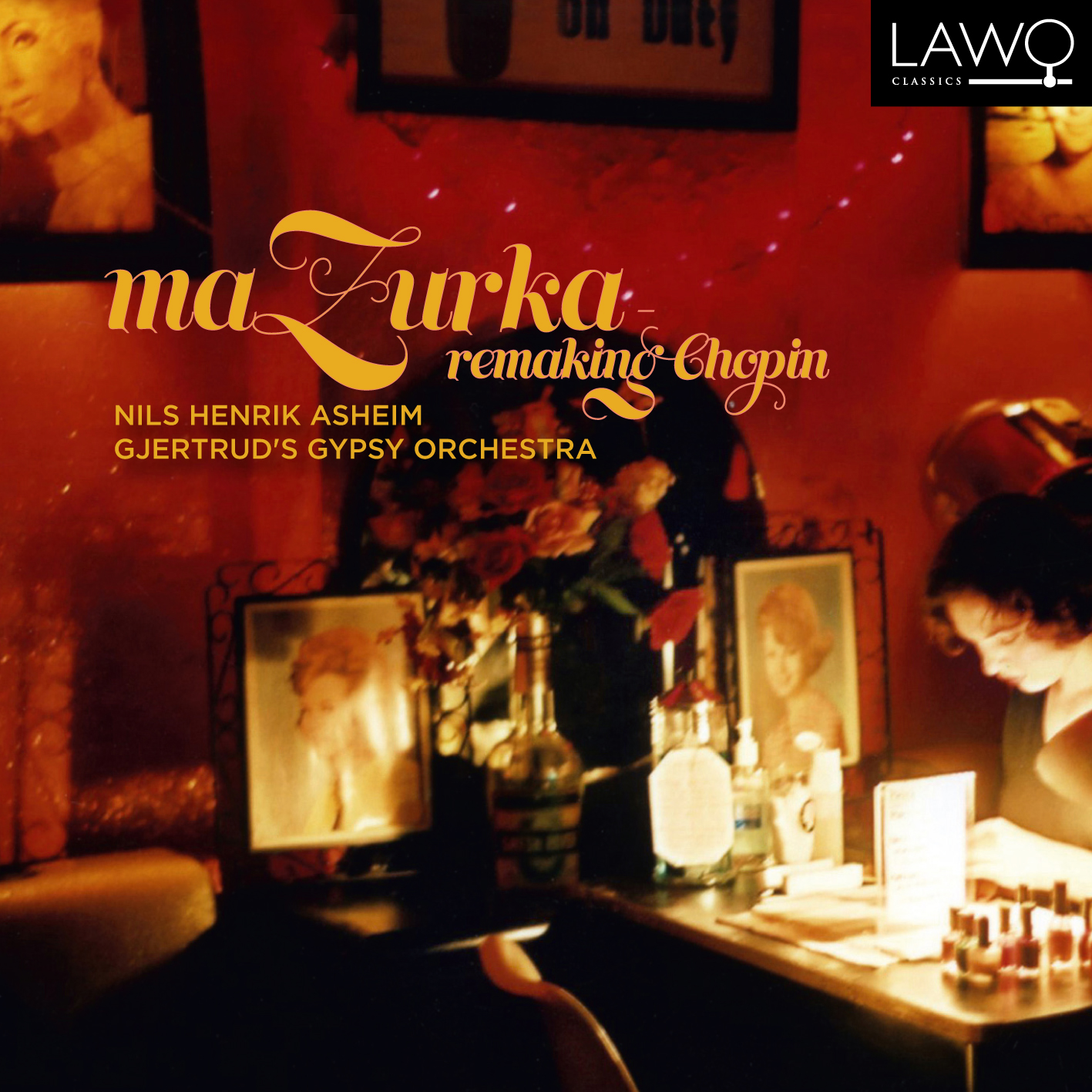
Mazurka – Remaking Choping
Nils Henrik Asheim | Gjertrud’s Gypsy Orchestra (Orchestra)
Stream & download
Tracks
Frédéric Chopin (1810–1849)
Mazurka, Op. 68
Mazurka, Op. 7
Mazurka, Op. 33
Mazurka, Op. 17
Mazurka, Op. 67
Mazurka, Op. 6
Mazurka, Op. 7
Mazurka, Op. 24
Mazurka, Op. 30
Mazurka, Op. 24
Credits
- Performer
- Nils Henrik Asheim | Gjertrud Økland | Georg Reiss | Tom Karlsrud | Pål Thorstensen | Trond Villa | Helene Waage | Ernest Bango
- Orchestra (unspecified)
- Gjertrud’s Gypsy Orchestra
- Composer
- Nils Henrik Asheim
- Arranger
- Nils Henrik Asheim
- Producer
- Jan Martin Smørdal
- Engineer
- Stein Inge Brækhus
- Editing
- Audun Bormann
- Mastering
- Brad Blackwood
- Piano tuner
- Arnfinn Nedland
- Liner notes
- Nils Henrik Asheim
- English translation
- Jim Skurdall
- Executive producer
- Vegard Landaas
- Booklet editor
- Hege Wolleng
- Cover photo
- Blunderbuss
- Artist photo
- Nils Henrik Asheim by Tove Elin Berg
- Design
- Anna-Julia Granberg | Blunderbuss
- Recording location
- Ulefos Hovedgard
- Recording country
- Norway
- Original source
- 44.1 kHz, 16 bit
- Discs / tracks
- 1 disc | 12 tracks
- Produced with support from
- The Audio and Visual Fund | Fund for Performing Artists | Creo’s Remuneration Fund | Arts and Culture Norway
- Release year
- 2010
- Label
- LAWO Classics
- Duration
- 48:30
- EAN
- 7090020180175
- ISRC
- NOEHX1007010/120
Booklet text
THE MAZURKA ROAD
For whatever the reason, perhaps I was in a melancholy period, Chopin's mazurkas turned up on my piano, day after day over the course of one year.
Little by little, as the music was played over and over again, it began to live its own life. Small details grew larger, tore themselves loose, and formed their own music.
I contacted Gjertrud's Gypsy Orchestra, and we began to toy with the material together. We discovered clues from so many places in this music and wanted to pursue them to see down which road they would lead us.
We unraveled seams, stopped for two measures to create an opening in time, and wove tapestries of sound around Chopin's shadow. In order to encircle the soul of the mazurka, we had to attack from different angles.
Track commentaries (as printed, tracks 1–8)
1. Mazurka Opus 68 No. 2, A minor …strings, strings… as your finger runs across the strings of an instrument, the theme arises. The wheel spins slowly around, an endless trail of A-minor, journey, train, cart, Central Europe… into the realm of folk music.
2. Mazurka Opus 7 No. 3, F minor The rhythm, mazurka in ¾ time, a basic pattern of two short notes and two long. The extremes: the dance in the ballroom and the danse macabre. A rhythmic skeleton pared down to the bone, turned into a caricature.
3. Mazurka Opus 33 No. 4, B minor Improvisation: When Chopin played, he ornamented differently each time. Improvisation can also dissolve the themes, allowing colours to bleed into one another — the colours from the old Collard & Collard piano.
4. Mazurka Opus 33 No. 3, C major The miniature, based on two chords, the first merging into the second. We peer inwards into the inner workings, a music box duplicated in a minuscule kaleidoscope.
5. Mazurka Opus 17 No. 4, A minor Telling a story, unrestfully, slow line dance over no floor. We follow the composition as we would a film… scenes, images, shadows, landscape. At a certain place, a parenthesis in time… a long improvised moment.
6. Mazurka Opus 67 No. 4, A minor The folk music collective, the Gypsy Orchestra's typical style of playing. The violinist leading, the others skillfully embellishing around a traditional arrangement… the voices flow together, flow apart.
7. Mazurka Opus 6 No. 1, F-sharp minor The opening, a gesture, an invitation to something? Chopin is radical, questioning. The mazurkas abound with openings rather than conclusions. In the middle: the archetypal mazurka devouring itself!
8. Mazurka Opus 7 No. 1, B-flat major The unbecoming Chopin… the street and art colliding, perfume and the odor of dung. The powerful leap upwards, the dancer magnified to King Kong out of control… and Bartók comes to visit.
(No commentaries are printed for tracks 9–12 — see INTERNT.)
About the composer (as printed)
FRÉDÉRIC CHOPIN (1810–1849), born in Poland of a Polish mother and French father. He moved to Paris in 1830 and lived there for the rest of his life, but he always remained a staunch Polish patriot. Regarded as one of the most prominent composers for piano of all time. Composed 58 mazurkas for this instrument. Mazurka is actually a generic term for the Polish dances mazurek, oberek, and kujawiak. All the same, Chopin's mazurkas are not dance music, but rather a free and elaborate commentary, playing with the rhythmic and melodic elements of folk music.
— Notes: Nils Henrik Asheim · English translation: Jim Skurdall