
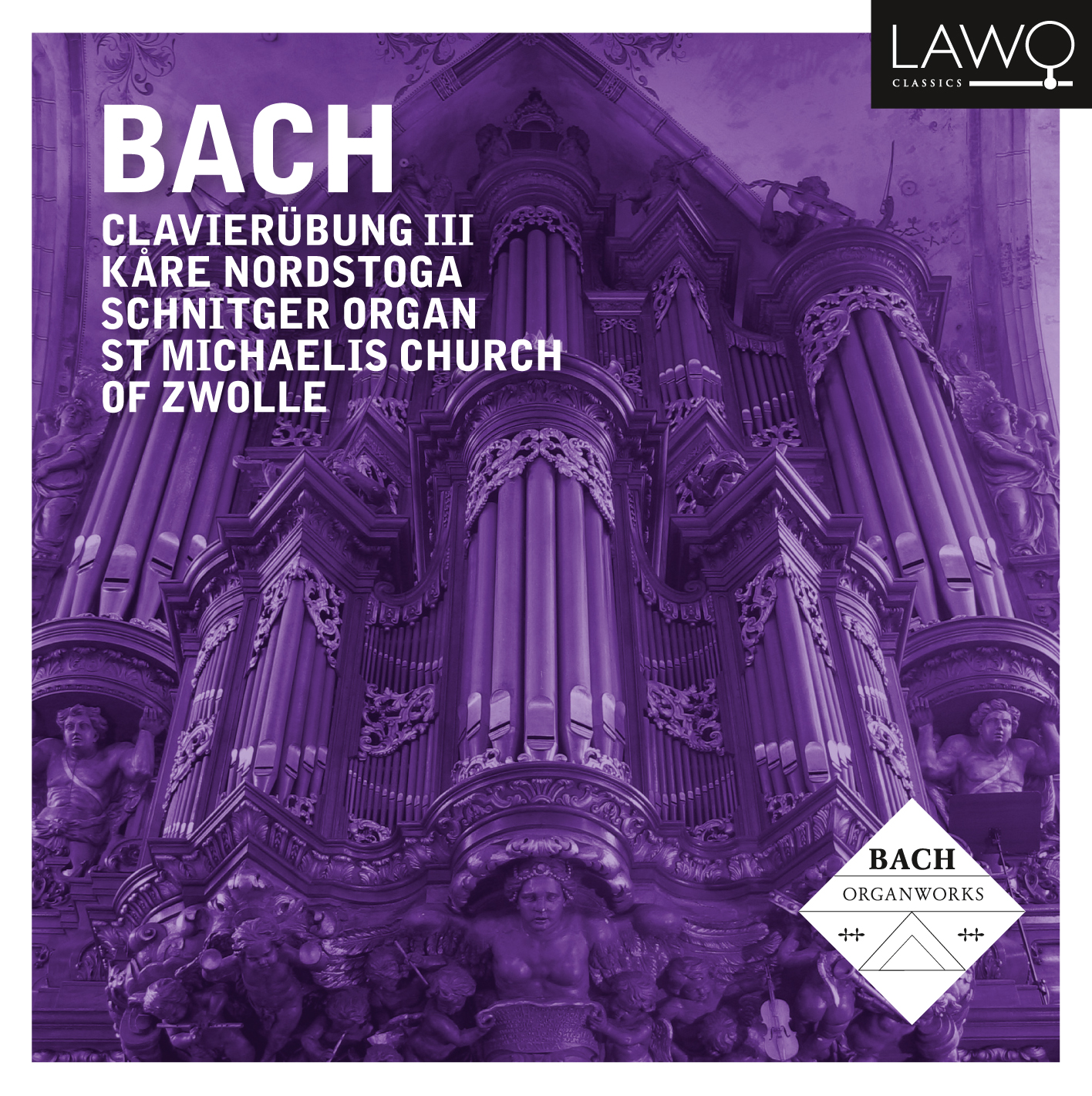
Bach: Clavierübung III – Schnitger Organ St Michaelis Church of Zwolle
Kåre Nordstoga (Organ)
Listen
Tracks
Disc 1
Johann Sebastian Bach (1685–1750)
Prelude and Fugue in E-Flat Major, BWV 552, "St. Anne"
Disc 2
4 Duets, BWV 802-805
Prelude and Fugue in E-Flat Major, BWV 552, "St. Anne"
Credits
- Performer
- Kåre Nordstoga (Organ)
- Composer
- Johann Sebastian Bach
- Producer
- Vegard Landaas
- Engineer
- Thomas Wolden
- Editing
- Vegard Landaas
- Mastering
- Thomas Wolden
- Liner notes
- Ove Kristian Sundberg
- English translation
- Jim Skurdall
- Executive producer
- Vegard Landaas
- Booklet editor
- Hege Wolleng
- Cover photo
- Blunderbuss
- Artist photo
- Kåre Nordstoga by Thomas Carlström
- Design
- Blunderbuss
- Recording location
- St Michaelis Church, Zwolle, Holland
- Recording country
- Germany
- Recording year
- 2009
- Recording dates
- 24.06.2009 | 25.06.2009 | 26.06.2009
- Original source
- 44.1 kHz, 16 bit
- Series
- Bach Organ Works
- Discs / tracks
- 2 discs | 27 tracks
- Release year
- 2010
- Label
- LAWO Classics
- Duration
- 1:44:00
- EAN
- 7090020180120
- ISRC
- NOEHX1003010/270
Booklet text
CLAVIERÜBUNG III
Over the better part of a decade Bach published four volumes in a series entitled Clavierübung. "Clavier" is used here in the broader sense of "keyboard," while the word "Übung" is perhaps better understood as "interpretation" rather than in its more common meaning of "practice."
Clavierübung I (1731) is a collection of 6 partitas which Bach had published singly since 1726; Clavierübung II (1735) contains the Italian Concerto and the Overture in the French style, while Clavierübung IV comprises the celebrated Goldberg Variations.
The original manuscript of Clavierübung III (1739), the first of Bach's published organ works, bears the subtitle "Chorale Preludes and Duets." Meanwhile, recipients of the work got a more elaborate description thrown in for good measure: "Clavierübung, third part, consisting of various preludes for organ based on the Catechism and other hymns; for music lovers, and, in particular, for connoisseurs of such works for the recreation of the spirit, composed by Johann Sebastian Bach, Royal Polish and Electoral Saxon Court Composer, Conductor, and Directore Chori Musici in Leipzig. Published by the Author."
The year 1739 with the publication of Clavierübung III denotes the beginning of Bach's third Leipzig period, which also represents the final phase of his life and work as a composer. It was a phase in which Bach created works with no immediate practical aim, a phase in which he was occupied with collecting, editing, adapting, and completing. And yet perhaps we ought to regard this more as outward appearance.
It seems that at the start of the last decade of his life, Bach looked inward, plumbing the depths of his own life and intellectual history. He embarked on an unparalleled process of probing deep into the history of his own church and ecumenical history (B-Minor Mass), and, not least, he embarked on an intense exploration of the principles of his own art (e.g., in The Art of the Fugue), which simultaneously for him likely had the status of principles of reality.
Clavierübung III is a landmark composition in this context through its actualisation of the experiences of Bach's youth and its immersion in the ecclesiastical tradition within which Bach felt so genuinely at home. Throughout the history of Lutheranism, catechism hymns had been like a faithful companion of Luther's Small Catechism (1529/1531). And Luther's catechism hymns were part and parcel of the thorough study of the Catechism during Bach's school days as well (e.g., Michaelis School in Lüneburg, 1700-1702), and in a variety of artistic versions. Thus Bach was not using just any hymns here, nor, for that matter, as regards the aforementioned "other hymns."
Clavierübung III comprises more than 21 preludes and includes four somewhat mysterious duets, and, last but not least, the Prelude and Fugue in E-Flat Major—Bach's last important work of this kind. It serves as the grandiose framework for the entire cycle, consisting of 27 movements in all.
The question of symbolism in Bach's works is a topic which persistently provokes vehement debate, especially as pertains to various forms of number symbolism. With regard to the work under discussion it is, at any rate, virtually impossible to ignore the role the number 3 and powers of this number (3 to the second power, etc.) play in this context. And the number 3 is not only a number with deep roots in the history of number symbolism in general. It also has special symbolic significance in a Christian context by virtue of its association with the mystery of the Holy Trinity.
So perhaps there is some peculiar meaning in the very fact that this work, which was intended for a church setting, constitutes the third part of the Clavierübung series; that it is framed by movements in a key with three flats; and that the total number of movements is precisely 27 (3 to the third power). Perhaps even something as prosaic as Bach's offer to sell the work for 3 Thaler had special meaning for him.
Prelude in E-Flat Major (1)
The majestic opening number, with the rhythmic quality of French overture, is supported by three thematic ideas. Although each quite distinct in itself, together they reveal an inner affinity, inasmuch as the second can be said to grow out of the first, and the third out of the two preceding motifs. They are expressed in the following sequence: A – B – A – C – A – B+C – A.
The Missa Setting (2–10)
Artistic arrangements of the Kyrie and Gloria sections were, under the name of Missa, used on certain occasions in the Lutheran worship tradition (cf. Bach's four so-called short masses, together with the B-Minor Mass as it existed in 1733). Usually, however, particular hymns were permitted to represent the liturgical sections, and it was this tradition of the hymn-based mass which Bach drew upon in Clavierübung III.
Forming the basis for the Kyrie movements is the older trope known by the name "Kyrie fons bonitatis," which entered Lutheran worship in the 1500s in its German version—and in Thomissøn's Danish version in 1569 and Jesperssøn's in 1573. The second section is represented by the traditional Gloria hymn "Allein Gott in der Höh sei Ehr" (All Glory Be to God on High) by Nicolaus Decius (1523).
In the arrangement of the three verses of the Kyrie trope (addressed to the Father, Son, and Holy Spirit), Bach introduced the principle used for all the catechism hymns, whereby each melody was arranged in a pedaliter movement for both the manual and the pedals, and a manualiter movement without pedals. But in the Kyrie, where the three verses comprise a unit, he had the three longer movements, "Kyrie, Gott Vater in Ewigkeit," "Christe, aller Welt Trost," and "Kyrie, Gott heiliger Geist" follow in direct sequence, after which he presented the shorter, simpler movements in the same manner.
One cannot help but notice that in his arrangement of the Gloria section, Bach dispensed with the doublet principle, which otherwise characterizes the collection. The fact is that he composed three movements over the Gloria melody, all three, moreover, trio movements. One reason may have been that "All Glory Be to God on High" has the character of a Trinity hymn. Another possible reason is that Bach wanted the entire Missa section to comprise 9 (3x3) movements. It may even have been a fortunate concurrence of both possibilities.
The Catechism Setting (11–22)
The 2x6 arrangements of the catechism hymns follow—as these hymns themselves—the course of the catechism's so-called "parts." Many see a relationship between Bach's arrangement of each of the hymns in two movements, one large and the other smaller, and Luther's two catechisms, the large and the small.
The Ten Commandments: Dies sind die heilgen zehn Gebot (11–12)
The large version (11) is a five-voiced movement for two manuals and pedal. The right hand and pedal execute a lively trio, while the left hand enters with the cantus firmus in longer note values—and in canon. There is undoubtedly an underlying symbolic intention in the use of the canon principle here. In Baroque music it was regarded as a symbol of the very idea of inherent order in the music. And even the meaning of the word canon (rule, guideline) makes it tempting to consider a connection between this principle and the treatment of the commandments. For that matter, in Baroque times it was often used to illustrate an example to be followed, or the like.
The subsequent fughetta (12) with its theme (10 beats) based on the chorale's opening phrase, makes 10 appearances, most probably an allusion to the ten commandments. Some associate the fughetta's cheerful gigue-like rhythm with Luther's closing words in the section on the commandments, in which he calls attention to God's promise of grace and all good things for all who keep His commandments. In Luther's words: "Therefore we should also love and trust in Him, and willingly live in accordance with His commandments."
The Creed: Wir glauben all an einen Gott (13–14)
The organo pleno version (13) has the form of a chorale fugue with its thematic basis in the opening phrase of the melody assigned to the three upper voices. It is supported by a distinctive ostinato figure in the pedal which is executed—probably not without a certain symbolic significance—in the octave interval which forms the musical basis and framework. At the very end of the movement, the chorale's last phrase appears in the tenor and seems to suggest that the thematic material which has been developed is meant to represent the entire chorale.
The smaller version (14) is again a fughetta, elegant and expressive, and with a rhythmic quality reminiscent of the opening of a French overture.
The Lord's Prayer: Vater unser im Himmelreich (15–16)
The large five-voiced Lord's Prayer composition (15) opens as a trio sonata, in which imitating upper voices paraphrase the chorale melody, while the pedal voice is implemented in a manner even suggesting a string bassist in a composition of that kind. Into this already complicated setting, chorale melodies are gradually added and once again arranged phrase by phrase as a canon. But here the canon voices are not meant to be played with one hand as in the large movement based on the commandments (11), and this results in an exceedingly complicated movement in all respects.
That the composition was worth the effort was an opinion shared in any case by Albert Schweitzer, who wrote: "The large Lord's Prayer version is a magnificent dreamlike piece, in which even the blessed truth that humankind can invoke the help of God as its father finds expression. In the theme extracted from the melody's opening, it is as though the voices sing forth 'Our Father! Our Father!', while at the same time sobbing with joy. This music has an ethereal quality about it."
After this great effort on the part of both the performer and the listener, the subsequent simple and straightforward presentation of the chorale melody (16), supported by a free three-voiced figuration, provides a certain sense of repose.
Holy Baptism: Christ, unser Herr, zum Jordan kam (17–18)
In the large setting of the Baptism Chorale (17), we encounter a lively chorale fantasia with the chorale melody distinctively carried by the pedal voice. Even Philipp Spitta regarded the continuously flowing semiquaver motive, derived, incidentally, from the cantus firmus, as a musical image of the River Jordan. A comparison with the chorale cantata based on the same chorale (BWV 7) lends support to such an interpretation.
The second version of the Baptism Chorale (18) is formulated as a fughetta based on the first phrase of the melody. That each of the three appearances of the theme is followed by a version in reverse obviously invites symbolic interpretations.
The small chorale setting (three-voiced and in 3/4 time) consists of 27 measures (and consequently 81 beats), while the large chorale comprises 81 measures (3 to the fourth power).
Confession / Penitence: Aus tiefer Not schrei ich zu dir (19–20)
The pedaliter version of the chorale of confession and penitence is a kind of large-scale organ motet. It is the only six-voiced movement among Bach's organ compositions, and it reveals a mastery of counterpoint to a degree which Bach himself seldom demonstrated. Two of the six voices are assigned to the pedal (double pedal!), with the upper pedal voice carrying the cantus firmus.
The manualiter setting of the chorale (20) is a four-voiced movement in rigorous motet style, with the cantus firmus in the soprano line. The fugal treatment of the melody phrases in the three lower voices allows themes to appear both in their original form and in reverse.
Sacrament of the Altar: Jesus Christus unser Heiland (21–22)
The large setting of the Communion chorale (21) is once again (as with nos. 11 and 17) in the form of a chorale fantasia. A lively two-voice invention develops over a solemn cantus firmus in the pedal. The distinctive "disjunct motive" which opens the movement (and is present throughout) can be seen in the light of the hymn's fifth line: "Thou shalt hold thy faith unshaken."
The last of the 12 arrangements of the catechism hymns (22) is in the form of a masterly four-voiced fugue over the introductory phrase of the chorale melody, whereby the theme appears all the way to the end in lengthened note values (the tenor).
Duetto (23–26)
The four duets, in spite of their sonorous transparency, are an ambiguous element in Clavierübung III. The ambiguity in this context is in regard to exactly what function these two-voice inventions—in a sequence of gradually ascending basic keys (e–f–g–a, minor–major–major–minor)—are meant to have. There have been a wide variety of attempts at explanations, from the theory that their inclusion is due to a misunderstanding, to more subtle interpretations which establish connections all the way back to Plato's "Timaios" and the Dorian central tetrachord in Greek music theory.
One of the more reliable explanations is that the duets were intended to be played freely during the Eucharist (sub communione), and another that they were included in accordance with a wish that the collection should encompass 27 pieces (3 to the third power). That such a wish was taken into consideration must in any case be regarded as highly likely.
Fugue in E-Flat Major (27)
Clavierübung III closes just as grandiose as it begins, and despite the distance between the Prelude and the Fugue, there can be no doubt that they belong together. In English-speaking lands it is better known under the title "St. Anne," due to the striking resemblance between the fugue's first theme and the opening phrase of the melody of a familiar English hymn known as "St. Anne"—without any necessary implication that Bach "borrowed" the theme from William Croft (1678-1727).
The Fugue in E-Flat Major is known as a triple fugue, consisting as it does of three cohesive sections, each with its own independent subject. Here the openness to symbolic interpretation found in the three thematic ideas of the Prelude is even more insistent. Having as they do a certain kinship with these thematic ideas, the three fugue subjects appear with contours that are an obvious invitation to a trinitarian interpretation—the first, majestic and dignified (the Father); the second, supple, vigorous (the Son); and the third, effervescent, lively (the Holy Spirit).
The symbolic interpretation provides yet another dimension when one considers that the triple fugue's opening subject reappears in somewhat altered form in the second and third parts. It is natural to see in this an expression of the fundamental concept in church doctrine, which, in connection with the mystery of the Holy Trinity, speaks of "one being" and yet "three persons."
The basic idea underlying Clavierübung as a whole is in no way readily apparent. Indeed, the entire work can be viewed from the perspective of the Mass, but it is perhaps appropriate to regard the nine Kyrie and Gloria movements (2-10) as an "organ mass," while the subsequent 12 chorale adaptations (11-22) are understood as something of an "organ catechism."
Clavierübung III can be said to form a kind of portal to the last and more introspective phase of Bach's life as a composer. The work contains the seeds of that which, on the one hand, culminated in the completion of the B-Minor Mass (1748-49), and, on the other, led to works (e.g., The Art of the Fugue) which point in the direction of a sort of immaterial music.
And with its profound roots in the Lutheran tradition, we may presume to say that Clavierübung III lets Bach step forward as "Lutheranism's musical Church Father." (Albert Schweitzer)
— Notes: Professor Ove Kristian Sundberg · English translation: Jim Skurdall
Biographies
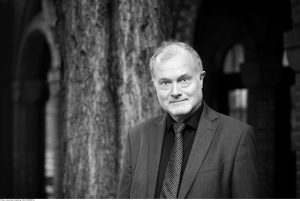
Kåre Nordstoga
Kåre Nordstoga (b. 1954) studied at the Norwegian Academy of Music under Søren Gangfløt, Bjørn Boysen and Kaare Ørnung, among others. Following his debut concert in 1978, he continued his studies under David Sanger in London, and was for a time organist at Ullern Church before coming to Oslo Cathedral in 1984. He has also been associated with the Norwegian Academy of Music, where he was appointed professor in 1994.
As cathedral organist at Oslo Cathedral, Nordstoga frequently performs a large repertoire, which has included two popular concert series with Bach's complete organ works. His recordings include the organ music of Bach, Brahms, Franck, Widor and Liszt, all of Bach's violin sonatas recorded on the cathedral's chancel organ in collaboration with violinist Geir Inge Lotsberg, as well as several recordings of Norwegian organ music. Nordstoga is an active concert organist.
In recent years he has been soloist with the symphony orchestras of Oslo, Bergen and Trondheim, and he has been invited to organ festivals abroad, including Aarhus, Notre Dame in Paris, and the Musashino Cultural Center in Tokyo. In 2006 he was awarded the Lindeman Prize for his active contribution to musical life.
Johann Sebastian Bach
Johann Sebastian Bach was born on 21 March 1685 in Eisenach into an extensive family of musicians. Orphaned by the age of ten, he was raised by his elder brother Johann Christoph in Ohrdruf before receiving a scholarship to the Michaelisschule in Lüneburg in 1700. His first appointment, in 1703, was as a court violinist to Duke Johann Ernst of Saxe-Weimar, but within months he became organist at the Neue Kirche in Arnstadt, composing his first significant organ works and, in 1705, travelling to Lübeck to study with Dietrich Buxtehude. In 1707 he became organist of St Blasius's Church in Mühlhausen and married his cousin Maria Barbara; the following year he entered the service of Duke Wilhelm Ernst in Weimar as court organist, rising to concertmaster in 1714 and building a reputation as an organ virtuoso.
In 1717 Prince Leopold of Anhalt-Köthen appointed him Hofkapellmeister, a productive period that yielded much of his instrumental output, including violin concertos and orchestral suites, though it was also marked by the death of his wife in 1720; he remarried the following year to Anna Magdalena Wilcke. In 1723 Bach was elected Thomaskantor in Leipzig, a post he held for the rest of his life, composing there his great vocal works, including the St John and St Matthew Passions and over two hundred cantatas, until his death on 28 July 1750.