
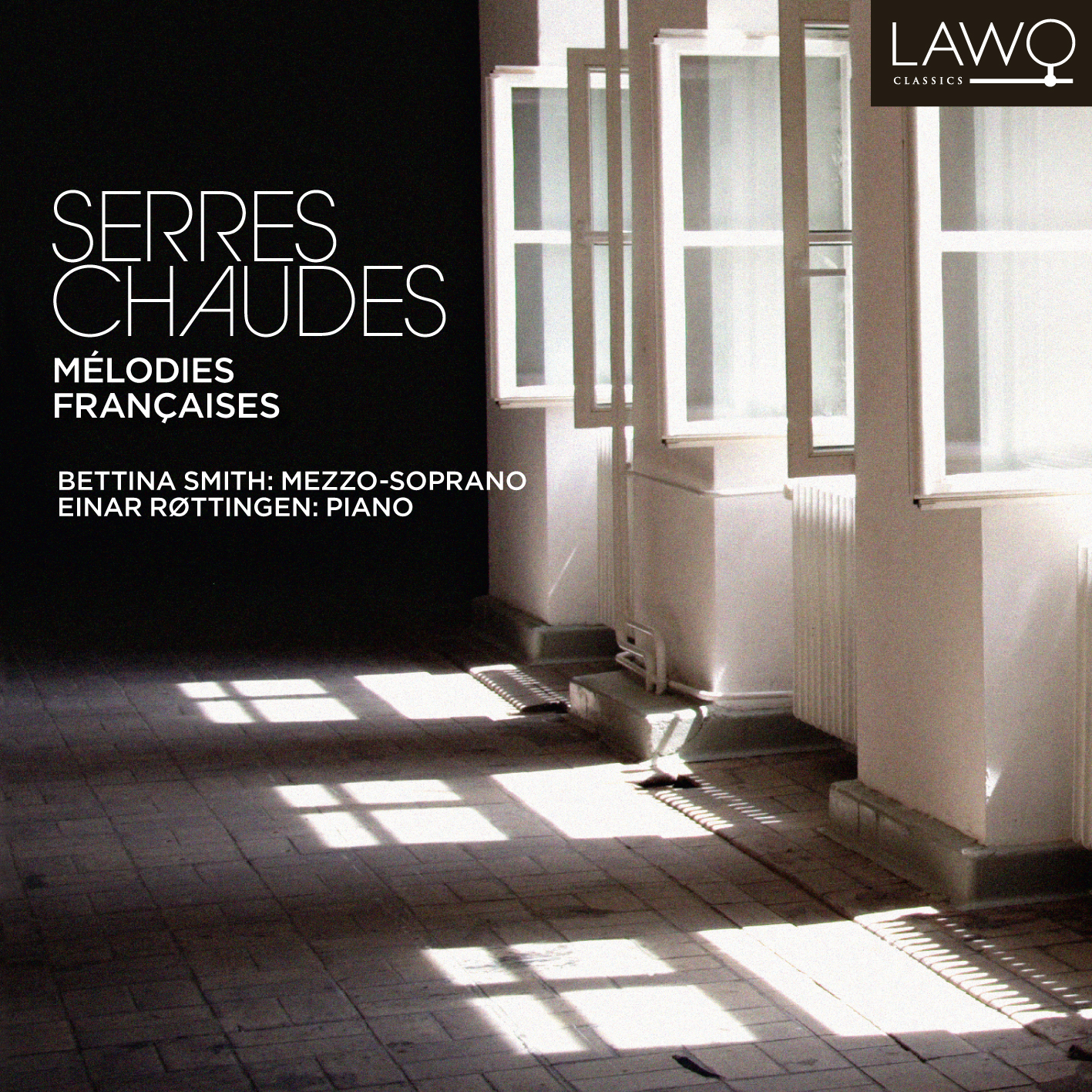
Serres Chaudes – Mélodies Francaises
Bettina Smith (Mezzo-soprano) | Einar Røttingen (Piano)
SERRES CHAUDES
The CD “Serres Chaudes” was recorded by two artists who share a special fondness for the French art song repertoire—mezzo-soprano Bettina Smith and pianist Einar Røttingen. It was their wish to focus on lesser known works of three masters of La Mélodie Française, as the genre is known in French. Quite naturally their choice fell on Ernest Chausson’s “Serres Chaudes,” Gabriel Fauré’s “Le Jardin Clos,” and Camille Saint-Saën’s “La Cendre Rouge.”
What these song cycles have in common is that each is a late opus and regarded as a main work of the respective composer. This is French music with French texts from a limited time period when European music experienced major changes of style and genre. Moreover, they are seldom performed and few recordings exist—there are, for example, no other available recordings of Saint-Saën’s “La Cendre Rouge.” That the texts are written by poets regarded as Symbolists is a further common thread. On this new CD from LAWO two distinguished artists present a treasure trove of songs seldom accessible to the listening public.
Stream & download
Tracks
Ernest Chausson (1855–1899)
Serres Chaudes, Op. 24
Gabriel Fauré (1845–1924)
Le Jardin Clos, Op. 106
Camille Saint-Saëns (1835–1921)
La Cendre Rouge, Op. 146
Credits
- Performer
- Bettina Smith (Mezzo-soprano) | Einar Røttingen (Piano)
- Composer
- Ernest Chausson | Gabriel Fauré | Camille Saint-Saëns
- Lyricist
- Maurice Maeterlinck | Charles van Lerberghe | Georges Docquois
- Producer
- Arild Erikstad
- Engineer
- Gunnar Herleif Nilsen
- Editing
- Gunnar Herleif Nilsen
- Mastering
- Thomas Wolden
- Piano tuner
- Richard Brekne
- Liner notes
- Arvid O. Vollsnes
- English translation
- Jim Skurdall
- Executive producer
- Vegard Landaas
- Booklet editor
- Vegard Landaas
- Cover photo
- Blunderbuss
- Design
- Anna-Julia Granberg | Blunderbuss
- Recording location
- NRK Hordaland Studio, Bergen
- Recording country
- Norway
- Recording year
- 2008
- Recording dates
- 30.08.2008 | 31.08.2008 | 01.09.2008 | 02.09.2008
- Original source
- 44.1 kHz, 16 bit
- Discs / tracks
- 1 disc | 23 tracks
- Produced with support from
- Fund for Performing Artists | The Audio and Visual Fund | University of Bergen
- Release year
- 2009
- Label
- LAWO Classics
- Duration
- 49:37
- EAN
- 7090020180083
- ISRC
- NOEHX0906010/230
Booklet text
The title Serres chaudes (Hothouses) reflects something of the content of this recording. This is French music with French texts from a limited time period when European music experienced major changes of style and genre. Common also to the songs is the basis of the texts. They are all written by poets who called themselves or were regarded as symbolists.
The designation symbolists is often used for a group of French-speaking literati who were attracted to the ideas of Stéphane Mallarmé (1842-1898). Moreover, they wanted to be a kind of avant-garde, sharing the desire to be modern and build on the works of those whom they called "the first modern poets," Charles Baudelaire (1821-1867) and Paul Verlaine (1844-1896).
However, Mallarmé also thought of himself as a linguist and took a musical approach: The French language makes use of 24 letters, and like the 12 tones within an octave, these characters can be combined in countless ways to give us literature. This system of black alphabetic characters on white paper can be a type of "verbal piano," whereby the words result from combinations of the different "keys": "…with the multifarious combinations that are possible in the elaboration of a sentence or verse, …their own abstract doctrine emerges, which is just as esoteric as any theology."
In addition to the letters (alphabet characters/sounds), Mallarmé emphasized stillness, silence—it is equally as important as any letter, and perhaps much more effective.
The key word in Symbolism is music. The Romanticists had turned literature into something approaching visual art. Many poems present images which remain long after we have forgotten the words that evoked them. But an image at that time was, after all, figurative; it represented and achieved its effect by means of reference to elements outside the sphere of art and the emotions. Music, on the other hand, is abstract, direct art. And because the sounds which are used occur but seldom in daily life, music has an independence not shared by the other branches of art. The Symbolists took the same view as the German philosopher Schopenhauer, who thought that music presents universal ideas in the absence of a medium and represents the world in its innermost reality.
The Symbolists' objective was to imbue literature with this same directness and absoluteness. Feeling and experience took precedence; reason had to yield. All our feelings are entirely clear. But verbal expression of feelings suffers under the yoke of language. Therefore, they must be translated into symbols. Some say that through their interest in music, the Symbolists wanted to exchange precision for vagueness, but this is not in keeping with the French spirit. The Symbolists wanted to express their ideas with more precision than words alone can convey. Only then might they achieve "true knowledge." The Symbolists likewise thought (dreamed) that the material world was but a superfluous manifestation, a symbol.
Thus another key word in Symbolism is suggestion. Presenting a poem is closer to a direct experience than a description of an experience. The Symbolists were under an obligation to express ideal beauty, "something wondrous which exists behind the gravestone," which we sense instinctively or directly and yearn for nostalgically.
The real world is but a veil which must be torn asunder if one is to achieve pure understanding of the way things are. But how can the poet attain such understanding, when he has nothing at his disposal but words, which become worn and degraded in their trivial day-to-day use? Indeed, he can. "By omitting the description, he can describe even more." By breaking up the syntax and interrupting the association of ideas and usual images, he can create other, unfamiliar, disconnected associations, and this quality of disconnectedness, combined with the music in the lyrics, ought to evoke that which is inexpressible, the idealized conception of the way things are. What is more, it is not a matter of making anything meaningfully clear in intellectual terms. Just feeling it, sensing it, is sufficient. An endeavour of this kind to pluck from lyric poetry all intelligible elements and reshape it into a melodious formula was, without a doubt, something new.
The expression "pure poetry" occurs often in connection with the Symbolist poets. The "story," or "idea," that which the poem "deals with," is not poetry. Such elements exist outside the poetic realm. The "true content" of the poem is incomprehensible and can only be experienced intuitively. Pure poetry is not of necessity better poetry. The value of a poem lies not in the themes it treats or the views arising from it, but rather in intangible qualities that can neither be translated nor discussed rationally.
Pure poetry must concern itself with the most fundamental conditions which shape external appearances. Like the Impressionist painters around the same time who blurred the contours of the object in light's reflection of colours, the Symbolists rejected any expression of fixed form, precise demarcations, the bulkiness of solid objects. They labored to capture an evanescent reflexion of time in a day or a season, the incessant rhythm of life in work, decomposition, and recomposition.
In such a way the most fleeting nuances were used to express the concealed laws of nature and all things living, between transitory appearances and eternal causes. The specific reality of the material world seems to vanish. The whole of nature is nothing other than a transient image, a veiled symbol, obscured by eternal laws.
For the French composers around the turn of the last century, Symbolism represented what was modern, something new and forward-looking, something which gave expression to the spirit and individuals of the new age. In France, however, the composers did not want a break with existing tradition; they could only reject some of the established conventions. Gradually, they also rejected the musical hero of the literary Symbolists, the German, Richard Wagner. Musicians were expected, more and more, to adapt to a common French culture, which had proved to be sufficiently vigourous. At the same time, by the use of new musical means, their expression could follow modern trends. The critics used the term "Impressionism" for some of the new radical music, although this categorization is associated with visual art. And it has become an established concept, even though Musical Symbolism perhaps would have been more representative for the musical preferences of the time.
The three song cycles on this CD all have their basis in Symbolist poems. In contrast to earlier cycles, the composers have foregone any musical thematic unity between the songs. It is above all the themes which are the common link.
ERNEST CHAUSSON: Serres chaudes, Op. 24 (1893-1896) (Text: Maurice Maeterlinck) Ernest Chausson (1855-1899) obtained a degree in law, before studying composition with Jules Massenet at the Conservatory in Paris, a classical French music education at the time. With his judicial background he became involved in many organizations and institutions within the cultural world; he had his own salon, and there was scant time for composing. In his opus list there are only 39 numbers, and his most well-known work today is Poème for violin and orchestra.
In the 1890s Chausson became acquainted with Debussy and his music, at which time he modified his style from lines and sounds of late Romanticism toward Debussy's richly coloured, nonfunctional chords and fluid time. The focus shifted from opera dreams and theatre music to more intimate musical forms. During this time Chausson also read translations of Russian authors—Turgenev, Tolstoy, Dostoevsky—which perhaps contributed to his pessimism at the end of his life.
The Belgian Symbolist poet, Maurice Maeterlinck (1862-1949) said: "I grew up in my father's hothouses," whence the title of Chausson's song cycle based on Maeterlinck's texts. The songs were received enthusiastically by radical musicians. Conservative critics, too, were well-disposed, underscoring the mood of the songs created by their harmonic language and their sound.
GABRIEL FAURÉ: Le jardin clos, Op. 106 (1914) (Text: Ch. van Lerberghe) Gabriel Fauré (1845-1924) dominated French musical life for a long period of time, both as composer and by virtue of his position as director of the Paris Conservatory. He spent 20 years revising his most famous work, the beautiful Requiem, and though he wrote many songs and song cycles, he let them mature by making small changes before publishing them.
He said himself that he suffered from "spleen," the English catchword which became important for the modern individual (also in Norway) and which characterizes a kind of melancholy, a weariness of existence among intellectuals for whom the material world is too clamourous. Spleen was an ideal word for symbolists, and Fauré used Verlaine's poem of the same name before 1890. Like his mentor, Saint-Saëns, Fauré was consciously aware of being "French" in his music and in his work for national culture, though without becoming chauvinistic. He could go to Belgian Symbolists to find his texts. He composed the incidental music to Maeterlinck's Pelléas et Mélisande in 1898 (four years before Debussy completed his opera), and he wrote two song cycles based on texts of Maeterlinck's friend and compatriot, Charles van Lerberghe (1861-1907): La chanson d'Ève (1907) and Le jardin clos (1915). Van Lerberghe was best known as a symbolist dramatist, but Fauré's songs cast light on his lyric poetry. The poems in this last song cycle have a rather simple and free form, which carries over to the music. Fauré allowed a flexibility of movement in the lines both in tempo and rhythm. It is as if he is transferring the Church's psalmodic Gregorian plain chant to the music of the salon. The songs become anti-German, and they are not "written in sand."
CAMILLE SAINT-SAËNS: La cendre rouge, Op. 146 (1914) (Text: G. Docquois) Camille Saint-Saëns (1835-1921) was, in his youth, preoccupied in particular with the new expressiveness of Romantic composers, such as Schumann and Liszt. But gradually he turned his attention to what he called the "composers of Classicism," Bach and Händel, as well as to the French tradition. Like Chausson and Fauré, he founded his association for French culture: Ars Gallica. French music should possess the qualities of moderation, clarity, balance, precision, and logic, all of which are French virtues. As a consequence, the music would become classical, in the sense of being exemplary and well-formed.
Saint-Saëns wrote songs throughout most of his long career as a composer, including some based on his own texts. When he had completed the cycle La cendre rouge, he wrote to his friend Fauré that he had dedicated to him "a collection of ten pieces for voice and piano, which I have completed. They are based on some lovely poems by Georges Docquois [1863-1927]. It will delight me to see your honourable name at the top of my collection. I dare not call them songs, for they are something quite different, something I cannot describe. Some are cheerful, others serious. There is something here for every taste, let us hope there is also something for you."
— Notes: Arvid O. Vollsnes · English translation: Jim Skurdall
Biographies
Bettina Smith
Bettina Smith is from Bergen, Norway. After graduating from Bergen Conservatory of Music, she studied with Wout Oosterkamp and Elly Ameling at the Royal Conservatory of Music in The Hague, receiving a Master's degree with distinction. This was followed by specialized study in Switzerland at the Zurich International Opera Studio.
Her two-year engagement there included performing several roles on the main stage of the Zurich Opera House. Since making her debut in February 2001 at the Berlin State Opera singing the role of Berta in Rossini's The Barber of Seville, she has performed at Europe's leading opera houses and concert halls and at major European festivals. With a wide repertoire ranging from medieval to contemporary music, Bettina Smith appears regularly as an oratorio and cantata soloist, in addition to being an active chamber musician.
Oratorios include Verdi's Requiem; Mendelssohn's Elias; Mozart's C-minor Mass, Requiem, Credo Mass and Coronation Mass; all the Bach passions, as well as the Magnificat and B-minor Mass; Rossini's Stabat Mater; Telemann's Die Gekreuzigte Liebe and St Luke Passion; Liszt's Christus; Bruckner's Mass in F minor and Te Deum; and Mahler's Eighth Symphony.
European festivals where Bettina has performed include the Bergen International Festival, Festspiele Zürich, Rhijnauwen Chamber Music Festival, Utrecht Early Music Festival, Mozart-Tage and Bach-Tage in Lucerne, Brahms Festival Den Haag, Hindemith Festival Den Haag (where she performed Des Todes Tod with Nobuko Imai), and the Stravinsky Festival 2000 at the Amsterdam Music Theatre with the National Ballet. Together with Norwegian pianist Einar Røttingen, she has performed at various festivals in Norway and abroad.
Bettina has recorded for Dutch, German, Swiss and Norwegian Radio and has received a number of prestigious scholarships, among them the Edwin Ruud Stipend and the Herbert von Karajan Music Legacy. In 2001 she was a prizewinner at the Francesco Viñas Competition in Barcelona, where she also received a special prize from Dalton Baldwin for outstanding lieder singing. She has previously released two critically acclaimed CDs on the LAWO Classics label with pianist Einar Røttingen: Serres Chaudes (LWC1008) with songs by Fauré, Chausson and Saint-Saëns, and Voices of Women (LWC1067) with songs by Norwegian composers Valen, Stalheim and Hvoslef. Bettina Smith is Associate Professor of singing at the University of Stavanger.
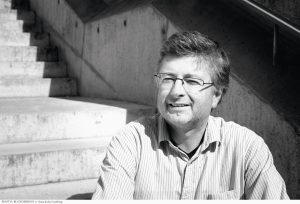
Einar Røttingen
Pianist Einar Røttingen is Professor of Music Performance at the Grieg Academy, University of Bergen. He received his education at the Bergen Conservatory of Music and the Eastman School of Music. In addition to being a frequent guest at the annual Bergen International Festival and the Edvard Grieg Museum concert series in Norway, he has performed extensively as a soloist and chamber musician in major cities in Europe, the USA, Japan and China.