
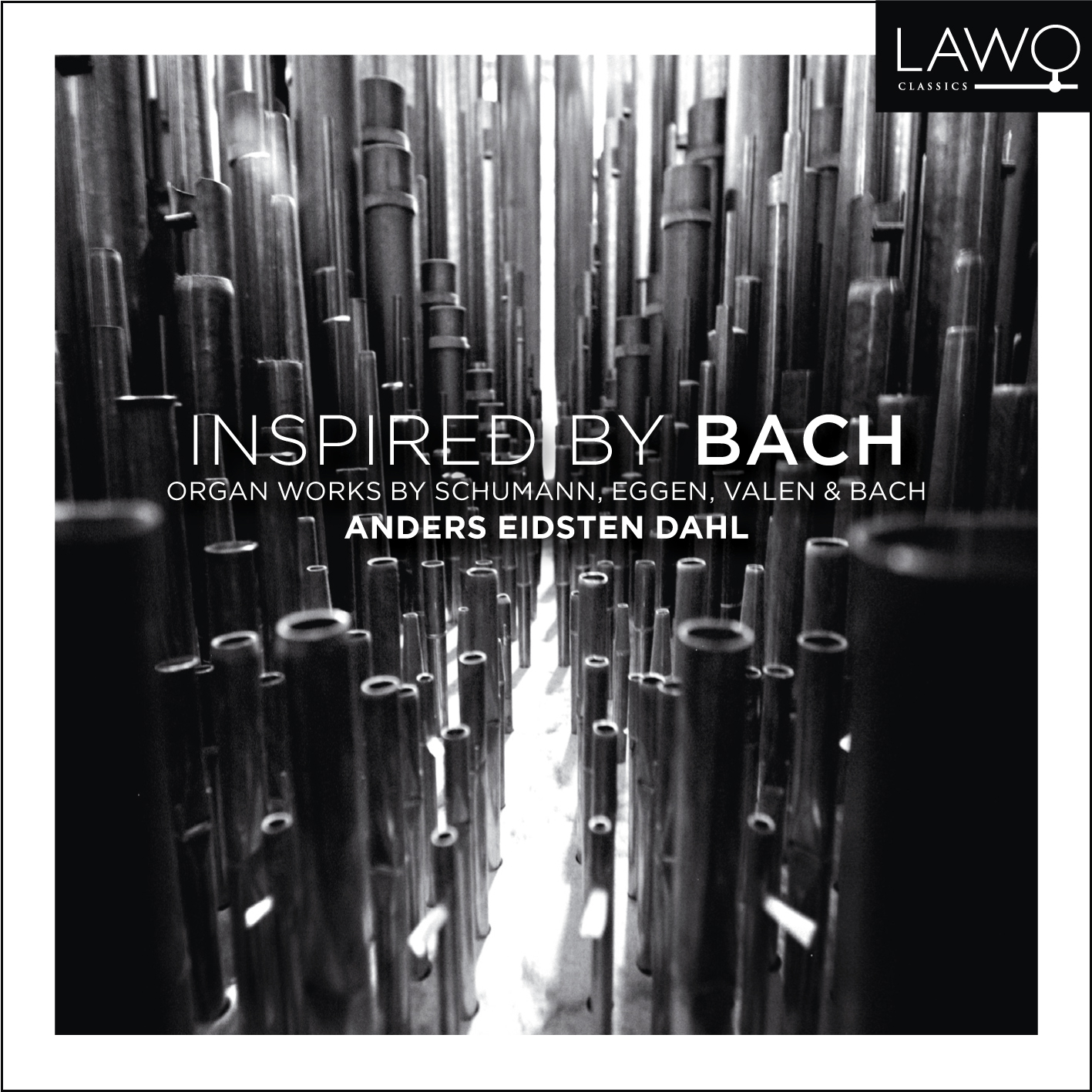
Inspired by Bach – Organ works by Schumann, Eggen, Valen & Bach
Anders Eidsten Dahl (Organ)
INSPIRED BY BACH
It is the young Norwegian organist Anders Eidsten Dahl who has recorded the CD “Inspired by Bach” with music by Robert Schumann, Arne Eggen, Fartein Valen and Johann Sebastian Bach. Common for these composers are the influence of Bach in their creative mission. In Robert Schumann´s “Skizzen für den Pedalflügel” and “Studien für den Pedalflügel – Sechs Stücke in kanonischer Form”, written for the now relatively unusual pedal grand piano, Schumann seeks to build a connection between a contrapuntal way of thinking and a poetic expression. Schumann himself believed that the pedal grand piano, which was somewhat widespread in the 19th century, would become the piano of the future. However, the quality of the music has made it fit within the central romantic organ repertoire. Arne Eggen was organist in Bragernes church between 1908-24 and wrote his grand Ciaconna for organ in 1917. When the Danish organ builder Carsten Lund built the organ in 1998, one chose to use seven-eight very central parts from the old Claus Jensen-organ which had survived in the several re-built organ from 1872. Several of the most important parts in today´s organ are actually from the time Eggen was organist in the church.
This is the first time the work is available on CD, a work that must be said to be one of the most central Norwegian organ works from the romantic tradition. Fartein Valen had like most composers of his generation, an organist exam. However, he wrote only two organ works, “Preludium og fuge” og “Pastorale”, now for the first time available on CD. Both works are good examples of Valen´s personal dissonating contra punt where Valen has left much of the musical colouring to the performer. The main organ in Bragernes church is built (1998) by the Danish organ builder Carsten Lund. Lund is counted among the most well-esteemed organ builders in the Nordic countries today. The organ and the room in Bragernes church are among the most splendid in Norway, and romantic organ music becomes the instrument especially well.
Listen
Tracks
Robert Schumann (1810–1856)
Skizzen Für Den Pedalflügel, Op. 58
Arne Eggen (1881–1955)
Robert Schumann (1810–1856)
Sechs Stüche In Kanonischer Form, Op. 56
Fartein Valen (1887–1952)
Prelude And Fugue, Op. 33
Johann Sebastian Bach (1685–1750)
Credits
- Performer
- Anders Eidsten Dahl (Organ)
- Composer
- Robert Schumann | Arne Eggen | Fartein Valen | Johann Sebastian Bach
- Producer
- Vegard Landaas
- Engineer
- Thomas Wolden
- Editing
- Vegard Landaas
- Mastering
- Thomas Wolden
- Liner notes
- Harald Herresthal
- English translation
- Jim Skurdall
- Executive producer
- Vegard Landaas
- Booklet editor
- Vegard Landaas
- Cover photo
- Anna-Julia Granberg
- Design
- Anna-Julia Granberg | Blunderbuss
- Recording location
- Bragernes Church, Drammen
- Recording country
- Norway
- Recording year
- 2008–2009
- Recording dates
- 19.10.2008 | 20.10.2008 | 16.01.2009 | 17.01.2009
- Original source
- 96 kHz, 24 bit
- Discs / tracks
- 1 disc | 15 tracks
- Produced with support from
- Arts and Culture Norway | Lydia and Harald Lyches Foundation | Drammen Kommune
- Release year
- 2009
- Label
- LAWO Classics
- Duration
- 1:11:30
- EAN
- 7090020180076
- ISRC
- NOEHX0905010/150
Booklet text
WITH BACH AS MODEL
In June, 1842, the 21-year-old Norwegian pianist, Thomas Tellefsen, arrived in Paris to study piano with Frédéric Chopin. The son of the cathedral organist in Trondheim, he had learned to play both harpsichord and organ. In Paris he was astonished to discover that the city's organists were performing marches and dance music rather than church music on the many magnificent organs. Their fingers flew over the keys, while their feet rested on either side of the pedalboard.
In 1844 Tellefsen wrote to his father asking if he could borrow his pedalboard. It was, he said, impossible to obtain the likes of it in France. But Tellefsen had plans not only to use it while practicing harpsichord. He also wanted to show it to piano makers Erard and Pleyel in the hope that they might produce pedalboards for upright and grand piano. "What would you say," he asked his father, "if you heard Bach's immortal pedal fugue played using such means," whereby he was referring to Bach's fugue from Fantasie und Fuge in G minor. From this correspondence the reader could be left with the impression that it was Thomas Tellefsen who inspired the two French piano makers to turn out the first pedal grand piano in France.
The Leipzig Conservatory ordered a pedal grand piano from Pleyel. That in turn aroused the interest of Clara and Robert Schumann, who had immersed themselves in the study of counterpoint following a concert tour through Russia. Robert Schumann's diary confirms that they both studied counterpoint and wrote fugues from February to June, 1845. "Fugepassion," a passion for fugues, Robert Schumann wrote a number of times in his diary in the course of that spring and autumn, while completing his Sechs Fugen über den Namen BACH für Orgel oder Pianoforte mit Pedal, op. 60. Both Clara and Robert wanted to learn to play with pedals in order to fully utilize the pedal technique, so in April, 1845, they borrowed a pedalboard. According to Clara, it afforded them much pleasure. "We wanted to practice with it so that we could play the organ," she wrote in her diary. Robert Schumann had court organist Johan Schneider in Dresden play some of the fugues for him on the organ, and on a trip to Amsterdam in 1853 he was delighted to listen to organist Jan van Eijken's performance of the Adagio In B Major, from Studien für den Pedalflügel - Sechs Stücke in kanonischer Form, op. 56. It suggests that Schumann imagined that all works for pedal grand piano could be played on the organ.
Studien für den Pedalflügel - Sechs Stücke in kanonischer Form, op. 56 is dedicated to organist Johann Gottfried Kuntzsch, who was Schumann's first piano teacher in Zwickau in 1820. Both Kuntzsch and others took care that Schumann acquired an appreciation of Johann Sebastian Bach's music at an early age. He had, for example, procured a copy of Die Kunst der Fuge in 1837, and in 1838 he fervently practiced pieces in Das wohltemperierte Klavier.
Schumann was beside himself with enthusiasm for Felix Mendelssohn's organ concert in St. Thomas Church in Leipzig in 1840, and in letters, diary entries, and articles he repeatedly stated that his aim as an artist was to create a strong bond between a contrapuntal way of thinking and poetic expression. Bach's fugues had become the standard for the craft of composition, and Schumann believed for a time that only his Fugen über den Namen BACH would survive him as composer. He was, moreover, certain that the pedal grand piano would endow the piano with entirely new musical possibilities, something which did not prove correct. The first editions of opus 56 and 58 indicate that the works can be performed for three-handed or four-handed piano, but today they belong principally to the organ repertoire of the Romantic period.
Anders E. Dahl opens the CD-recording with Skizzen für den Pedalflügel, op. 58 (1845). The work comprises four pieces, which, despite their difference in character, are tied together by a common dance-like motif that repeats itself and is used in all the movements. The form is the three-part Lied form A—B—A. Each of the parts consists of two parts which are repeated. Just like the minuet or scherzo, the individual movements are in ¾ time with a middle section (trio) contrasting with the outer parts. Typical techniques used in Schumann's piano pieces, as, for example, the melody moving in parallel sixths in the outer voices, while the middle voices create figurations, illustrates the close connection of these pieces with Schumann's other poetic character pieces. While the piano technique in this work actually has little to do with polyphony, the line back to Bach is all the more prominent in the first of the Studien für den Pedalflügel, op. 56. Some of the other movements suggest associations with Mendelssohn, but as a whole the movements are typical Schumann character pieces of varying poetic content. Studie V, for example, is structured like a scherzo and became a prototype for similar character pieces by Max Reger and Louis Vierne.
Arne Eggen (1881-1955) took his organist's degree at the Conservatory of Music in Kristiania in 1905 and composed Ciaconna for the organ in 1917. Upon completing the degree in Kristiania he continued his organ studies with St. Thomas cantor Karl Straube in Leipzig. At the same time, he received a solid foundation in music theory and composition at Mendelssohn and Schumann's conservatory, where techniques of Baroque masters were an integral part of the curriculum. The chaconne and passacaglia form was one of the most prevalent types of variation and was so popular among organ students that a countless number of such works for the organ were composed in the first third of the twentieth century.
In Norwegian music history Arne Eggen is first and foremost associated with the oratorio Kong Olav (1930) and the opera Olav Liljekrans (1931-1940). In the oratorio the archaic features are prominent, while the opera, which incorporates many elements of folk music, can be regarded as a prolongation of Norway's period of National Romanticism. Viewed in this context, Ciaconna stands in stark contrast to later developments in Eggen's style. Here we find no typical features of National Romanticism. This monumental work for organ has much in common with the organ works of Max Reger, and yet it is distinctive. Eggen composed Ciaconna while he was organist at Bragernes Church in Drammen (1908-1924), and the work demonstrates that he was an organist of some importance who possessed great technical proficiency. Apart from L. M. Lindeman's two significant sets of variations from the nineteenth century, Ciaconna must be regarded as the most significant Norwegian work for organ before Arild Sandvold composed his Introduksjon og Passacaglia in 1927.
Fartein Valen (1887-1952) was some years younger than Arne Eggen. After completing his organist's degree at the Conservatory of Music in Kristiania in 1909, Valen studied composition with Max Bruch and Carl Leopold Wolf at the Academy of Music in Berlin. The style of his earliest works was heavily influenced by Brahms and the late German Romantic period, but over time it developed in the direction of atonal expressionism.
Following his years in Berlin, Valen felt that he had not mastered his craft well enough to express all he wished to express. For further practice he began transposing all of Bach's 48 preludes and fugues from Das wohltemperierte Klavier to other keys. It is perhaps not so odd that from time to time while engaged in the project he dreamed that he received visits and advice from Bach. On one occasion, Bach appeared to be standing in the middle of his bedroom. He went over to a bookshelf, stopped, pointed to a book, then vanished. Valen knew at once which book Bach had pointed to. It was a collection of Bach fugues, and he interpreted this as a sign that he was to compose polyphonic works, not with consonances as Bach had done, but rather based on dissonances. Beginning in 1924 Valen chose to compose in a free polyphonic twelve-tone style. By using the chromatic scale as material for motifs and themes, he believed he could create something new.
Fartein Valen was the child of missionaries and himself deeply religious by nature. This is most evident in his music from the 1930s. He produced among other works ten motets before composing his only two works for organ in 1939, Preludium og Fuga, op. 33, followed by Pastorale, op. 34.
Valen's musical ideas were often inspired by poems, pictures, and things he experienced in nature. In Preludium og Fuga for piano, op. 28, the idea for the staccato motif came from the motion of the waves during a boatride. 2 Preludier for Piano, op. 29, was inspired by J. F. Millet's painting "The Sower," as well as by a picture of the disciple Peter walking on water. But though he used such sources of inspiration, Fartein Valen insisted that he did not write program music. The pictures stimulated his imagination, to be sure, but the ideas were developed wholly according to musical principles.
The source of inspiration for his Pastorale for organ was El Greco's painting "The Adoration of the Shepherds." Again, this was not a musical portrait, nor was it an interpretation of the subject matter. The musical ideas were triggered instead by the painting's highly compressed mood. Pastorale is composed in a musical form which is often associated with Christmas and Jesus' birth, but apart from the characteristic 6/8 time, Valen's work is a contrapuntal masterpiece and a little universe of thematic associations and contexts, guided entirely by musical effects. A first listening may not reveal all the contrapuntal details, but the listener will discern nevertheless how the music rises and falls with respect to tension or concentration—and here we are using Valen's own words as our point of departure.
Valen first wrote the fugue in Opus 33, which is a characteristic example of his increasingly dissonant polyphony. The theme of seven measures consists of four different two-measure motifs based on the chromatic scale in such a way that a sense of key remains elusive. In the polyphonic process the motifs are utilized individually in various ways. Both in Preludium og Fuge and in Pastorale Valen contents himself with using few dynamic markings and leaves coloring and elaboration to the performer.
The music on this recording is full of contrasts and, from a historical perspective, begins in the 1840s and spans a period of one hundred years. What the composers represented here have in common is that they have used Johann Sebastian Bach as their model. Thus it seems appropriate to conclude this journey from Romanticism to twelve-tone music with a work from the master himself.
In March, 2008, parts of St. Thomas cantor Wilhelm Rust's manuscripts were turned over to the University and State Library of Sachsen-Anhalt in Halle, and it was then that Stephan Blaut and Michael Pacholke discovered that the collection contained a complete copy of Johann Sebastian Bach's choral fantasia on "Wo Gott der Herr nicht bei uns hält." Until then only a few measures of the work, which is dated to between 1705 and 1710, were known to exist.
This discovery, as well as the high quality of the music, has caused something of a sensation, and over this short period of time the work has been circulated and performed in many parts of the world. The choral lines of this large-scale fantasia are arranged in typical baroque manner in a four-voiced polyphonic movement, in which soprano and bass alternate in presenting the chorale in an ornamented form.
— Notes: Harald Herresthal · English translation: Jim Skurdall