
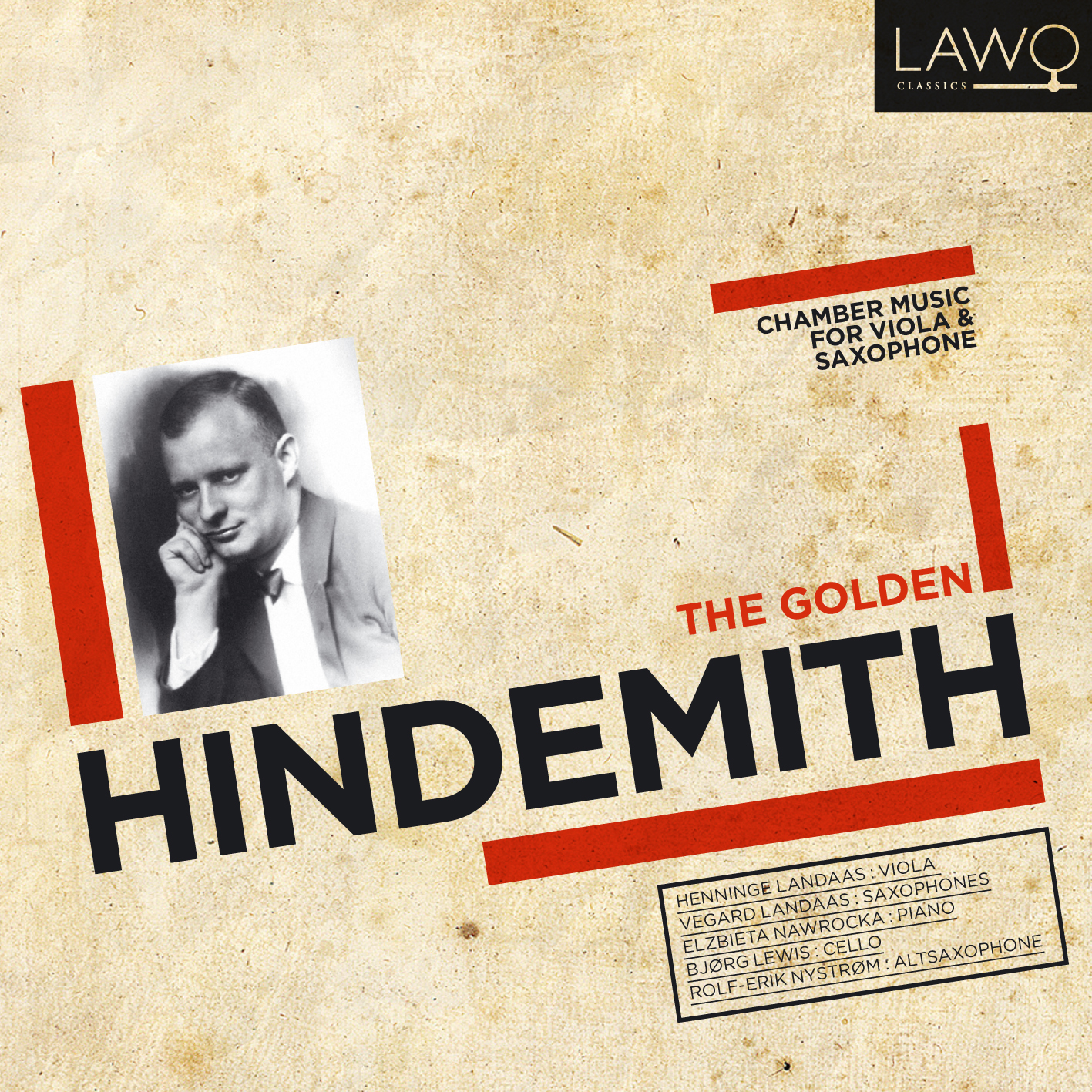
Paul Hindemith
The Golden Hindemith – Chamber Music For Viola & Saxophone
Henninge Landaas (Viola) | Vegard Landaas (Saxophone) | Elzbieta Nawrocka (Piano)
THE GOLDEN HINDEMITH – CHAMBER MUSIK FOR VIOLA AND SAXOPHONE
Many regard Hindemith’s music as rather inaccessible. Hindemith himself was impulsive, very much concerned with the emotional aspect of music, and tired of people who only thought of music in theoretical terms. The musicians on this recording from LAWO Classics have set themselves the task of showing the not so familiar, more playful Hindemith. The CD begins with a duet for viola and cello. That the work is seldom performed in concert and virtually impossible to find as a recording is due to its high degree of difficulty. The instrumental voices are interwoven in intricate parts in which the cello suddenly soars above the viola. The elaborate interplay is presented by Henninge Landaas on viola and Bjørg Lewis on cello. Also included is the familiar solo sonata for viola opus 25/1 in Henninge Landaas’s sparkling interpretation.
The CD contains the complete chamber works for saxophone composed by Paul Hindemith. The saxophone duet in three movements was written for the legendary saxophonist Sigurd Racher, but it was never performed during the composer’s lifetime. It is heard here in a delectable rendering by two of Norway’s leading saxophonists, Rolf-Erik Nystrøm and Vegard Landaas. In the sonata for alto saxophone and piano there is a dualism that is especially evident in the last movement, where Landaas’s saxophone represents that which is timeless, while the piano of Elzbieta Nawrocka stands for what is restless and modern. The main work featured on the CD is the Trio for Tenor Saxophone, Viola and Piano. One would have to search far and wide to find more closely interwoven parts than these!
In the CD booklet the listener will also find passages from a stage play entitled “Tre takter takk!” written by actor and author John Nyutstumo. It was commissioned by the musicians and especially adapted to the music on the CD.
Stream & download
Tracks
Paul Hindemith (1895–1963)
Duett Für Bratsche Und Violoncello (1934)
Henninge Landaas (viola) | Bjørg Lewis
Konzertstück Für Zwei Alt-Saxophone (1933)
Rolf-Erik Nystrøm | Vegard Landaas
Sonate Für Bratsche Allein, Op. 25 NO. 1 (1922)
Henninge Landaas (viola)
Sonate Für Alt-Saxophon Und Klavier (1943)
Elzbieta Nawrocka | Vegard Landaas
Trio for Viola, Tenor Saxophone and Piano, Op. 47
Henninge Landaas (viola) | Elzbieta Nawrocka | Vegard Landaas
Reviews
There is certainly a exuberant spirit to the album.…
Show more Show less
There is certainly a exuberant spirit to the album. It is perhaps particularly lively in the concert piece for two alto saxophones – skilfully performed by Vegard Landaas and Rolf Erik Nystrøm. Likewise, the trio for saxophone, viola and piano concludes with a fireworks display of variations, whilst the sonatas are once again imbued with a more contemplative mood. … or in the sonata for viola solo: ‘Rasendes Zeitmass. Wild. Tonschönheit ist Nebensache’. For me, this final sonata is a highlight, interpreted with intensity and passion by Henninge Landaas. In general, it should be said that with such performers on board, there is every reason to appreciate the one-year-old label Lawo’s aim of supporting its artists over the long term.Show original
Der er absolutt eit sprudlande uttrykk på plata. Kanskje særleg sprettent er det i konsertstykket for to altsaksofonar – dyktig utført av Vegard Landaas og Rolf Erik Nystrøm. Likeeins avsluttar trioen for saksofon, bratsj og klaver med eit fyrverkeri av variasjonar, medan sonatane igjen er meir ettertenksamt lada. … eller i sonaten for bratsj åleine: «Rasendes Zeitmass. Wild. Tonschönheit ist Nebensache». Denne siste sonaten vert for meg eit høgdepunkt, heftig og inderleg tolka av Henninge Landaas. Generelt bør seiast at med slike utøvarar på lag, er der all grunn til å setja pris på eitt år gamle selskapet Lawo sitt mål om å følgja sine utøvarar over tid.
 Dagsavisen
Norwegian
The selection of works makes this recording a splendid presentation of certain strands in twentieth-century music history.…
Show more Show less
The selection of works makes this recording a splendid presentation of certain strands in twentieth-century music history. Hindemith explores both the instruments and the relationship between the present and the past. The final work on the album, the ‘Trio for Tenor Saxophone, Viola and Piano’ from 1928, is the only piece in which the saxophone and viola sound together. It thus feels like a musical summary of the album, lending it a sense of cohesion.Show original
Sammenstillingen av verker gjør platen til en flott presentasjon av noen linjer i det tjuende århundrets musikkhistorie. Hindemith prøver ut både instrumentene og forholdet mellom samtiden og historien. Det siste verket på platen, «Trio for tenorsaksofon, bratsj og klaver» fra 1928, er det eneste verket der saksofonen og bratsjen klinger sammen. Det føles dermed som en musikalsk oppsummering av platen, og gir platen en enhetlig karakter.
 Bergens Tidende
Norwegian
This is quite simply sophisticated music for a select few, but performed by incredibly talented musicians.…
Show more Show less
This is quite simply sophisticated music for a select few, but performed by incredibly talented musicians. The CD contains all of Paul Hindemith’s chamber works for saxophone, and this recording is a minor masterpiece… for those with a particular interest.Show original
Dette er rett og slett avansert musikk for noen få, men fremført av fantastisk dyktige musikere. CD-en inneholder samtlige kammerverk for saksofon skrevet av Paul Hindemith og utgivelsen er et lite mesterverk... for spesielt interesserte.
 Telemarksavisa
Norwegian
The fact that they are performed in such a polished and beautiful manner is truly magnificent.…
Show more Show less
The fact that they are performed in such a polished and beautiful manner is truly magnificent. The music is undoubtedly demanding for the performer – both in terms of form and technical challenges. But when performed in such an airy and virtuosic manner as here, it is easy to let a smile accompany the playful vibrations in your ears. The musicianship here is of the very highest calibre.Show original
At de fremføres på en slik gjennomført og vakker måte er storveis. Musikken er nok krevende for utøveren - både når det gjelder form og tekniske utfordringer. Men når de fremføres på en så luftig og virtuos måte som her, er det enkelt å la smilet følge øregangens lekne vibrasjoner. Musiseringen her er av meget godt merke.
 Smaalenene
Norwegian
First and foremost, this is a recording that lifts your spirits.
Show original
Først og fremst er dette en humørskapende innspilling.
 Kulturspeilet
Norwegian
Show all 10 reviews
The duet for viola and cello is performed superbly by two of Norway’s finest chamber musicians today, Henninge Landaas on viola and Bjørg Lewis on cello.…
Show more Show less
The duet for viola and cello is performed superbly by two of Norway’s finest chamber musicians today, Henninge Landaas on viola and Bjørg Lewis on cello. The record label LAWO Classics has given these two performers a very fine, airy sound. Warm and without excessive reverberation. An excellent booklet. They showcase Hindemith’s playful side, and I have no hesitation in recommending this new Norwegian recording. The musicians are several notches sharper, playing with greater finesse and clarity than the benchmark recording. There is a forward momentum and a playfulness that are simply superb. Very entertaining, elegant and alertly performed. Highly recommendedShow original
Duett for bratsj og cello blir spilt utrolig bra av to av Norges beste kammermusikere i dag, Henninge Landaas, bratsj og Bjørg Lewis, cello. Plateselskapet LAWO Classics har gitt disse to utøverne veldig god og luftig lyd. Varm og ikke overdrevet ekko. Et eksellent teksthefte. De vil vise den lekne Hindemith, og jeg vil ikke nøle med å anbefale denne nye Norske innspillingen. Musikerne er flere hakk vassere, bedre og renere spilt enn referansen. Det er en fremoverbue og en lekenhet som er helt fortreffelig. Veldig morsomt, elegant og våkent gjort. Anbefales på det varmeste
… and, looking back, I don’t regret for a second that I gave this album a chance on the emmLabs.…
Show more Show less
… and, looking back, I don’t regret for a second that I gave this album a chance on the emmLabs. At times quite avant-garde, and at others almost verging on the overly lyrical and folksy. The recordings are of a very high standard in terms of sound engineering. The musicians featured are also drawn from the Norwegian (and international) elite in this field.Show original
… og angrer i etterkant heller ikke et sekund på at jeg gav dette albumet en sjanse i emmLabs'en. Tidvis temmelig avantgardistisk, og atter annetsteds nesten på grensen til det overlyriske og folkelige. Innspillingene holder en meget høy kvalitet rent Iydteknisk. Musikerne som medvirker er også hentet fra norsk(og internasjonal) elitedivisjon innen feltet.
The musicians on this album take their cue from precisely this impulsive and improvisational approach, conveying the music in a lively and, not least, playful manner.…
Show more Show less
The musicians on this album take their cue from precisely this impulsive and improvisational approach, conveying the music in a lively and, not least, playful manner. The opening track, ‘Duet for Viola and Cello’, is particularly fine, brilliantly performed by Henninge Landaas and Bjørg Lewis. The album’s main work, *Trio for Viola, Tenor Saxophone and Piano*, is also a fascinating listen; the musicians’ interplay is truly a delight to the ear. In addition, the *Concert Piece for Two Alto Saxophones*, *Solo Sonata for Viola* and *Sonata for Alto Saxophone and Piano* can be found on this recording.Show original
Musikerne på denne plata tar utgangspunkt i nettopp det impulsive og improvisatoriske, og formidler musikken levende og ikke minst lekende. Særlig flott er åpningsinnslaget, Duett for bratsj og cello, glitrende tolket av Henninge Landaas og Bjørg Lewis. Også platas hovedverk, Trio for bratsj, tenorsaksofon og piano, er fascinerende å lytte til, musikernes samspill er virkelig en fryd for øret. I tillegg er Konsertstykke for to altsaksofoner, Solosonate for bratsj og Sonate for altsaksofon og klaver å finne på denne innspillingen.
 Hamar Arbeiderblad
Norwegian
This is a delightful CD of Hindemith chamber music.…
Show more Show less
This is a delightful CD of Hindemith chamber music. The program is exceptionally well planned, with viola and saxophone alternating and finally combining. The composer played every instrument he wrote for, but the viola was especially his, as he played it professionally throughout his mature life (and left us many recordings thereof). He wrote as fluently for the saxophone as he did for the viola. Although each performance is successful in its own right, this marvelous disc is even more than the sum of its parts.
 Fanfare
This is a marvelous disc, impressively played and recorded and contains a fascinating selection of Hindemith’s greatly under-appreciated chamber music.
 Musicweb International
Read at Musicweb International →
Credits
- Performer
- Henninge Landaas (Viola) | Bjørg Lewis (Cello) | Rolf-Erik Nystrøm (Saxophone) | Vegard Landaas (Saxophone) | Elzbieta Nawrocka (Piano)
- Composer
- Paul Hindemith
- Producer
- Vegard Landaas | Jørn Pedersen
- Engineer
- Thomas Wolden
- Editing
- Vegard Landaas
- Mastering
- Thomas Wolden
- Liner notes
- John Nyutstumo
- English translation
- Jim Skurdall
- Executive producer
- Vegard Landaas
- Booklet editor
- Vegard Landaas
- Cover photo
- Blunderbuss
- Artist photo
- Vegard Landaas by Anna-Julia Granberg | Vegard Landaas by Camilla Momkvist-Skau
- Design
- Anette L’orange | Blunderbuss
- Recording location
- Sofienberg Church, Oslo | Jar Church, Bærum | Ris Church, Oslo
- Recording country
- Norway
- Recording year
- 2004–2007
- Recording dates
- 13.06.2004 | 22.10.2005 | 01.12.2006 | 16.06.2007 | 04.07.2007
- Original source
- 44.1 kHz, 16 bit
- Discs / tracks
- 1 disc | 14 tracks
- Produced with support from
- Fund for Performing Artists | The Audio and Visual Fund
- Release year
- 2009
- Label
- LAWO Classics
- Duration
- 55:19
- EAN
- 7090020180052
- ISRC
- NOEHX0903010/140
Booklet text
**Paul Hindemith** *Passages from a stage play* "Tre takter takk!" *by John Nyutstumo, written to the music of this CD.*
I am Paul Hindemith.
I began studying music at the age of twelve. As violinist, violist, pianist and percussionist I have cultivated an intimate knowledge of the following musical genres: all styles of chamber music, film and theatre music, folk music, dance music, military music, operetta and jazz. And in 1916 I became concertmaster of the Frankfurt Opera orchestra.
By then I had already composed and published my own music. My former teachers said: "These are not 'typical' art songs! They are much too free in form!" And they were the modern musicians of our time! Music composed from the depth of one's soul, paying no heed to the form of the song and the like, music that strayed a bit from the norm — that made them nervous! I wanted to write music, not songs and sonatas!! Of course if I write logically and my ideas just happen to produce an "old" form, there is no harm in that. But for goodness' sake I am not compelled to think in the same old ways! It was high time for me to shake off this conservative rubbish.
What was it that bound me to these earlier teachers? Tradition. Habit. But when I really wanted to know something, there was no one who helped me, no one I could talk music with because none of them had held onto their ideals: The whole of their art had become the mere craft. Try to scribble the Muse's sweetest kiss on a simple piece of paper and — when you think you have conjured up a moment of eternal bliss — what do these blockheads hear? Not music, just notes, measures, dynamics, forms and other trivialities. The trouble with the music of that time was the music was missing! And all I wanted was to make music. I care not a whit if people like it or not — as long as it is genuine and real.
I was 27 years old and a lot was happening in my life. For one thing, I discovered a new sport. I played viola d'amore, a magnificent instrument which had not been in wide use for a long time. Very little music has been written for it. It has the most delightful sound, unimaginably sweet and soft. It is difficult to play, but I played with great enthusiasm to everyone's enjoyment.
As a youngster I had been inspired by Expressionism and had written a letter: "I have completed the third piano piece. It sounds dreadfully degenerate; has no rhythm, key, or familiar harmony of any kind. If I continue on this path I'll wind up in that realm beyond good and evil where it will be impossible to know whether I have written a higher kind of music or merely a substitute for music. But I derive great satisfaction from it. One of the pieces is nine measures in length. My burning ambition is to write a piece of only three measures: theme, development, and coda."
While serving as a soldier in the First World War, I was a member of a string quartet, which was for our commanding officer a means of escape from the horrors of war. He was a great lover of music and a connoisseur and admirer of French art. So it was no wonder that his most ardent wish was to hear Debussy's String Quartet. We rehearsed the work and played it for him with much feeling in a private concert. Right after we ended the slow movement, a signal officer burst in visibly upset and reported that he had just picked up news of Debussy's death on the radio. We did not continue the performance. It was as if the soul had been removed from our playing. Now we felt for the first time how much more music is than just style, technique, and personal expression. Here music had transcended all political barriers, national hatred, and the wretchedness of war. Never before or since have I sensed so keenly in which direction music must be taken.
Shortly before the outbreak of the Second World War my wife and I felt pressure to leave Germany, so we moved to Switzerland, where we spent several happy years. We often had visitors, and my wife warned in her invitations that musicians would not be allowed in our home unless they brought along an instrument they had never played before. Once a guest took along his son's recorder. His wife had along an alto recorder, and the pianist a silver trumpet that could only be played in the key of D major. I looked around and decided on a saxophone, and my wife a cello. I assessed the situation and furnished myself with a stack of music paper. Ignoring the conversation around me for the next half hour, I composed a quintet based on the incompetence of each one of us.
[The full text continues through Hindemith's confrontation with the student "Günther" who would not appear on a programme between two Jewish composers, his exchange with Richard Strauss, and his final meditation on the great harmony that is death.]
A person must above all be true to himself, and in the opera *Mathis the Painter* I let Mathis express my innermost convictions: "We cannot escape the surroundings in which we are born. It is here we move about in everything we do. Above us there is another province: the strength that keeps us upright. Whatever we labor on, we must maintain our integrity and direct our work towards both centres. Let us thank the earth. Let us praise heaven."
I love life. What was it that drove me to leave those dear to me, to wander further and further away, using as my excuses debt, research, and affairs of state? It was for just once to hear the pure, clear song of earthly harmony. I have never known it in my soul. And so I was driven to search for it where it did not exist, and in disbelief flee from those closest to me, to the place where it seemed most certain to provide a sign.
Now I see that the harmony I was looking for is death. To know it we must die. In life there is no room for it.
— *Notes: John Nyutstumo · English translation: Jim Skurdall*