
Torstein Aagaard-Nilsen
Dynamis – Music for Brass Band by Torstein Aagaard-Nilsen
Manger Musikklag (Orchestra) | Bjørn Sagstad (Conductor)
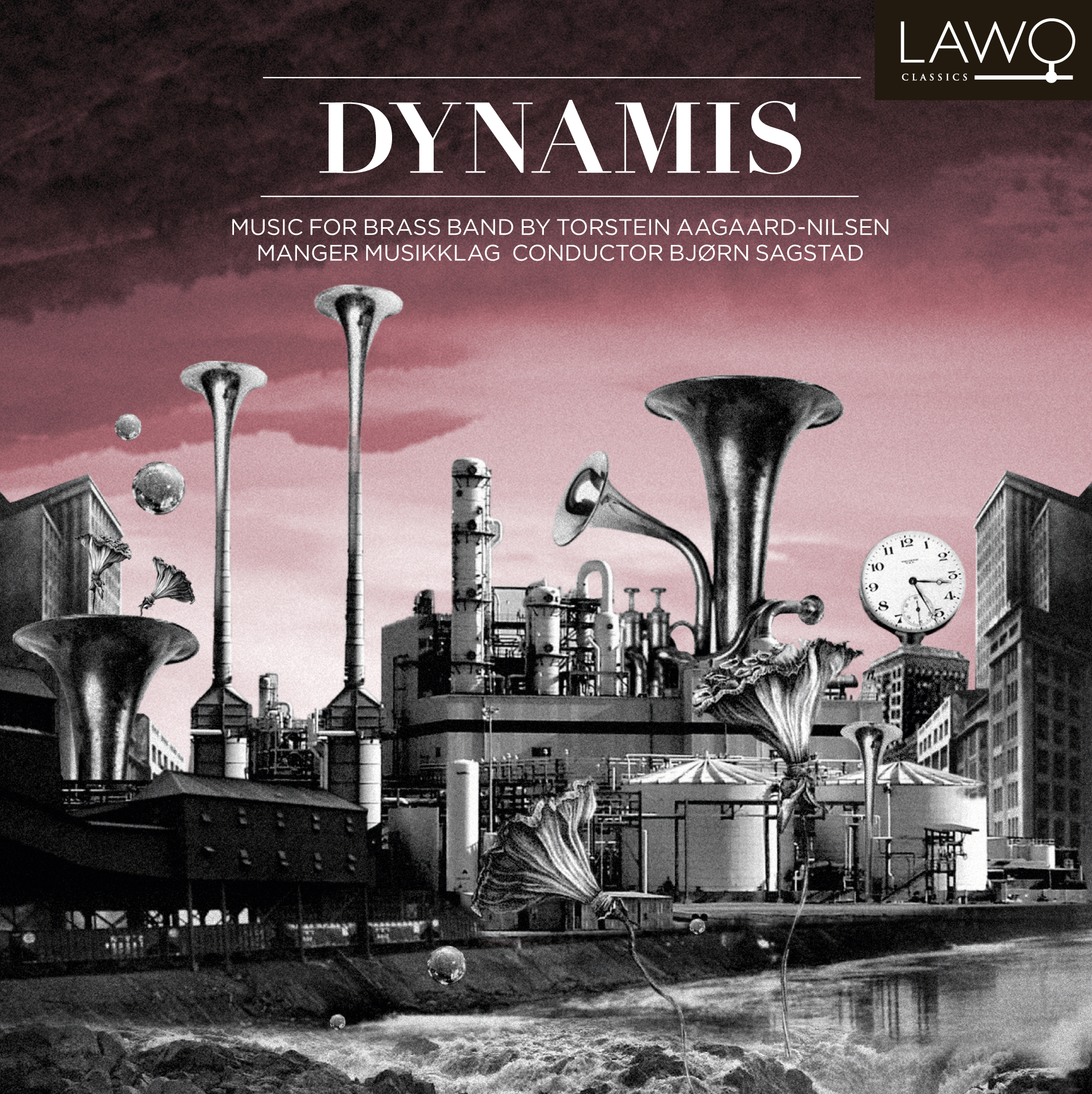
DYNAMIS
Manger Musikklag launched its newest CD «Dynamis». The recording contains music by Norwegian composer Torstein Aagaard-Nilsen. It was recorded in April, 2008, with Bjørn Sagstad conducting and the composer himself in the role of producer. Both are former members of Manger Musikklag.
«Dynamis (Missa Sophia)» – A concerto grosso commissioned by Elgar Howarth and Eikanger-Bjørsvik Musikklag in 1998. Written for brass band and four soloists. Cornet, Merete Vollan Drevsjømoen; Trombone, Birgitte Bjørnsdatter Bruget; Tuba, Pål Magne Austnes; and Marimba, Craig Farr. «Chant» – Commissioned by the Grenland International Brass Festival as the set piece for the church competition in the first section, 2007. «Cantigas» – Commissioned by Manger Musikklag as its chosen piece for the Norwegian Nationals in 2006. Its performance earned it 96 points. The prize for best soloist went to Camilla Søderstrøm Tveit (bass trombone).
«It has turned out to be a very special CD recorded by very special musicians. It was a joy to watch Bjørn Sagstad in front of the band during the recording sessions. He is a superb interpreter who knows brass band music from the inside», says Torstein Aagaard-Nilsen.
Listen
Tracks
Torstein Aagaard-Nilsen (*1964)
Cantigas
Dynamis (Missa Sophia)
Reviews
A varied programme for brass band. Manger Musikklag really impresses on this album.…
Show more Show less
A varied programme for brass band. Manger Musikklag really impresses on this album. Lovely soloists, a cohesive and well-rehearsed ensemble, and excellent sound production. You simply have to be impressed by these brilliant performers.Show original
Variert for brassband. Manger Musikklag overbeviser stort på denne plata. Nydelige solister, et homogent og samspilt ensemble, samt en særs god klangbehandling. Her er det bare å la seg imponere av strålende gode utøvere.
 Smaalenene
Norwegian
Dynamism with style! Aagaard-Nilsen has harnessed the brass band’s homogeneity and technical brilliance to create a truly magnificent work.…
Show more Show less
Dynamism with style! Aagaard-Nilsen has harnessed the brass band’s homogeneity and technical brilliance to create a truly magnificent work. The sound design by conductor Bjørn Sagstad is certainly of a high standard, particularly with a transparent, luminous final chord that I wish would never end. I am particularly impressed by the low brass, which plays rapid runs with double tonguing in the low register with remarkable clarity. The percussion section, led by Craig Farr, delivers a solid performance throughout the album. Aagaard-Nilsen’s music sets the mood for the listener, creating a space that either remains enclosed until the next movement of the work or opens up with a burst of sound from the band. Throughout the album, Aagaard-Nilsen makes full use of the brass band’s entire range, particularly a technique involving the phasing in and out of instruments in arpeggios, which produces a unique sound. This CD comes highly recommended to anyone with an interest in the genre!Show original
Dynamis med stil! Aagaard-Nilsen har utnyttet brassbandets homogenitet og tekniske brillians til et makeløst verk. Klangbehandling dirigent Bjørn Sagstad foretar seg er definitivt av høy standard, og spesielt med en transparent, lysende sluttakkord jeg ønsker aldri skal ta slutt. Jeg er spesielt imponert over grovmessing som med all tydelighet spiller hurtige løp med dobbeltunge i dypt register. Slagverkseksjonen med Craig Farr i spissen leverer en solid prestasjon gjennom hele skiven. Aagaard-Nilsens musikk setter lytteren i stemning, et rom som enten forblir lukket inntil neste sats i verket eller åpner seg med en utblåsning i bandet. Gjennom hele platen utnytter Aagaard-Nilsen brassbandets fulle register, spesielt en type arpeggio inn- og utfasing av instrumenter som gir en unik klang. Denne cd-en anbefales på det sterkeste til alle interesserte!
 Kulturkompasset
Norwegian
Manger Musikklag is one of the country’s finest brass bands, and it is a real delight at times to hear the standard of their playing.…
Show more Show less
Manger Musikklag is one of the country’s finest brass bands, and it is a real delight at times to hear the standard of their playing. The title track, “Dynamis”, is the album’s standout track, offering drama and power in a choral form.Show original
Manger Musikklag- er et av landets beste brassband, og det er tidvis frydefullt å lytte til nivået på musiseringen deres. Tittelverket ”Dynamis” er platas sterkeste kort, med dramatikk og kraft i messeform.
 Hamar Arbeiderblad
Norwegian
Well-balanced and skilful band playing. In the album’s main work, ‘Dynamis’, both the composer and the band give it their all.…
Show more Show less
Well-balanced and skilful band playing. In the album’s main work, ‘Dynamis’, both the composer and the band give it their all. It is melodious and dramatic, with the use of soloists lending it an almost oratorio-like dynamism. The sound of the brass section combined with the marimba is particularly fine. Manger Musikklag’s performance is well-balanced.Show original
Velbalansert og dyktig korpsspill. I platens hovedverk, «Dynamis», slår både komponist og korps til for fullt. Det er sangbart og dramatisk, med bruk av solister som gir det en nesten oratorium-aktig dynamikk. Særlig flott er klangen av messing sammen med marimba. Manger Musikklag spiller velbalansert.
 Bergens Tidendene
Norwegian
Powerful and significant. There can be little doubt that Manger Musikklag is one of Norway’s leading bands.…
Show more Show less
Powerful and significant. There can be little doubt that Manger Musikklag is one of Norway’s leading bands. They prove this once again on this album. This is, in fact, contemporary music of the very highest calibre, masterfully performed by an excellent band, and not least by a conductor with complete command of the repertoire. Add to that some sparklingly good soloists, and the result is quite simply superb.Show original
Sterk og viktig.At Manger Musikklag er et av toppkorpsene i Norge er det vel liten tvil om. Det beviser de også til gangs på denne platen. Dette er nemlig samtidsmusikk av ypperste klasse, mesterlig fremført av et godt korps, og ikke minst en dirigent med full kontroll over repertoaret. Legger du til gnistrende gode solister så blir jo dette rett og slett veldig bra
Show all 6 reviews
Norwegian composer Torstein Aagaard-Nilsen is one of the most original creative voices writing for brassband.…
Show more Show less
Norwegian composer Torstein Aagaard-Nilsen is one of the most original creative voices writing for brassband. The many delights and depths in this fine production will be appreciated by repeated listening.
Credits
- Conductor
- Bjørn Sagstad
- Performer
- Merete Vollan | Thor-Arne Pedersen | Camilla Søderstrøm Tveit | Birgitte Bjørnsdatter Bruget | Pål Magne Austnes | Craig Farr (Percussion)
- Orchestra (unspecified)
- Manger Musikklag
- Composer
- Torstein Aagaard-Nilsen
- Producer
- Torstein Aagaard-Nilsen
- Engineer
- Gunnar Herleif Nilsen
- Editing
- Gunnar Herleif Nilsen
- Mastering
- Thomas Wolden
- Liner notes
- Age Barlund | Line Hansen Talleraas
- Executive producer
- Vegard Landaas
- Booklet editor
- Vegard Landaas
- Cover photo
- Blunderbuss
- Artist photo
- Manger Musikklag by Christin Eide
- Design
- Anette L’orange | Blunderbuss
- Recording location
- NRK Hordaland Studio 23, Bergen
- Recording country
- Norway
- Recording year
- 2008
- Recording dates
- April 2008
- Original source
- 44.1 kHz, 16 bit
- Discs / tracks
- 1 disc | 10 tracks
- Produced with support from
- Radoy Kommune | Arts and Culture Norway | Norwegian Society of Composers | The Audio and Visual Fund
- Release year
- 2009
- Label
- LAWO Classics
- Duration
- 59:56
- EAN
- 7090020180038
- ISRC
- NOEHX0901010/100
Booklet text
This conversation between Åge Barlund and Torstein Aagaard-Nilsen took place in Oslo in November 2008, and by email in the following days. Åge is a former student of Torstein at Manger Folkehøgskule, and played in MML when Cantigas was played at the Norwegian National Championship.
Manger Musikklag has been one of the leading bands in Norway when it comes to commissioning and performing new music for brass band. For musicians and audiences, your name is often associated with MML and new music. Even though only one of the three works on this record is commissioned by MML, this CD still is a document that shows a long and close relationship. Can you say that this relationship has influenced your work as composer, and if so, how?
I was self-taught when I first moved to western Norway and started playing with Manger Musikklag, aged almost 20 years old. In other words, a late start. Growing up in Lofoten, I didn't have any tutors to guide me in the right direction. The meeting with the wonderful players in MML and the music we played under Michael Antrobus was a big inspiration for me. That was it. I dropped out of my science studies and started studying music at the Conservatory of Music in Bergen. MML and Tom Brevik were the first to commission music from me when they realized that I could do more than just play the trumpet and cornet. They were hard-working amateur musicians, and all they wanted was to play music they wanted to play. They had no obligations to play or commission, just pure curiosity.
That is why I wrote my first works for brass band. From the start there was a desire to tell stories in which these musicians could get involved. Trial and error is also an important aspect. The works that I wrote these early years were tested through excellent and immediate feedback. This work continued in 2005, when Cantigas was commissioned by MML. I could make adjustments to the music in a positive and comforting environment. To observe real enthusiasm when someone is playing your music gives you the confidence and energy to continue. At that point MML has been fantastic, towards me as well as other composers.
I think I have developed a kind of musical compassion with these people. I have always believed that there has to be an understanding of the musicians for whom I write. Also, since they do not have a formal musical education, but simply an above average fondness of music, it is my duty to find a way to meet with the musicians at some level. That is when I can tell my stories.
You mention story telling as a gateway to composing. Do the stories of the works on this record have something in common?
Yes they do, but first I must mention that I do not talk about stories literally, as in program music. Often, I'm influenced by the myths that exist in the cultures of the world, it is fascinating to read. We base much of our modern religious practice and cultural understanding on strong symbols and archetypes. I have always been concerned with a narrative development, where the piece unfolds – self-composes, so to speak. This is common in the three works. Chant is based on the simplicity of the anthem of Olav, and it turns into a multitude of voices as new layers are added. In Cantigas, a single pitch is sent off by the cornet soloist in the opening and is used as a recital note that evolves into harmony and melody. With Dynamis, the piece is born, so to speak, in the tuba soloist's single low D. At that exact moment the story begins and ends half an hour later.
The three works are also similar because they relate to what we regard as religious activities. In Chant this is obvious, by utilising the hymn derived from Gregorian music that was in use during the medieval period in the cathedral of Trondheim (Nidarosdomen) and other cathedrals and churches in Europe. "Cantiga" was originally a traditional song from medieval Spain, where King Alfonso the Wise gathered songs about the Virgin Mary and songs of religious wonders. The songs could sometimes be narrative ballads (cantigas de gesta). People would gather around the musicians and singers and were told tales of miracles. Isn't this exactly what we try to do playing music? To reach other people with fantastic stories, whether quiet or grand? As with the bass trombone in Cantigas, who urges a fight in the beginning accompanied by a ruined war drum.
Dynamis has derived directly from the mass as it is used in church, and in J. S. Bach's "Mass in B minor". I replaced the Latin names of the movements with quotations from the Proverbs of the Old Testament, chapter 8. It is a poetic representation of wisdom, which in addition is female: "Doth not wisdom cry? And understanding put forth her voice?" It is possible to read the texts independently, regardless of religion and culture, as a common legacy to all people. What is wisdom, really? "I was set up from everlasting, from the beginning, or ever the earth was." It is beautiful and mysterious. I have tried to build a game between the power of Creation, the Good, the Bad and the Human Being. They are shown as the soloists on tuba, cornet, trombone and the percussionist playing marimba and metal blocks. Dynamis has the subtitle Missa Sophia – Mass for Wisdom. I try to tell several things in the composition. It is far from one-dimensional – it is also a Concerto Grosso.
I would like to dwell on the link between Bach's great Mass in B minor and Dynamis. At the time of Bach, the choice of key was in itself an artistic mean. Some sources claim for instance that B minor was the key for patience, peacefully waiting for their destiny and obediently subjecting to divine commands. Are there any such links to this in Dynamis, or specific links to Bach's Mass, except for the form?
I have also read that B minor is the key for grief, pain and despair. But in the opening bars Bach's bass line is rising, as if our thoughts will be led upwards, to the text Kyrie eleison. Bach did a complete church service in music, using an existing form. That is how the service was at the time and still remains in the Catholic and Protestant Church today. There is a slightly different emphasis on the text though. Credo is the Apostles' Creed ("I believe in God, the Father Almighty, Creator of Heaven and Earth"), where every sentence becomes a movement in Bach's works.
In the fourth movement of Dynamis – "All they that hate me love death" – where "me" refers to the wisdom, I cite the Crucifixus section of the great Mass. This is shown by the descending chromatic bass line that is repeated thirteen times to the text "Crucifixus, etiam pro nobis, sub Pontio Pilato, passus et sepultus", which hardly needs translation. I do not use quotations to take advantage of the death symbolism as it would not work today. I rather try to create an image of the omnipresent evil. The trombone initiates the movement with an expression that breaks with the three preceding movements. It symbolizes evil and conflict. The marimba part, as a symbol of man, is now replaced by metal blocks in the noisy sections. And it is the marimba that plays the descending chromatic bass line in the centre section of the movement. The tuba, representing the Creator, supports the bass line at some places. God is not interfering by warding off evil. Then the trombone sounds again, ingratiating, partly citing elements from Bach's chorale, and hides the evil symbolised by the bass line. It causes us to stop thinking about death and evil. That is evil's excessive power. It is a chameleon – most of the time we do not see it, not before it is too late.
After this point the music moves in a new direction, despite the light scherzo character in the fifth movement where the cornet and tuba find each other. It cannot persist! The good's proximity to God has always been threatened. That is Job's paradox and is our problem in the relationship to religion today. Our modern knowledge about the world results in a view where good is not linked to God's being in the same way that Bach and his contemporaries would have linked them. The single note played by the cornet in the transition between the fifth and sixth movement is both a prayer and a resignation.
The sixth movement of Dynamis also includes Bach's music. The movement has become some of the most violent music I've written so far. The material is taken from the previously discussed fourth movement. There have always been wars and there have always been counter-reactions to wars in an ever-lasting cycle. It is here that Bach with his beautiful music, in the parallel key to B minor of the bright D major, asks for peace. I could not do the same, based on our current knowledge about peace. Bach had an unerring and deep faith that God was the one who could create peace, in the meaning peace of mind. I think of the word peace in a different way. If D major is the powerful and energetic key, then the expression I use here is a parallel to that. The four soloists citing Bach's chorale try to get through, while the other music is like a war march relieved by brutal outbursts. It is the world as we know it. I do not think we can cheer jubilantly of peace. The desire has to come from within and be based on some kind of interpersonal existence that has not yet been seen on earth. That is why Dynamis ends with an almost inaudible whisper from Bach's final bars: Dona nobis pacem.
It seems to me that Dynamis has a theme that is timeless and at the same time highly relevant for our time. Does the framework of the piece have any influence on your choice of narrative technique in relation to Chant and Cantigas? And do they have some of the same relevance to our time as Dynamis has?
The framework of a piece is usually included in the contract between the commissioner and me. So the length of the piece, the arena of the performance, soloist and other details will be decided in advance. Usually, a concert piece is different from a piece written for a competition, for instance in terms of length. Some of the elements of Dynamis evolve over a long time and have few entertaining elements. Therefore, it is probably unsuitable for competitions the way these are today, where length of performance is decided in the rules. With very few exceptions, nobody has had the courage to challenge the frames of the competitions.
Both Chant and Cantigas were commissioned for competitions. To overthrow the framework would then be the same as breaking the contract. Still, the ambition was to compose concert pieces that would be suitable for competitions as well: Chant for Grenland International Brass Festival 2007 and Cantigas for the Norwegian National Championships in 2006. The narrative technique has to be adjusted to the length of the piece. It is important that the composer has time to finish what he wants to tell. It is that prosaic, and that complicated.
Chant is a relatively short piece of music. That made it possible to concentrate on one idea throughout the piece, I enjoyed working like that. Cantigas was intended to be a larger concert piece composed within the limits of the rules of, for instance, the National Championships. Of course one can say that I shouldn't have started a piece intended for competitions with a ten-minute slow first movement! It's supposed to be entertaining, but I couldn't resist it! I am still not quite sure what the story of Cantigas is. The piece is not unambiguous. My hope is that it tells many different stories, and that the listener is able to discover these within the piece. The names of the movements, "Chorale", "Recitativo accompagnato" and "Hommage à B.B." are meant to change the mental images of the listeners, and each movement has a distinct sound of its own.
These are created by different positions of the instruments and different soloists. At the same time you can hear the connection between the movements – or maybe you will not even hear three movements at all, just two!
I choose to understand relevance in two different ways, firstly by being topical within the art music at the time of the performance. This does not necessarily reflect the content of the music. Secondly, I always try to be conscious of the relevance of the content of a piece. Yet I tend to let the current setting influence my choices. I don't really speculate in whether the piece is topical. In the process of composing I try to be true to my own ideals and pursue ideas I find interesting. And by using my sources of inspiration such as nature or culture, my inspiration undergoes an interpretation within me based on my previous experiences and my personality. I can never be certain of being understood. But I try to be clear without being obvious. I wish to communicate and still I seek opposition. I try to create a kind of friction within the listeners, at the encounter between what they understand and what they don't understand. Quality demands both. I hope these elements can be found in all the music on this record.
— Interview: Åge Barlund · Cover text: Åge Barlund · Text editor: Line Hansen Talleraas