
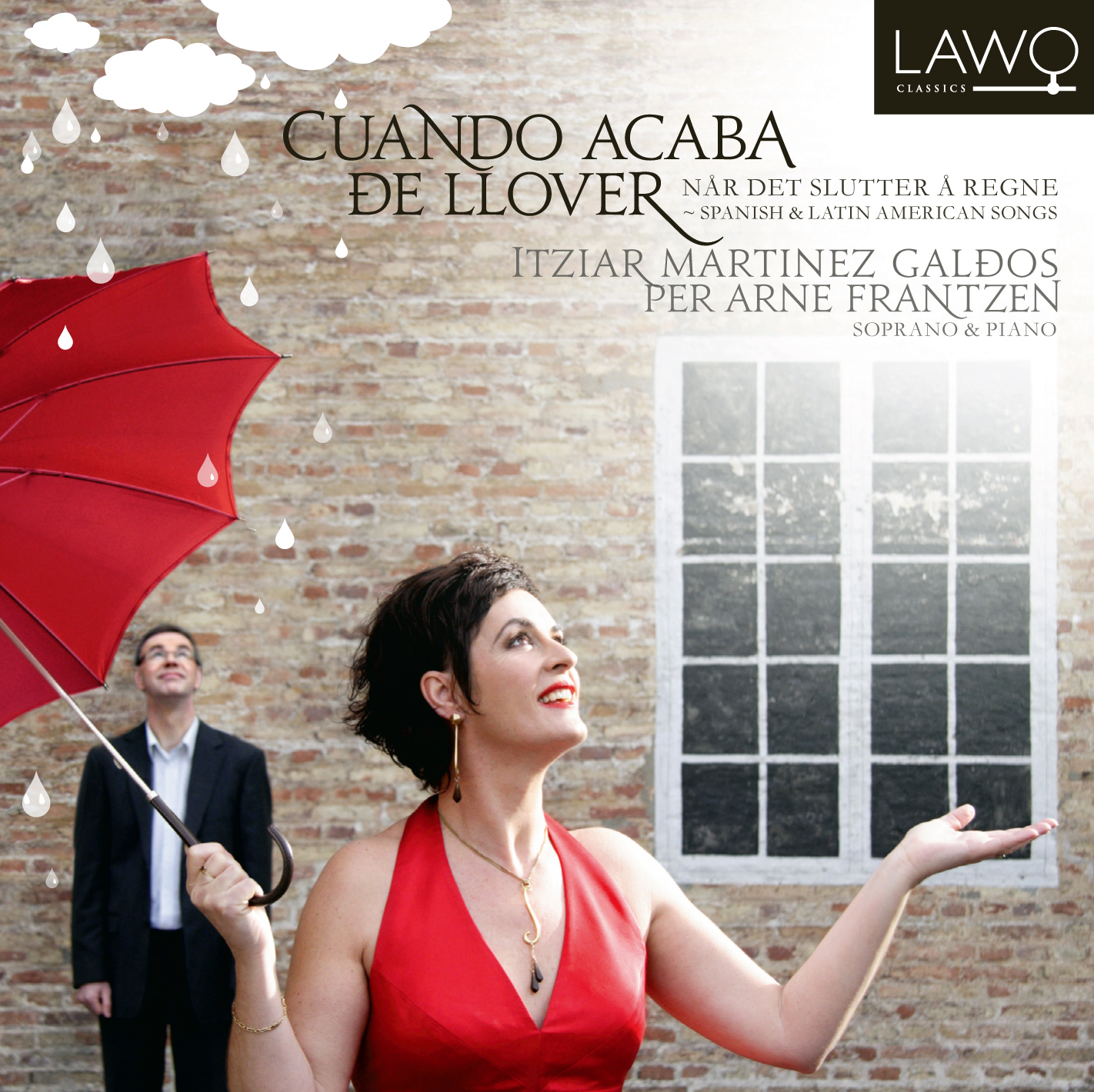
Cuando Acaba De Llover – Spanish & Latin American Songs
Itziar Martinez Galdos (Soprano) | Per Arne Frantzen (Piano)
WHEN THE RAIN STOPS FALLING
This debut CD by soprano Itziar Martinez Galdos and pianist Per Arne Frantzen entitled «Cuando Acaba De Llover» («When the Rain Stops Falling») was recorded by LAWO Classics and offers a collection of Spanish and Latin American classical song.
Martinez Galdos and Frantzen have enjoyed a close musical collaboration for over 25 years. They have performed throughout much of Europe, and their Spanish repertoire is the centerpiece of these performances. The songs on the CD embrace many moods, colours, and contrasts and will appeal to a wide audience.
What can we expect to hear when we listen to these songs? Rhythm, sun, colours, passion, castanets, dark eyes, bullfighting . . .? They are all to be found in «When the Rain Stops Falling,» plus one other essential ingredient-a big heart. The heart was the driving force behind this recording.
Listen
Tracks
Xavier Montsalvatge (1912–2002)
Cinco Canciones Negras
Jesús Guridi (1886–1961)
Seis Canciones Castellanas
Joaquín Nin (1879–1949)
Carlos Guastavino (1912–2000)
Cuatro Canciones Coloniales
Joaquín Turina (1882–1949)
Poema En Forma De Canciones
Reviews
The common thread running through the songs and the performance is warmth and intimacy.…
Show more Show less
The common thread running through the songs and the performance is warmth and intimacy. The talented pianist Per Arne Frantzen plays a delicate intro with a touch of impressionism. Itziar M. Galdos sings in a subdued and subtly sensual style, allowing the lyrics to carry the simple melody forward.Show original
Fellesnevneren for sangene og fremføringen er varme og nærhet. Den gode pianisten Per Arne Frantzen gjør en florlett intro med en touch av impresjonisme. Itziar M. Galdos synger neddempet og småsensuelt og lar teksten drive den enkle melodien fremover.
A showcase of beauty!
Show original
En demonstrasjon på skjønnhet!
 Romerikes blad
Norwegian
She sings incredibly beautifully. Beautiful, playful, expressive and melodious songs.…
Show more Show less
She sings incredibly beautifully. Beautiful, playful, expressive and melodious songs. Galdos has a beautiful voice which she controls with musical flair and a keen sense of poetic richness. The fact that she is ably supported by Frantzen is evident throughout the entire recording.Show original
Hun synger utrolig vakkert. Vakre, lekende, uttrykksfulle og velklingende sanger. Galdos har en vakker stemme som hun styrer med musikalsk teft og sans for den poetiske rikdommen. At hun er godt sekundert av Frantzen erfares til fulle gjennom hele innspillingen.
 Aftenposten
Norwegian
A recording characterised by cool elegance and underlying passion.…
Show more Show less
A recording characterised by cool elegance and underlying passion. It is a tone that Galdos masters very well.Show original
Innspilling preget av sval eleganse og underliggende lidenskap. Det er et tonefall som Galdos behersker meget godt.
 Dagbladet
Norwegian
Their performance is far more interesting; the song is explained and really sticks in your head.…
Show more Show less
Their performance is far more interesting; the song is explained and really sticks in your head. I’m completely blown away. They’re so into it, utterly convincing. This album is the real deal. Frantzen shows he can play fast – castanets, guitars, clapping – it’s all here. A fun album from LAWO.Show original
Deres foredrag er mye mer interessante, sangen blir forklart og smyger seg inn i øret. Jeg smelter helt. De er så med, totalt overbevisende. Denne platen er the real thing. Frantzen får vist at han kan spille fort, kastanjetter, gitarer, klapping og alt er her. Morsom plate fra LAWO.
 på sporet, NRK P2
Norwegian
Show all 8 reviews
Passion, wit and laughter are rarely far away.…
Show more Show less
Passion, wit and laughter are rarely far away. A sensual undertone is ever-present, however dark the subject matter may be. Throughout, Galdos’s voice is focused, clear and rich. She gives space to the simple format and to the lyrics. Galdos offers a vulnerable interpretation of heartbreak. Yet the musical result is largely melodious, thanks in large part to Frantzen, who contributes authentic portrayals of a range of different moods.Show original
Lidenskapen, snerten og latteren er sjeldan langt unna. Ei sensuell undertone er stadig nærverande, om tematikken er aldri så svart. Gjennom det heile er Galdos si stemme konsentrert, klår og fyldig. Ho gjev rom for det enkle formatet og for det tekstlege. Galdos gjev ei sårbar tolking av kjærleikssorg. Men det musikalske resultatet er i hovudsak velklingande, òg mykje grunna Frantzen, som bidrar med truverdige framstillingar av ei rekkje ulike stemningar.
 Dagsavisen
Norwegian
Itziar Martienz Glados and Per Arne Frantzen present a selection of Spanish and Latin American composers on this album.…
Show more Show less
Itziar Martienz Glados and Per Arne Frantzen present a selection of Spanish and Latin American composers on this album. Most of the songs have their roots in the romance. On the album’s finest tracks, Jesús Guridi’s ‘Seis canciones castellanas’, the music is reminiscent of French composers and, to some extent, international neoclassical music. The ensemble playing is impeccable.Show original
Itziar Martienz Glados og Per Arne Frantzen presenterer et utvalg spanske og latinamerikanske komponister på denne platen. De fleste sangene har røtter i romansen. På platens beste sanger, Jesus Guridis «Seis canciones castellanas, høres musikk som kan minne om franske komponister og til dels internasjonal neoklassisk musikk. samspillet er upåklagelig.
 Bergens tidende
Norwegian
By the time this recital was finished, I was so thoroughly engrossed in their joint interpretation that I didn’t even think about their technique at all.…
Show more Show less
By the time this recital was finished, I was so thoroughly engrossed in their joint interpretation that I didn’t even think about their technique at all. It was just as if the composers were speaking to me through her voice and his piano—and that, ideally, is how it should be. Thus her singing is not only, for me, more interesting than de los Angeles but also more interesting than mezzo Teresa Berganza.
 Fanfare
Credits
- Performer
- Itziar Martinez Galdos (Soprano) | Per Arne Frantzen (Piano)
- Composer
- Xavier Montsalvatge | Jesús Guridi | Joaquín Nin | Carlos Guastavino | Joaquín Turina
- Lyricist
- Rafael Alberti | Néstor Luján | Nicolás Guillén | Ildefonso Pereda Valdés | León Benarós | Ramon de Campoamor
- Producer
- Vegard Landaas
- Engineer
- Thomas Wolden
- Editing
- Vegard Landaas
- Mastering
- Thomas Wolden
- Piano tuner
- Thron Irby
- Liner notes
- Geirr Oppi | Itziar Martinez Galdos | Per Arne Frantzen
- English translation
- Jim Skurdall
- Executive producer
- Vegard Landaas
- Booklet editor
- Vegard Landaas
- Cover photo
- Anna-Julia Granberg
- Artist photo
- Itziar Martinez Galdos by Anna-Julia Granberg | Per Arne Frantzen by Anna-Julia Granberg
- Design
- Anna-Julia Granberg | Blunderbuss
- Recording location
- Sofienberg Church, Oslo
- Recording country
- Norway
- Recording year
- 2007
- Recording dates
- 07.11.2007 | 08.11.2007 | 09.11.2007 | 10.11.2007 | 11.11.2007
- Original source
- 96 kHz, 24 bit
- Discs / tracks
- 1 disc | 23 tracks
- Produced with support from
- DNB | Spanish Embassy in Norway | Norwegian Academy of Music
- Release year
- 2008
- Label
- LAWO Classics
- Duration
- 1:02:36
- EAN
- 7090020180021
- ISRC
- NOEHX0802010/230
Booklet text
The Composers
Many great composers have, down through the years, set Spanish poetry to music and arranged popular folk tunes. For this CD we have chosen a set of Spanish and Latin American songs. The songs span a broad range of moods, colors, and contrasts and will appeal to a wide audience.
Why did the choice fall on the composers Montsalvatge, Guridi, Nin, Guastavino, and Turina?
This project actually began with Xavier Montsalvatge, who was born in Gerona in the northern part of Catalonia. His compositions embrace all genres of music, from symphonies to opera, and from ballet to film music. And while he was strongly influenced by twelve-tone technique and the music of Wagner in the beginning, his later works show the influence of French and Creole music and music of Cuban origin. In addition to his life as a composer, Montsalvatge was a professor of composition in Barcelona at the Academia Marshall and the Municipal Conservatory of Music. He became one of the greatest composers of Spanish music, perhaps the greatest in the last half of the 20th century.
It was as music critic for the newspaper "La Vanguardia" that we met Montsalvatge at the Quincena Musical Festival in San Sebastian in the late 1980s. There we had the unique honor of being instructed by him. We performed "Cinco canciones negras," after which he shared his ideas regarding tempos, mood, etc., even suggesting changes in the edition we had. Above all, we received inspiration from the composer on how we could "add some seasoning" to our own interpretation.
And then we changed course. We had a Spanish composer who wrote in the Cuban style. What if we found a Cuban composer who wrote in the Spanish style? The answer was Joaquin Nin.
It is both surprising and amusing that "Polo," "Canto Andaluz," and "El Vito," the songs on this CD most representative of flamenco, a genre so closely linked to Spanish music, were written by a Cuban composer. Joaquin Nin moved to Spain as a boy and studied in Barcelona. In 1902 he left for Paris, where he immersed himself in composition and counterpoint at the Schola Cantorum. As pianist, he toured throughout Europe and South America. He was a celebrated interpreter of Bach and early Spanish works, and his enthusiasm for the Spanish Baroque is evident in a number of his compositions. Likewise, his work shows the influence of French Impressionism.
In order to achieve greater balance, we felt like including yet another composer from the Americas, but this time one with a totally different style.
The Argentine composer Carlos Guastavino was born in 1912, the same year as Xavier Montsalvatge. He studied music in Santa Fe and Buenos Aires. He is regarded as one of the foremost composers of the 20th century in Argentina, with more than 200 works, of which some 150 are romances for voice and piano. By his rejection of modernist and avant-garde movements he became a model for Argentina's younger generation of popular and folk musicians of the 1960s. Besides songs, he wrote chamber music and a great number of choral works. "Cuatro canciones coloniales" are four lyrical songs, moving in their simplicity, and a delicate contrast to the more carefully composed Spanish cycles.
One of the great Basque composers, Jesús Guridi, was born in Vitoria, Basque Country. Sometimes called "the Spanish Respighi," he is held in high regard in music circles in Spain. He attained national prominence as a composer with his much beloved zarzuela "El Caserio," and with his "diez melodias vascas." Following studies at the conservatory of music in Madrid, the 16-year-old Guridi received a generous scholarship which made it possible for him to spend two years studying piano, organ, and composition at the Schola Cantorum in Paris. "Seis canciones castellanas" is a cycle of profound contrasts. Here things shift from sad love songs to flirtation and coquettishness, from temperamental moods to the most beautiful melodies.
Joaquin Turina was destined to become one of his generation's most prominent composers. His style is entirely dedicated to national ideals, and his musical interest is wholly focused on Andalusian folk music, in particular, from his own home region around Seville. Turina's career was, it is true, overshadowed to a great extent by that of the older de Falla, but, even so, Turina's music can be regarded as the most important of its time. "Poema en forma de canciones" begins with an impressive piano solo—one can almost call it a piano overture—which later in the cycle is elegantly woven into the song "Los dos miedos."
It is interesting to note in closing that Nin, Turina, and Guridi were born in the same period, all three within seven years of each other.
We wish you a pleasurable listening experience together with us.
— Notes: Itziar Martinez Galdos & Per Arne Frantzen, in collaboration with Geirr Oppi · English translation: Jim Skurdall
Biographies
Itziar Martinez Galdos
Itziar M. Galdos, soprano
Itziar Martinez Galdos is from San Sebastian in Spain, where she began her study of voice. She received her diploma in music in Stuttgart, and then in 1985 she came to Oslo to study at the National Opera Academy.
Galdos made her début in 1988, and was awarded the 'Debutant Prize' and the 'European Movement Prize' the same year. In 1989 she became a permanent soloist with The Norwegian National Opera, where she has interpreted a wide range of roles from the standard repertoire to contemporary opera. She received critical acclaim for her interpretation of Puccini's famous heroine, Manon Lescaut, and for Tosca, as well as Desdemona in Verdi's 'Otello'.
Her latest major roles have been The foreign princess in Rusalka by Dvorak, the highly dramatic Minnie in La Fanciulla del West by Puccini, Elisabeth in Tannhäuser by Wagner and the powerful and ambitious Lady Macbeth by Verdi.
As one of the most eminent romance singers in Scandinavia, Galdos performs throughout much of Europe together with Per Arne Frantzen, and her Spanish repertoire is generally the centerpiece of these performances.
Itziar M. Galdos has been awarded 'Operaens Venners Ærespris' and the prestigious Kirsten Flagstad Prize. In spring of 2013 the Kingdom of Spain honoured her outstanding contribution to the Norwegian cultural and musical scene by awarding her the title of Commander of the Royal Order of Isabella the Catholic.