
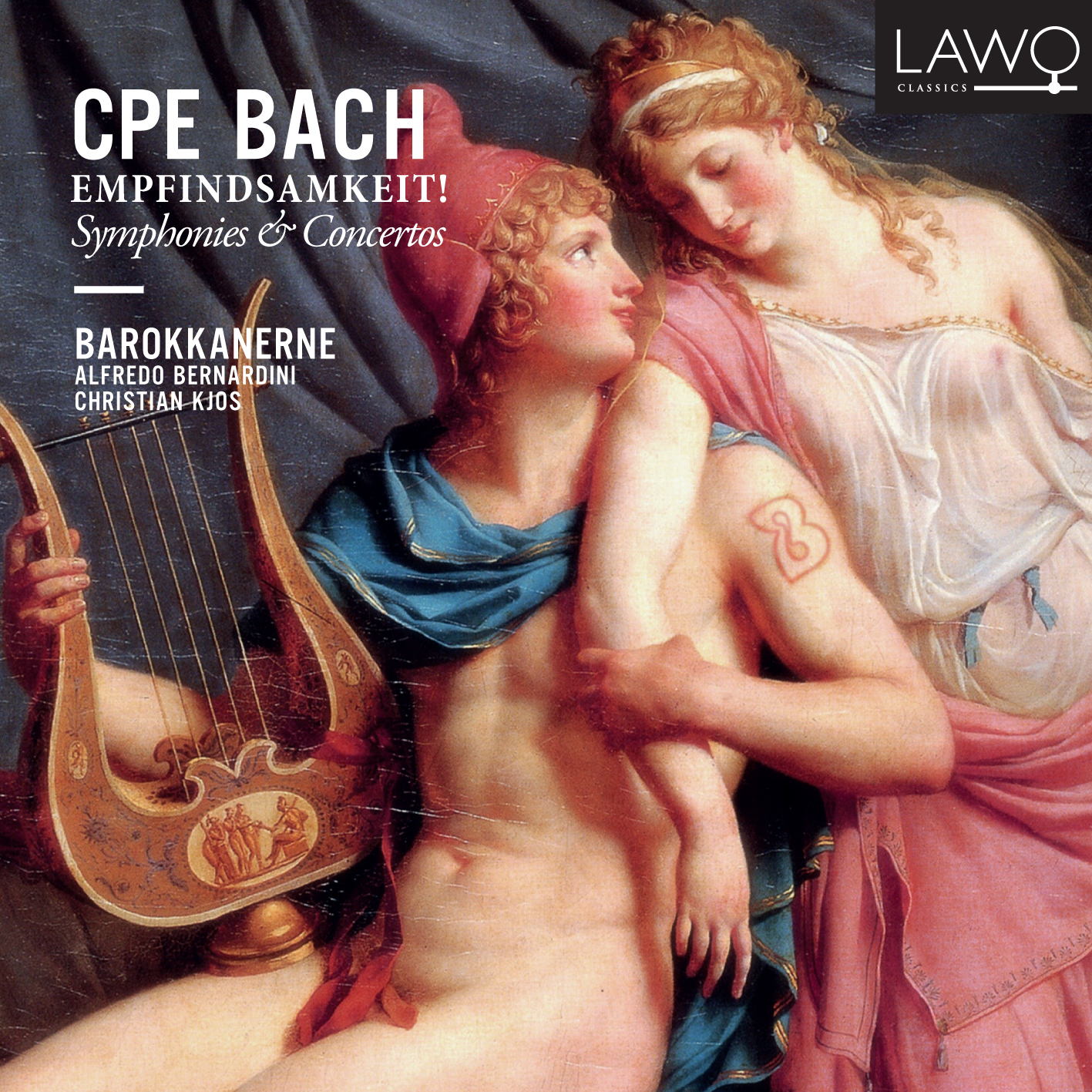
Carl Philipp Emanuel Bach
Empfindsamkeit! – Symphonies & Concertos
Barokkanerne (Baroque ensemble) | Alfredo Bernardini (Oboe) | Christian Kjos (Harpsichord)
Listen
Tracks
Carl Philipp Emanuel Bach (1714–1788)
Symphony in E Minor, WQ 178
Barokkanerne
Oboe Concerto in E-flat Major, WQ 165
Harpsichord Concerto in D Minor, WQ 17
Barokkanerne | Christian Kjos
Symphony I in D Major, WQ 183/1
Barokkanerne
Credits
- Performer
- Alfredo Bernardini (Oboe) | Christian Kjos (Harpsichord)
- Baroque ensemble
- Barokkanerne
- Composer
- Carl Philipp Emanuel Bach
- Producer
- Vegard Landaas
- Engineer
- Thomas Wolden
- Editing
- Vegard Landaas
- Mastering
- Thomas Wolden
- Liner notes
- Christian Kjos
- English translation
- Jim Skurdall
- Executive producer
- Vegard Landaas
- Booklet editor
- Hege Wolleng
- Cover art
- Jacques-Louis David
- Cover photo
- Blunderbuss / Anette l'Orange (cover)
- Artist photo
- Barokkanerne by Mona Ødegård
- Design
- Anette L’orange | Blunderbuss
- Recording location
- Østre Fredrikstad Church, Fredrikstad
- Recording country
- Norway
- Recording year
- 2012
- Recording dates
- 19.04.2012 | 20.04.2012 | 21.04.2012 | 22.04.2012
- Original source
- 96 kHz, 24 bit
- Discs / tracks
- 1 disc | 12 tracks
- Produced with support from
- Fund for Performing Artists
- Release year
- 2013
- Label
- LAWO Classics
- Duration
- 58:00
- EAN
- 7090020180397
- ISRC
- NOEHX1208010/120
Booklet text
"The instant I entered, he conducted me up stairs, into a large and elegant music room, furnished with pictures, drawings, and prints of more than a hundred and fifty eminent musicians: among [these] […] his father and grandfather. After I had looked at these, M. Bach was so obliging as to sit down to his Silbermann clavichord, and favourite instrument, upon which he played three or four of his choicest and most difficult compositions, with the delicacy, precision, and spirit, for which he is so justly celebrated among his countrymen. In the pathetic and slow movements, whenever he had a long note to express, he absolutely contrived to produce, from his instrument, a cry of sorrow and complaint, such as can only be effected upon the clavichord, and perhaps by himself.
After dinner, which was elegantly served, and chearfully eaten, I prevailed upon him to sit down again to a clavichord, and he played, with little intermission, till near eleven o'clock at night. During this time, he grew so animated and possessed, that he not only played, but looked like one inspired. His eyes were fixed, his under lip fell, and drops of effervescence distilled from his countenance. He said, if he were to be set to work frequently, in this manner, he should grow young again. He is now fifty-nine, rather short in stature, with black hair and eyes, and brown complexion, has a very animated countenance, and is of a chearful and lively disposition.
His performance to-day convinced me of what I had suggested before from his works; that he is not only one of the greatest composers that ever existed, for keyed instruments, but the best player, in point of expression; for others, perhaps, have had as rapid execution: however, he possesses every style; though he chiefly confines himself to the expressive. […] It must be owned, that the style of this author is so uncommon, that a little habit is necessary for the enjoyment of it."
The foregoing excerpt is taken from Charles Burney's The Present State of Music in Germany, the Netherlands and United Provinces (London, 1773), an account of his travels giving us unique and remarkably animated insights into the musical life of large parts of Europe during the second half of the eighteenth century.
Bach's style can be linked to a trend in German literature in which a subjective view of reality, and extremes of emotion, were given free expression in reaction to the constraints imposed by the Enlightenment. The movement came to be called Sturm und Drang (storm and stress) and manifested itself from 1760–1780. Bach himself believed that "[…] a musician cannot move others unless he too is moved; thus, he must feel all the emotions that he hopes to arouse in his listeners", an opinion he articulated in his influential work on keyboard technique, Versuch über die wahre Art das Clavier zu spielen (Berlin, 1753). The essence of Bach's expressive style is Empfindsamkeit — sensitivity.
Barokkanerne would like to share a few interesting thoughts expressed by the Norwegian composer Magne Hegdal in an article entitled "Carl Philipp Emanuel Bachs revolusjonerende formverden" / "Carl Philipp Emanuel Bach's Revolutionary Form Universe" (Studia Musicologica Norvegica, 1989):
"In recent years there has been a dramatic upsurge of interest in the music of Carl Philipp Emanuel Bach. Doubtless this has something to do with performance practice, inasmuch as a more authentic manner of playing has allowed the expressive power and wealth of nuance to come into its own right in a very different way to before. But there are deeper reasons, too. I believe many of us feel that in its structure and expression this music is, in a special way, closer to us and our times.
Bach stands between epochs, between categories found in history books. Music historians lack a clear designation for the time in which he lived. Rococo, the Age of Sensibility, Storm and Stress — none of these are primary concepts of music history. And 'pre-Classical music' is typically a negatively defined concept: music which has yet to achieve the perfection of Classicism.
Thus, we find ourselves in a situation that seems to challenge our notions of both history and quality. For to what does this typical transitional figure owe his ability to survive? How can he be of immediate interest 200 years after his death?
Thinking in terms of epochs is, in my opinion, a confining approach to history that limits our understanding of quality. Bach will never be a great composer as long as we continue to think this way. He will always be considered an exponent of a transitional period: no longer Baroque, and not yet Classicism.
Another manner of assessment of major importance in traditional music history has been to associate quality with the idea of continuous development: a great composer is one who builds on the premises of the past while at the same time laying the foundation for further development. It is this to which, in spite of everything, Bach owes his unique position in music history — as a forerunner of Viennese Classicism. His importance can hardly be overestimated.
But what of the rest, what of those aspects that do not lead anywhere? Often, much of the most radical and innovative in Bach's production has been ignored or overlooked — because it is not compatible with our view of history as a continuous process, guided by a kind of inherent, mystical natural law. These are aspects of his music which his successors did not understand, and did not pursue.
Here we are referring to essential qualities that we cannot appreciate until we regard Bach's work as the creative effort of an independent artist who transcended the premises of his own time, moved boundaries, and expanded the potential for artistic expression, experience, and realization with uncommon clarity and consistency.
Among the most striking qualities of Bach's musical art are the clear-cut contrasts: he is spontaneous — and deliberate; emotional and intellectual; direct and analytic. He can be simple and unassuming, yet not flinch from the most arduous challenges. His music touches the heart, but speaks as well to the rational intellect.
He is the spontaneous improviser, the master of direct communication. Likewise, his musical forms are characterized by their thoroughness, leaving nothing to chance — or, in any case, calculating apparent randomness with utmost precision.
The background is the Age of Enlightenment, a time when the universalist philosophical outlook of the Baroque Era found itself yielding to a more direct experience and exploration of reality — a perspective that placed human reason at the center. The old music, which with its foundation in an ordered harmonic structure had been able to merge the most disparate elements into a grand synthesis, had seen its day as a true expression of the experience of reality. This was an age of sensibility — but also of reason; a time open to what was possible. And, not least, it was a time of change, a period of immense upheaval and radical ideas that would lead to a time of great revolution and the overthrow of a hierarchical society.
In the midst of all this, Bach's music, rich in suspense and contrasts, stands as a personal interpretation and a radical stance. Flowing from subjective feelings and a well-defined idea, his music seeks to create a genuine and enduring expression in a tonal world divested of its valid foundation."
In 1738, at the age of twenty-four, Bach received an appointment as harpsichordist at the modest court of Crown Prince Frederick of Prussia in Rheinsberg north of Berlin. Two years later, the crown prince became King Frederick II of Prussia, known as Frederick the Great, and his musicians were assimilated into the court orchestra in Berlin. The 1740s were an extremely productive time for Bach as newly appointed court harpsichordist. The greater portion of his time was spent composing instrumental music, particularly concertos and sonatas for harpsichord. The Harpsichord Concerto in D minor (Wq 17) is dated 5 April 1745 and must have met with approval by performers and audiences of the time, as it has been preserved in a great number of manuscript copies from the mid-1700s. Bach liked to polish his harpsichord concertos and he revised a number of them many years after they had been composed. Barokkanerne have chosen to record a version of the second movement that in all likelihood was embellished by the composer himself during just such a process of revision.
Bach arranged a number of his harpsichord concertos for other solo instruments, but in the case of his two oboe concertos from 1765, they were written first for oboe and later revised for harpsichord. It is not known for whom they were written. Berlin had competent oboists at the time, but the concertos may have been intended for a travelling virtuoso such as the German oboist Johann Christian Fischer. Burney characterized Fischer as "the most pleasing and perfect performer on the hautbois [who] had the honour, during a month, to accompany his majesty, Frederic, the King of Prussia, alone, four hours every day." Alone? Where was Bach, the King's own accompanist and court harpsichordist? He had, as it turns out, been banished from the court for a brief period of time. It seems he had complained about the wretched road conditions from Potsdam to the King's summer palace, Sanssouci.
Bach's symphonic music was not only performed by the court orchestra at the Stadtschloss in Berlin or at one of the King's summer residences, but also around the city among the budding private and more or less public musical societies in which Bach's works were highly esteemed. Bach informs us in his autobiography, dating from 1773, that he has written "a couple of dozen symphonies", but we can imagine that some of them perished in the flames in 1786, when excessive self-criticism motivated him to burn a number of his earlier works. Among those which fortunately escaped this fate was the Symphony in E minor (Wq 178) from 1756. It was even known beyond northern Germany, for when Burney met the famous composer, Johann Adolf Hasse, in Vienna in 1772, he wrote the following in his journal: "[He] desired me to enquire after a symphony of that author in E minor, which he thought the finest that he had ever heard." This was the only one of the Berlin symphonies that was published in Bach's lifetime, but without wind parts.
For almost thirty years Bach worked as Frederick II's underpaid court harpsichordist, until in 1768 the King granted him permission to accept the position of director of music in Hamburg, a post that had been filled for forty-six years by his godfather, Georg Philipp Telemann. Hamburg's days of glory, musically speaking, were a thing of the past, but, as Bach said to Burney: "I am now reconciled to my situation, except indeed, when I meet with men of taste and discernment, who deserve better music than we can give them here."
The Symphony in D major (Wq 183/1) from 1776 is the first of the four known as the Hamburg symphonies. While wind parts were added to a few of the earlier Berlin symphonies after Bach left Berlin, the Hamburg symphonies were from the beginning conceived for a large orchestra comprising two flutes, two oboes, two horns, a bassoon, and strings.
A critic wrote of the performances in 1776: "These symphonies display precisely the novelty and originality that astonishes one so greatly in all Bach's works and make an indescribable effect when they are well performed by a suitable ensemble. Some time ago we heard them performed by an orchestra of some forty players, directed by the Herr Kapellmeister himself. Each symphony was played twice, and we will never forget the impression that this music made on us. The stronger the forces are on each part, particularly the bass, and the more the players have practiced, the better these symphonies will sound."
(Quoted from: CPE Bach, The Complete Works III/3, ed. David Kidger, 2005)
But not only audiences and critics were enthusiastic. Bach himself seems to have been extremely pleased, as revealed in what he wrote to music publisher Johann Gottlob Breitkopf: "Permit a small word to be said between us. […] A year ago I composed 4 large symphonies for orchestra with 12 obbligato parts. It is the greatest thing of this type that I have done. My modesty does not allow me to say more about them."
(Quoted from: CPE Bach, The Complete Works III/3, ed. David Kidger, 2005)
— Notes: Christian Kjos · English translation: Jim Skurdall