
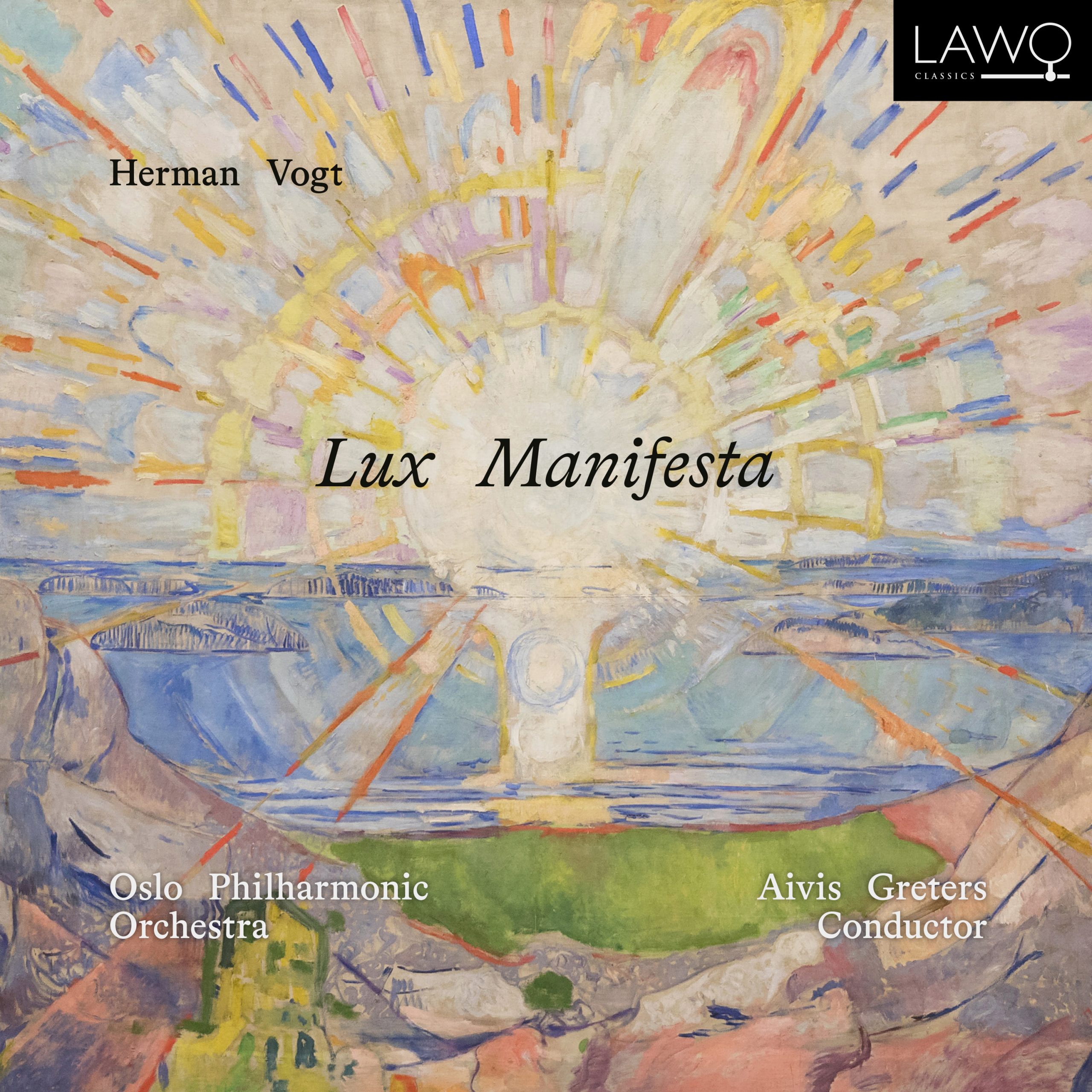
Lux Manifesta
Oslo Philharmonic Orchestra (Symphony orchestra) | Aivis Greters (Conductor)
LUX MANIFESTA
Lux Manifesta is a release featuring orchestral works by Herman Vogt, performed by the Oslo Philharmonic Orchestra under the baton of Aivis Greters. The album takes its title from Vogt’s large-scale orchestral work Lux Manifesta, which is the central work on the recording.
Translated as “manifested” or “revealed light”, Lux Manifesta is a work in which light functions as a guiding metaphor. Drawing on biblical and theological sources, the music unfolds across five movements exploring ideas of creation, revelation, and spiritual reflection. The album also includes Canticle of the Sun, an orchestral fantasia inspired by Francis of Assisi's powerful poem of the same title.
The recording reflects a close artistic collaboration between composer, orchestra, and conductor, presenting Vogt’s expansive sound world with clarity and structural focus, and allowing contrasts between stillness and intensity to emerge in great breadth.
Herman Vogt is a leading voice in contemporary Norwegian composition, known for music that engages deeply with the classical tradition while addressing existential and spiritual themes.
The Oslo Philharmonic Orchestra is one of Scandinavia’s leading symphonic ensembles, with a long-standing commitment to performing contemporary music alongside the core repertoire. Aivis Greters is an increasingly prominent conductor on the international stage, recognised for his focused musical direction and work with major orchestras across Europe.
Listen
Tracks
Herman Vogt (*1976)
Lux Manifesta
Credits
- Conductor
- Aivis Greters
- Performer
- Oslo Philharmonic Orchestra | Aivis Greters
- Symphony orchestra
- Oslo Philharmonic Orchestra
- Composer
- Herman Vogt
- Producer
- Vegard Landaas
- Engineer
- Thomas Wolden
- Editing
- Vegard Landaas
- Mastering
- Thomas Wolden
- Liner notes
- Andrew Mellor
- Executive producer
- Vegard Landaas
- Booklet editor
- Torgeir M. Landaas
- PR
- Camilla Momkvist-Skau
- Accounting
- Torgeir M. Landaas
- Cover art
- Edvard Munch
- Design
- Anette L’orange | Blunderbuss
- Recording location
- Oslo Concert Hall
- Recording country
- Norway
- Recording year
- 2024
- Recording dates
- 13.05.2024 | 14.05.2024 | 15.05.2024 | 16.05.2024
- Original source
- DXD (352.8 kHz, 24 bit)
- Discs / tracks
- 1 disc | 6 tracks
- Release year
- 2026
- Label
- LAWO Classics
- Duration
- 57:24
- EAN
- 7090020183794
- ISRC
- NOEHX2535010-60
Booklet text
Herman Vogt's work extends a line of artistic thinking established in the Romantic period. His music presents an emotional but formally disciplined response to the central questions of existence, grappling with the very problem of the place of the individual in the world that occupied the likes of Ludwig van Beethoven, Robert Schumann and Gustav Mahler. Much of Vogt's music follows the established rubric of Classical Romanticism but dresses it in a modern but often tonal sound, both sensitive and stringent. His music's duality echoes fundamental philosophical dilemmas that have always remained with us, pitting the veiled and vague against the distinct and clear.
Vogt was born in Drammen in central-southern Norway. He studied composition at the Norwegian Academy of Music (where he also studied violin) with Lasse Thoresen, Olav Anton Thommessen, Henrik Hellstenius and Bjørn Kruse and at the Royal Conservatory of The Hague with Martijn Padding and Louis Andriessen. His music has been performed by the Oslo orchestras and new music ensembles, and by many more besides. It includes four instrumental concertos, miscellaneous orchestral works and tone poems, two string quartets and numerous solo and chamber works.
A particularly fertile collaboration in the domain of sacred music has been that with the organist Anders Eidsten Dahl, a key figure in Nordic church music who enjoys a career as a teacher, concert organist and music director in the parish of Drammen, where Vogt was born. In 2020, Dahl gave the first performance of Vogt's five-part organ work Light Shall Shine Out of Darkness in Oslo Cathedral. The piece, recorded by Dahl on LAWO Classics (LWC1235), was the result of a process of exploration undertaken by both organist and composer.
On his part, Vogt had become interested in the sonic reach of the organ as a musical instrument — particularly the almost overwhelming scope of textural possibilities presented by its potentially endless combinations of stops. Vogt saw the organ as 'a gateway into the world of opulent homophonic and polyphonic sound' and became fascinated by the confluence of its ability to sustain notes to any required length and its timbral qualities as a wind instrument (or assemblage of them).
As a twenty-first century composer, Vogt was also forced to ask himself the question of how to write for the instrument in the post-Messiaen age, given the seminal effect of the French composer's organ music on our collective perception of what that music might be. When Light Shall Shine Out of Darkness was recorded by Dahl, Vogt wrote of the organ as 'a condensed orchestra'. Soon enough, the allure to convert the work into an orchestral score proved too great to ignore and in 2021, Vogt orchestrated the piece, now with the title Lux Manifesta.
Like much of Messiaen's output, Lux Manifesta is a work that speaks of faith. Not, however, the unequivocal Roman Catholicism of that composer but more 'a free-thinking, non-dogmatic religious point of view, possibly a modern approach to faith', according to Vogt. The work's five movements embrace central elements of Christian teaching and tradition but also German Passion literature and apocryphal texts. The Latin title Lux Manifesta can be translated as 'manifested light' or 'embodied light'. The title alludes to the core Christian idea of God incarnating into human flesh — uniting divine and human natures, as well as to the idea of light in Christianity as a metaphor for spiritual enlightenment.
The first part is titled 'The Kingdom is Within You, and it is Outside You'. 'It is taken from the apocryphal Gospel of Thomas, saying 3,' explains Vogt, 'and a possible version of the quotation of Jesus is found in the canonical gospels.' Vogt points to two translations of the passage from Luke's gospel, including 'for behold, the kingdom of God is within you' (17:12) and interprets the phrase as suggesting that 'it is through getting to know oneself that one is able to see the beauty of the world and become fully human', describing the music as 'laid out as contemplative, inner-directed.' There are echoes of Messiaen in the tone clusters that soon emerge, shifting shape and timbre like clouds. The predominantly wind and brass-based texture is visited by shimmering percussion before rising to an expressionistic peak, after which an epilogue-like passage for strings leads back to winds, before the music comes to rest on a delectable spread chord.
The second part is titled after a phrase from the Gospel of John: 'I Am the Light of the World' (the phrase continues: 'whoever follows me will not walk in darkness but will have the light of life', 8:12). Vogt aligns John's pitting of light with darkness to the idea of light as a symbol of truth and goodness against dark as deceit and malice — as espoused by the Essenes, the mystic Jewish sect that existed in Judea before, during and after Jesus's time. 'This is a powerful and luminous movement with fiery crescendos and diminuendos,' explains Vogt, 'punctuated in the middle by a section of tranquil tonal textures.' Some of the music's rhythmic stasis, drive and flux — as well as its brazen colours — again recall Messiaen's writing, particularly for orchestra. The movement ends with a flourish.
The third part takes as its title a line from scripture but first, a fragment from Picander's text for Johann Sebastian Bach's St Matthew Passion: 'See the Saviour's Outstretched Hands' ('Sehet, Jesus hat die Hand'). The second part, 'And He Took The Children In His Arms', comes from Mark's Gospel (10:15–16): 'Truly I say to you, whoever does not receive the kingdom of God like a child shall not enter it. And he took them in his arms and blessed them.' Just as Bach made extensive structural use of the symbol of the cross, so does Vogt here, placing this lullaby movement in the centre of his work. A solo viola leads off this tender, weaving song initially for strings, which are joined for the apotheosis by woodwind and brass.
'You Are The Light of the World' takes its title from Matthew's Gospel (5:14). The music frolics immediately, like an expressive celebratory march, with shades of Bohuslav Martinů's rhythmic ebullience and harmonic sidestepping. This material surrounds a more serene central episode characterized by long lines and open harmonies. 'It symbolizes a steadfast faith in love and goodness that can be found in us humans,' says Vogt, 'and the possibility we have of choosing our actions, and faith in our good potential.' The final chord billows outwards in an embrace.
Part 5 is titled 'Our Lasting Peace; May He Find Rest in Me'. This, explains Vogt, is not a quotation but rather a distillation of convergent sentiments surrounding peace found throughout the New Testament (though he points specifically to a passage in Paul's letter to the Galatians: 'But the fruit of the Spirit is love, joy, peace, patience, kindness, goodness, faithfulness…', 5:22). The music, says Vogt, is peaceful and subtle. From low brass, a theme emerges in parallel high and low strings, with the feel of an incantation. The steady building thereafter feels like a coming-to-terms, with the emotional weight in the music's steady retreat back towards low brass and a warming, consoling final chord.
Solsangen was commissioned by the Oslo Philharmonic, which gave the first performance on 23 August 2018 under Vasily Petrenko. The title comes from the Canticle of the Sun, the poem dictated on his deathbed by Francis of Assisi.
The poem is a song in praise of God for his creations: the sun, the moon, the stars and the elements as well as love, life and ultimately death. Vogt was inspired in particular by the poem's vitality and exuberance, as well as its more sobering reflections on the place of humans in the universe — a duality which is apparent in music by turns joyful and contemplatively fragile. The same idea is further explored using bitonality and ever-shifting tonal centres, which reflect the two-sided nature of the poem and its acknowledgment that the joy of life cannot be realized without the acceptance of death.
An enraptured atmosphere hangs over the music from its initial unfurling towards a falling motif built of adjacent notes, as low, muddy orchestral textures contrast with high, glistening ones. The music is frequently underpinned by a deep, existential rumbling. This appears to feed rising tensions that lead to one central eruption in the middle of the piece and two subsequent passages of orchestral exuberance and angst, the latter leading to a serene coda.
— Andrew Mellor, author of The Northern Silence — Journeys in Nordic Music and Culture (Yale University Press)
Biographies
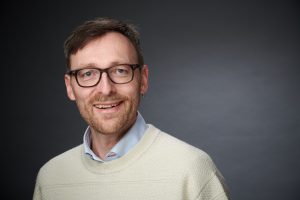
Herman Vogt
Herman Vogt (b. 1976) studied composition at the Norwegian Academy of Music from 1999 to 2004 with Bjørn Kruse, Lasse Thoresen, Olav Anton Thommessen and Henrik Hellstenius, and completed a master's degree in composition at the same institution in 2018 under Asbjørn Schaathun. In 2003 he studied composition at the Royal Conservatory in The Hague with Martijn Padding and Louis Andriessen. He also studied the violin at the Norwegian Academy of Music from 1995 to 1997.
Vogt's music has been performed at the ISCM World Music Days in Sydney and Belgium (the latter together with the Transit Festival), the Nordic Music Days in Copenhagen and Stockholm, ULTIMA in Oslo, Borealis in Bergen, and other festivals in Norway and abroad.
His works have been performed by the Oslo Philharmonic, Norwegian Radio Orchestra, Trondheim Symphony Orchestra, BIT20 Ensemble, Oslo Sinfonietta and Athelas Sinfonietta; pianists Ian Pace and Sveinung Bjelland; violinist Geir Inge Lotsberg; cellists Timo-Veikko Valve and Audun Sandvik; and organist Anders Eidsten Dahl. Conductors include Edward Gardner, Vasily Petrenko, Pierre-André Valade, Baldur Brönnimann, Christian Eggen, Ingar Bergby, Peter Szilvay, Per Kristian Skalstad and Anna-Maria Helsing, alongside many other ensembles and musicians in Norway and abroad.
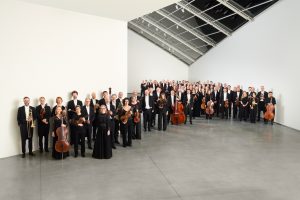
Oslo Philharmonic Orchestra
On 27 September 1919, a new orchestra took to the stage of the old Logan Hall in Oslo to give its first public concert. Conductor Georg Schnéevoigt presided over thrilling performances of Edvard Grieg's Piano Concerto and Christian Sinding's First Symphony. After forty years of making-do, the Norwegian capital had at last got the orchestra it deserved. The Oslo Philharmonic was born. In the eight months that followed, the Oslo Philharmonic gave 135 concerts, most of which sold out. It tackled passionate Mahler, glistening Debussy and thrusting Nielsen.
Soon, world famous musicians were coming to conduct it, relishing its youth and enthusiasm. Igor Stravinsky and Maurice Ravel visited Oslo to coach the musicians through brand new music. National broadcaster NRK began to hang microphones at the orchestra's concerts, transmitting them to the whole of Norway.
Over the next half-century, the Oslo Philharmonic's reputation grew steadily. Then, in 1979, it changed forever. A young Latvian arrived in Norway, taking the orchestra apart section-by-section, putting it back together a finely tuned machine with a whole new attitude. Under Mariss Jansons, the orchestra became a rival to the great Philharmonics of Vienna, Berlin and New York. It was soon playing everywhere, from Seattle to Salzburg, Lisbon to London. Back home in Oslo, it got a modern, permanent concert hall of its own. In 1986, EMI drew up the largest orchestral contract in its history, ensuring the world would hear the rich, visceral sound of the Oslo Philharmonic. Three decades after that, the world is still listening. The Oslo Philharmonic retains its spirit of discovery and its reputation for finesse.
Under Jukka-Pekka Saraste it cultivated even more the weight and depth that Jansons had instilled; under Vasily Petrenko, it worked at the highest levels of detail and style. Under Klaus Mäkelä's leadership from 2020 to 2026, the orchestra recorded all of the Sibelius symphonies and Shostakovich's symphonies Nos. 4–6. The orchestra also collaborated with Janine Jansen on Sibelius's Violin Concerto and Prokofiev's First Violin Concerto. During the same period, the orchestra toured regularly and performed at major international festivals, including the BBC Proms in 2022. Today, the Oslo Philharmonic performs more than 130 concerts annually in Oslo and around the world.
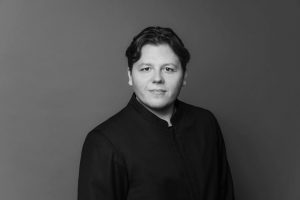
Aivis Greters
Aivis Greters is a Latvian conductor and has been Principal Guest Conductor at Gothenburg Opera since 2023, after two years at the house as Kapellmeister. There he has led Carmen, Iolanta and the gala concert for the 30th anniversary of the Opera’s new house.
Highlights of his 2025/26 season include the opening of the Oslo Philharmonic’s season at Oscarsborg Fortress and debuts with the Berner Symphonieorchester, the Norrköping Symphony Orchestra and the Warsaw Philharmonic. He returns to the Deutsches Symphonie-Orchester Berlin, Sinfonietta Riga and the Latvian National Symphony Orchestra. In recent seasons he has debuted with the Wiener Symphoniker, the Mozarteum Orchestra Salzburg, the Norwegian Radio Orchestra, the Bamberger Symphoniker and the NDR Elbphilharmonie Orchestra, among others, and he works regularly with the Royal Stockholm Philharmonic and the Swedish Radio Symphony Orchestra.
Rooted in the musical tradition of Latvia, he has conducted all three of the country’s major orchestras and made his Latvian National Opera debut in 2022. He won second prize at the 2021 Deutscher Dirigentenpreis.
Greters began his career in 2018 as artistic director of the Latvian Youth Choir Kamēr, which under his direction won the Grand Prix at the Tolosa Choral Contest in 2018 and the European Grand Prix in 2019, becoming the first choir to win three European Grand Prix titles. In 2021 he received the Grand Music Award of Latvia as Young Artist of the Year.