
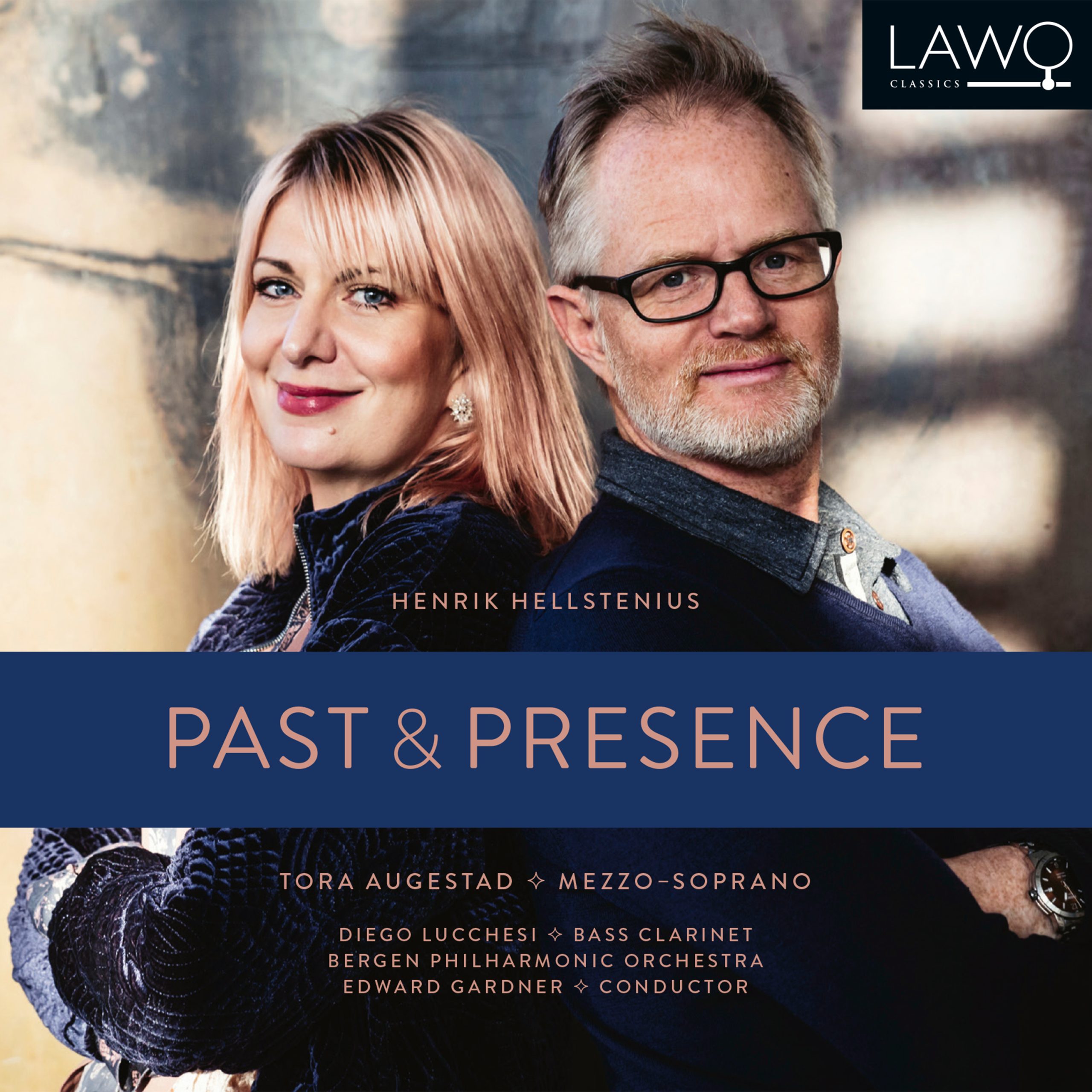
Past & Presence
Tora Augestad (Mezzo-soprano) | Diego Lucchesi (Clarinet) | Bergen Philharmonic Orchestra (Symphony orchestra) | Edward Gardner (Conductor)
Listen
Tracks
Henrik Hellstenius (*1963)
As If The Law Is Everything
Edward Gardner (conductor) | Bergen Philharmonic Orchestra | Tora Augestad
Robert Schumann (1810–1856)
Robert Schumann's Dichterliebe
Edward Gardner (conductor) | Bergen Philharmonic Orchestra | Tora Augestad
Credits
- Conductor
- Edward Gardner
- Performer
- Diego Lucchesi (Clarinet) | Tora Augestad (Mezzo-soprano)
- Symphony orchestra
- Bergen Philharmonic Orchestra
- Composer
- Henrik Hellstenius
- Producer
- Vegard Landaas
- Engineer
- Thomas Wolden
- Editing
- Vegard Landaas
- Mastering
- Thomas Wolden
- Liner notes
- Andrew Mellor
- Executive producer
- Vegard Landaas
- Booklet editor
- Hege Wolleng
- PR
- Camilla Momkvist-Skau
- Cover photo
- Britt Embry
- Artist photo
- Tora Augestad by Asa Maria Mikkelsen | Tora Augestad by Benjamin Ealovega | Tora Augestad by Mette Kaaby | Tora Augestad by Magnus Skrede | Tora Augestad by Oddleiv Apneseth
- Design
- Anette L’orange | Blunderbuss
- Recording location
- Grieghallen, Bergen
- Recording country
- Norway
- Recording year
- 2016–2020
- Recording dates
- 14.04.2016 | 15.04.2016 | 27.11.2017 | 28.11.2017 | 11.09.2020
- Original source
- DXD (352.8 kHz, 24 bit)
- Discs / tracks
- 1 disc | 16 tracks
- Produced with support from
- Norwegian Society of Composers
- Release year
- 2021
- Label
- LAWO Classics
- Duration
- 62:13
- EAN
- 7090020182513
- ISRC
- NOEHX2120010/160
Booklet text
A Theatre of Sound and Silence
Henrik Hellstenius's intense yet unassuming exploration of the interacting worlds of sound and time has spanned more than three decades. That hunger for discovery is perhaps the single most unifying feature across his life and work. It was already forming rapidly in his youth, from his teenage years spent listening to Keith Jarrett and Jan Garbarek to his studies of spectral music with Gérard Grisey in Paris.
In between, Hellstenius studied musicology at the University of Oslo and composition at the Norwegian Academy of Music, where he is now a professor. Even then, Hellstenius was only interested in looking forward. Presently, his music is best heard as an intense reflection on the times we're in, each piece the culmination of a slate-cleaning hunt for new sounds and delivery techniques that best serve the text (or subtext) in question and often draw out rich assets from minimal or unassuming material.
The composer's many concertante works, like his operas, tell real-life stories – whether personal and narrative or purely coloristic and abstracted. The mostly vocal works in this collection offer an inside track on the composer's response to idea and text, full of 'presence' and in the present tense, even when elements of the subject matter hark back to the past – to musical or constitutional foundation stones. They reveal the sort of fresh and fragmented lyricism that, in so many of the composer's works (vocal or otherwise), barely allows itself to be heard.
A constant stimulus for Hellstenius has been the work of performing musicians. 'They have something I don't – an intimate knowledge of their instrument and ideas about how it can be used,' the composer once said. One such musician is the bass clarinetist Diego Lucchesi, with whom Hellstenius worked on projects organized by BIT20, the contemporary music ensemble of Norway's second city, Bergen. The two soon started to discuss a potential new work for Lucchesi to play. A commission eventually came from Lucchesi's principal employer, the Bergen Philharmonic Orchestra, for whose 250th season Hellstenius wrote his concerto for bass clarinet, Still Panic, in 2016.
The title refers to an infamous work by the British composer Harrison Birtwistle. Panic is a concerto for alto saxophone, drum kit, woodwinds, brass and percussion first heard at the Last Night of the BBC Proms in London in 1995, after which the corporation received numerous complaints from conservative television viewers. Birtwistle's piece, which describes 'the feelings of ecstasy and terror experienced by animals in the night at the sound of Pan's music' according to the composer, was played in Bergen in 2000 alongside the first performance of Hellstenius's own score Theatre of Sleep.
As a response to Birtwistle's concerto, the sense of mania and unease in Hellstenius's Still Panic often lies under the surface rather than thrusting out in the foreground. There are aerated, calm textures in music stalked still by a sense of rumbling discomfort. Often, the soloist leads the orchestra into agitation.
The score obsesses over a small amount of actual musical material, the most prominent being a motif described by the composer as a 'neurotic, rotating figure' heard frequently from the soloist and born of the hooting descending intervals heard right at the start of the piece. As the music plays on the bass clarinet's inherent ability to sound heavy and unwieldy, the bass clarinetist responds with theatrical shouts of 'ouch!' Behind the soloist the orchestra ripples in and out of forceful interaction, beautiful and sometimes fragile but possessed of a certain elemental power even when apparently lying latent.
In a slow central section, the neurotic, rotating motif turns sleepy and the soloist appears to be awakened from his slumber by the gentle prodding of the orchestra. Some sense of positive energy then enters the score, the rotation of the coil, and various other plain intervals, now pointing upwards. A more satisfied, blissful frenzy takes root before six steady, repeated notes from the soloist diffuse the tension once and for all.
In 2017, Hellstenius fulfilled another commission from the Bergen Philharmonic Orchestra with a concertante piece for the ensemble and the Norwegian mezzo-soprano and actor Tora Augestad. As If the Law Is Everything uses material included in the work Loven ('The Law'), written for the Oslo Philharmonic Orchestra three years previously.
A consummate singing actor, Augestad has been a longstanding collaborator of the composer's and sang the role of the Queen in his second opera Ophelias: Death by Water Singing (also available on LAWO). Hellstenius had Augestad's voice in mind when writing the piece. 'She has this special timbre in her voice, or more specifically, timbres: a strange combination of the German Weill tradition and the classical lied tradition and long experience as a singer of contemporary music,' he says.
As If the Law Is Everything sets to music verse by the Norwegian author and poet Øyvind Rimbereid that reflects on laws both natural and manmade. Across seven sections, Hellstenius's work explores criminal law, the laws of nature and what Rimbereid refers to as 'the first human law' – to be present for each other and caring of one another. Included are first-person portraits of three women: a thief hiding from the authorities, a judge reflecting 'on the fragile balance between right and wrong' and a murder victim who, in the first instance, the law has failed.
The singer/speaker personifies all three, oscillating between dramatic character declamation and cool recitation of legislation and fact. 'The vocal lines and the sounds of the mezzo-soprano, together with the colours of the orchestra, are meant to widen the possible meaning of the words and their poetic images, creating dramatic tension and possible reflection,' writes the composer in his own programme note. The words themselves are always in the driving seat.
But the subtext is just as clear. Behind those words, the orchestra's mosaic of figuration and layers of rhythms form a sort of spectral reflection on the text, rather than reinforcing its narrative. 'The Law' introduces the idea of law as a theoretical abstract, commanding us to 'honour', 'laud' and 'sing' the law, the singer's wordless vocal flights obeying the latter. 'To Be' takes the form of a patter song whose rhythmic drive is momentarily slackened or suspended, its text underlining the plight of the downtrodden in its blurring of the lines between the social conditions of poverty and criminality. The word 'home' has a multitude of implications, from institutional care to domestic abuse. The text may lead, but the music plunges down, soars up or spirals around in disorientation.
'The Stars' is a lyrical, high-register reflection on the lofty position of the judge in which the singer's voice floats at first over ethereal strings. But those same strings are soon filled with the weight of responsibility, treading with earthbound, heavy chords where they had once hung in the ethereal abstraction of theoretical morality and legal principle.
'The Laws of Nature' oscillates between spoken scientific explanation and pointed, agitated but lyrical singing in which the singer hovers suggestively on individual words and phrases, the orchestra bubbling, formulating and gravitating behind her. We are taken into a teeming forest of sounds in 'She Who Fell', from which the murder victim tries to manically piece together her traumatic journey. As the orchestra dissipates into fragments of intangible and tortured memory behind her, we soon learn that this is a voice from the grave. Rimbereid's accumulate laws – scientific, legislative and human – are indicted by the victim's statement that 'I was the one who fell through all the nets.'
Straight from the victim's moving declaration that 'no-one saw it', we are plunged cruelly but evocatively into the literalism of 'The Laws of Nature II'. While the scientific adumbration of climate change is rational and cool, the orchestra soon starts to sound ominous underneath, agitating towards protest. In the final 'Epilogue', the finger is pointed back towards all of us, with the implication that Rimbereid's 'first law' is not being observed as it should be. The piece ends almost on a lament, its last downward falling phrase aborted prematurely.
Robert Schumann's song cycle Dichterliebe is one of music history's most moving and admired song cycles. It was written in a little over a week in 1840, in the midst of a personal crisis in which Schumann's prospective father-in-law was attempting to block the composer's marriage to his daughter, mostly by slandering him. Partly in rebellion against the social order that held sway in Germany, Schumann turned to the poetry of Heinrich Heine, whose works looked west to Paris in their freedom, outspokenness and scented language.
Schumann set 16 of Heine's poems plotting a poet's love gone bad and his mood turned bitter. He gave notable freedom to the piano, whose introductions often establish a song's emotional state and whose codas just as often post-script the singing with a surge of emotion that could never be contained in words. Schumann also largely ignored Heine's metrical systems, instead focusing on the natural rhythms of the words themselves, often lingering on those he considered important.
Hellstenius's own Dichterliebe from 2015 consists of 'composed interpretations' of eight of Schumann's songs – a look at Dichterliebe through twenty-first century eyes but with the apparatus of the symphony orchestra Schumann knew well (albeit extended). An excavation of the original music's structural and emotional layers led Hellstenius to look for ways of allowing the songs to 'ring with a new atmosphere and sound'. The solo part was originally written for the Norwegian jazz singer Solveig Slettahjell – which itself put another slant on Schumann's melodic lines in particular. When the composer revised the songs in 2020, he did so, once more, with Augestad's voice in mind.
To begin, we hear Schumann's own first song 'Im wunderschönen Monat Mai', its already buoyant sentiments rendered almost as a fairytale or memory by Hellstenius's sweet, light orchestration. Even by Schumann's second song, 'Aus meinen Tränen spriessen', the poet is already talking of tears. The tune clings to positivity, but is weighted by Hellstenius's orchestra, sinking into dark colours and murky depths. Not even the bushy-tailed fanfare can save it. There is a similar effect in 'Die Rose, die Lilie, die Taube, die Sonne', torpedoed by a trombone glissando while the rest of the orchestra clasps its hands over its ears, as if it knows the poet's love is hopeless.
In Schumann's fifth song, 'Ich will meine Seele tauchen' Schumann's rippling piano accompaniment again takes on a fantasy element mostly through tuned percussion, while a muted trumpet traces a dark countermelody that induces further orchestral pressure. By 'Und wüssten's die Blumen, die kleinen', Schumann's eighth song, the poet is already in a self-pitying, bitter state. There is cold comfort in the orchestra, whose icy strings cast the poet's flowers as nettles. But those same strings move from noncommittal to impassioned and apparently supportive in the last verse, flowing over into a heated postlude.
In 'Das ist ein Flöten und Geigen' the jilted poet is forced to look on as his lover weds someone else. Hellstenius sets the song almost as a burlesque, a freewheeling musical helter-skelter that eventually comes back down to earth with a thud. 'Hör' ich das Liedchen klingen' is filled with a haunted melancholy with special poignancy attached to the word 'einst' ('once'), a touchstone in Heine's set that shifts tragically in meaning. The once translucent orchestra eventually rears up in anguish at the poet's 'unfathomable sorrow'.
Schumann's thirteenth song 'Ich hab' im Traum geweinet' is more nightmare than dream in Hellstenius's hands. The human voice sounds almost dismembered while the orchestra combines the shuffling chords of Schumann's original piano part with the ghostly aura of sustained and pitch-bending notes on strings, percussion and winds. Not even Hellstenius can slip free from the 'klang' of Schumann's nineteenth century, just as that composer felt himself captured entirely by the power of Heine's words.
— Andrew Mellor