
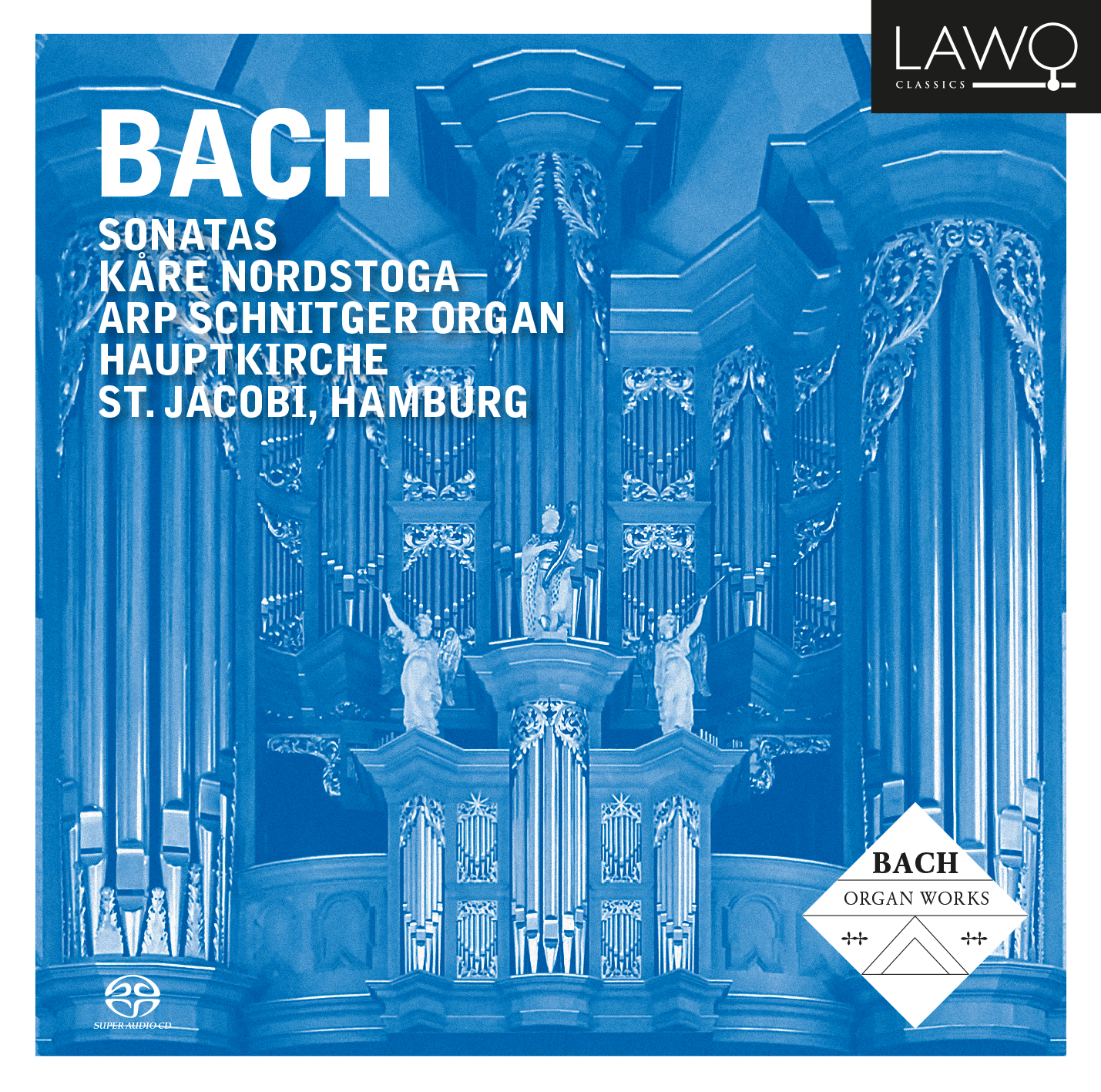
Bach: Sonatas – Arp Schnitger Organ Hauptkirche St. Jacobi Hamburg
Kåre Nordstoga (Organ)
BACH AND THE ART OF THE SONATA
“Bach — Sonatas” is the fourth double CD in a series of nine releases of Oslo Cathedral organist Kåre Nordstoga playing Bach’s organ music on historic instruments around Europe. The six trio sonatas are at the core of this release. Citing J. Forkel, who published the first major biography of Bach in 1802: “One can never say enough of their beauty.” We also get to hear two of Bach’s great toccatas, the C Major and the D Minor (“Dorian”), together with a Canzona in D Minor.
The album was recorded on the restored Schnitger organ in St. Jacobi Church in Hamburg. It is a wonderful example of North German organ building that was so important for Bach. With the abundance of contrasting overtones of this instrument, it is perfectly suited to Bach’s organ polyphony and especially to the six trio sonatas, which in many ways represent his crowning achievement in through-composed linear interplay. The unequal tempering of this old organ adds a dimension to the contrasts in keys, as heard in particular in the fresh, radiant tonality of the Toccata in C major.
Listen
Tracks
Disc 1
Johann Sebastian Bach (1685–1750)
Toccata and Fugue in D minor, BWV 538 (Dorian)
Trio Sonata No. 1 in E flat major, BWV 525
Trio Sonata No. 2 in C minor, BWV 526
Trio Sonata No. 3 in D minor, BWV 527
Disc 2
Toccata, Adagio and Fugue in C major, BWV 564
Trio Sonata No. 4 in E minor, BWV 528
Trio Sonata No. 5 in C major, BWV 529
Trio Sonata No. 6 in G major, BWV 530
Credits
- Performer
- Kåre Nordstoga (Organ)
- Composer
- Johann Sebastian Bach
- Producer
- Vegard Landaas
- Engineer
- Thomas Wolden
- Editing
- Vegard Landaas
- Mastering
- Thomas Wolden
- Liner notes
- Torkil Baden
- English translation
- Jim Skurdall
- Executive producer
- Vegard Landaas
- Booklet editor
- Hege Wolleng
- Cover photo
- Annika Momkvist-Uzunoglu
- Artist photo
- Kåre Nordstoga by Thomas Carlström
- Design
- Anna-Julia Granberg | Blunderbuss
- Recording location
- Hauptkirche St. Jacobi, Hamburg
- Recording country
- Norway
- Recording year
- 2013
- Recording dates
- 02.05.2013 | 03.05.2013 | 04.05.2013
- Original source
- 96 kHz, 24 bit
- Series
- Bach Organ Works
- Discs / tracks
- 2 discs | 25 tracks
- Produced with support from
- Fund for Performing Artists
- Release year
- 2015
- Label
- LAWO Classics
- Duration
- 129:22
- EAN
- 7090020180991
- ISRC
- NOEHX1511010/250
Booklet text
One Can Never Say Enough of Their Beauty …
The first page of a faded manuscript in the Berlin State Library reads: Sechs Orgel-Trios für zwei Manuale mit dem obligaten Pedal. Es dur. Cm. Dm. Em. Cd. Gd. In eigenhändiger Handschrift von Johann Sebastian Bach. (Six organ trios for two manuals with pedal obbligato. E flat major. C minor. D minor. E minor. C major. G major. In Johann Sebastian Bach's own hand.)
Then follows in parentheses: Sie sind für seinen ältesten Sohn Wilhelm Friedemann von ihm aufgesetzt welcher sich damit zu dem grossen Orgelspieler vorbereiten musste, der er nachher geworden ist. Man kann von ihrer Schönheit nicht genug sagen. Sie sind in dem reifsten Alter des Verfassers gemacht, und können als das Hauptwerk desselben in dieser Art angesehen werden. J. Forkel S. 60. (They were elaborated to enable his eldest son, Wilhelm Friedemann, to become the great organist he later became. One can never say enough of their beauty. They were created when the composer was at his most mature and can be regarded as his pinnacle achievement in the genre. J. Forkel, page 60.)
Thus, the title page was a later addition and quotes the first significant Bach biography published by Johann Nikolaus Forkel in 1802. It is based on information provided by Bach's sons, Wilhelm Friedemann and Carl Philipp Emanuel. But the subsequent pages in this treasure-filled envelope in Berlin are written in Johann Sebastian's own hand of around 1730. Water marks on the paper originated no earlier than 1727.
In the uppermost left corner of the score is written J. J., often used by Bach and other composers as an introductory inscription standing for Jesu juva and meaning Jesus, help. The title continues elegantly and deliberately Sonata 1 à 2 Clav. et Pedal. Di J. S. Bach. The following five sonatas have corresponding titles, and at the end of the last movement of Sonata no. 6 is written in somewhat awkward Italian: Il fine dei Sonate (meant to be di Sonate).
These are the only free, non-chorale-related works of Bach that have been collected as an opus. It seems he had the firm intention of creating something complete. As with other works during his later years in Leipzig, he took time to produce cyclical collections. In his book "J. S. Bach Sechs Sonaten" (2007) the Norwegian musicologist Idar Karevold points out that Bach, unlike his predecessors in Leipzig, had no university education. To compensate for this, he wished to document his theoretical knowledge, and the collections of large works during Bach's time in Leipzig are part of this documentation.
Inasmuch as the original manuscript has been preserved, we know more about these six sonatas than many of the master's other works for which dating and authenticity can be matters of controversy. But this is not to say that all questions have been resolved. That the music is aufgesetzt/elaborated takes into account that earlier works have been specifically adapted for his twenty-year-old eldest son. Not everything is new. It was not necessarily easy to resort to using older material. But Bach no doubt thought it a pity that good ideas should be so short-lived when they contained material of greater potential. Six organ sonatas of three movements each equals eighteen movements, and researchers have only found five of them in which there are no traces of earlier works such as cantata movements and chamber music.
Adaptations are often held in low esteem. Since the 1700s there has been a call for freshness and originality, but such a requirement can be irrelevant for the music involved.
A Bach scholar such as Meinrad Walter (Stuttgart Bach Festival 2008) asserts that, in the case of vocal music, it would have been faster for Bach to compose new music than to rework the old so thoroughly. But he recirculated because there is a surplus of quality in his music that leaves room for reusing it.
Bach's adaptations are thoroughly worked out in detail and tailored to the new instrument. The result is by no means a dreary copy of something earlier, and this pertains not only to the organ sonatas, but to every instance in which he used music from cantatas and from instrumental works in a completely new context.
Compared with his predecessors, Bach used the harpsichord in a new way. His sonatas for solo instrument and figured bass (violin, flute or gamba) are actually trio sonatas, since the harpsichordist does not only play accompaniment, but rather concertizes in the treble with the soloist. This upgrading of the keyboard instrument is a step in the direction of Bach's three-part sonata, trio sonata, for one instrument. The organ, with two manuals and pedal, is used for three vigorous and independent parts. The keyboard instrument has abandoned its subdued role as a foundation for the soloists and has itself assumed all the roles of a polyphonic universe.
The three-movement scheme fast-slow-fast is based in part on the Italian concerto. Bach knew it well from his work with the concertos of Vivaldi and Prince Johann Ernst in Weimar fifteen years earlier (cf. Kåre Nordstoga's recording, LAWO 1035). And in the fast sonata movements we can again find the typical rondo form with contrasts between ritornello and solo. At the same time, they bear the unmistakable stamp of the unrivaled master of the fugue.
The term sonata is a complex concept, with the four-movement trio sonata of the Italian composer Arcangelo Corelli (1653–1713) serving as a milestone. The young Handel composed a large number of trio sonatas following his stay in Italy. The three-movement sonata for keyboard instrument was not a significant genre prior to Bach. German composers such as Chr. Ritter and Bach's predecessor in Leipzig, Johann Kuhnau, had made contributions to the genre, but it was, above all, J. S. Bach who established it. Mendelssohn (Six Organ Sonatas, 1845) followed in Bach's footsteps, and, after him, a long succession of composers of organ sonatas.
Son Wilhelm Friedemann had a lot to cut his teeth on when he received the sonatas as lessons. They call for virtuosity on the manuals, and already in the very first bar there is challenging footwork in sixteenth notes.
As a definitive collection of etudes, the trio sonatas are for classical organists what Czerny's studies are for pianists. Playing the organ requires the ability to manoeuvre independent lines in both hands and the pedals, and this is perfected playing Bach's sonatas. In the words of Bach connoisseur Albert Schweitzer: To this very day they are the Gradus ad Parnassum for every organist. Whoever has studied them thoroughly will thereafter encounter scarcely a single difficulty. The slightest unevenness in touch is heard with appalling clearness in this complicated trio playing.
The sonatas are a book of study not only for performers, but for composers as well. Bach's private lessons for gifted students required a repertoire for the study of the noble art of polyphony.
At the same time, this is concert music and art in its full complexity, where the art of polyphony is cultivated alongside the most moving melodies. Wilhelm Friedemann wrote the following for Forkel's Bach biography at a time when the vigorous ideals of the Baroque age were compelled to yield to the elegance of Rococo: There are some adagios among them which even today could not be composed more melodiously.
Albert Schweitzer captures the distinctive quality of Bach's unique style in the sonatas: For the connoisseur there can hardly be purer aesthetic pleasure than to pursue these three lines in their graceful intertwining — so free and yet so bound by the laws of beauty.
Or, as Forkel put it: One can never say enough of their beauty …
— Notes: Torkil Baden · English translation: Jim Skurdall
Biographies
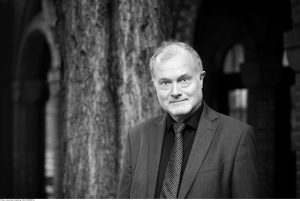
Kåre Nordstoga
Kåre Nordstoga (b. 1954) studied at the Norwegian Academy of Music under Søren Gangfløt, Bjørn Boysen and Kaare Ørnung, among others. Following his debut concert in 1978, he continued his studies under David Sanger in London, and was for a time organist at Ullern Church before coming to Oslo Cathedral in 1984. He has also been associated with the Norwegian Academy of Music, where he was appointed professor in 1994.
As cathedral organist at Oslo Cathedral, Nordstoga frequently performs a large repertoire, which has included two popular concert series with Bach's complete organ works. His recordings include the organ music of Bach, Brahms, Franck, Widor and Liszt, all of Bach's violin sonatas recorded on the cathedral's chancel organ in collaboration with violinist Geir Inge Lotsberg, as well as several recordings of Norwegian organ music. Nordstoga is an active concert organist.
In recent years he has been soloist with the symphony orchestras of Oslo, Bergen and Trondheim, and he has been invited to organ festivals abroad, including Aarhus, Notre Dame in Paris, and the Musashino Cultural Center in Tokyo. In 2006 he was awarded the Lindeman Prize for his active contribution to musical life.
Johann Sebastian Bach
Johann Sebastian Bach was born on 21 March 1685 in Eisenach into an extensive family of musicians. Orphaned by the age of ten, he was raised by his elder brother Johann Christoph in Ohrdruf before receiving a scholarship to the Michaelisschule in Lüneburg in 1700. His first appointment, in 1703, was as a court violinist to Duke Johann Ernst of Saxe-Weimar, but within months he became organist at the Neue Kirche in Arnstadt, composing his first significant organ works and, in 1705, travelling to Lübeck to study with Dietrich Buxtehude. In 1707 he became organist of St Blasius's Church in Mühlhausen and married his cousin Maria Barbara; the following year he entered the service of Duke Wilhelm Ernst in Weimar as court organist, rising to concertmaster in 1714 and building a reputation as an organ virtuoso.
In 1717 Prince Leopold of Anhalt-Köthen appointed him Hofkapellmeister, a productive period that yielded much of his instrumental output, including violin concertos and orchestral suites, though it was also marked by the death of his wife in 1720; he remarried the following year to Anna Magdalena Wilcke. In 1723 Bach was elected Thomaskantor in Leipzig, a post he held for the rest of his life, composing there his great vocal works, including the St John and St Matthew Passions and over two hundred cantatas, until his death on 28 July 1750.